


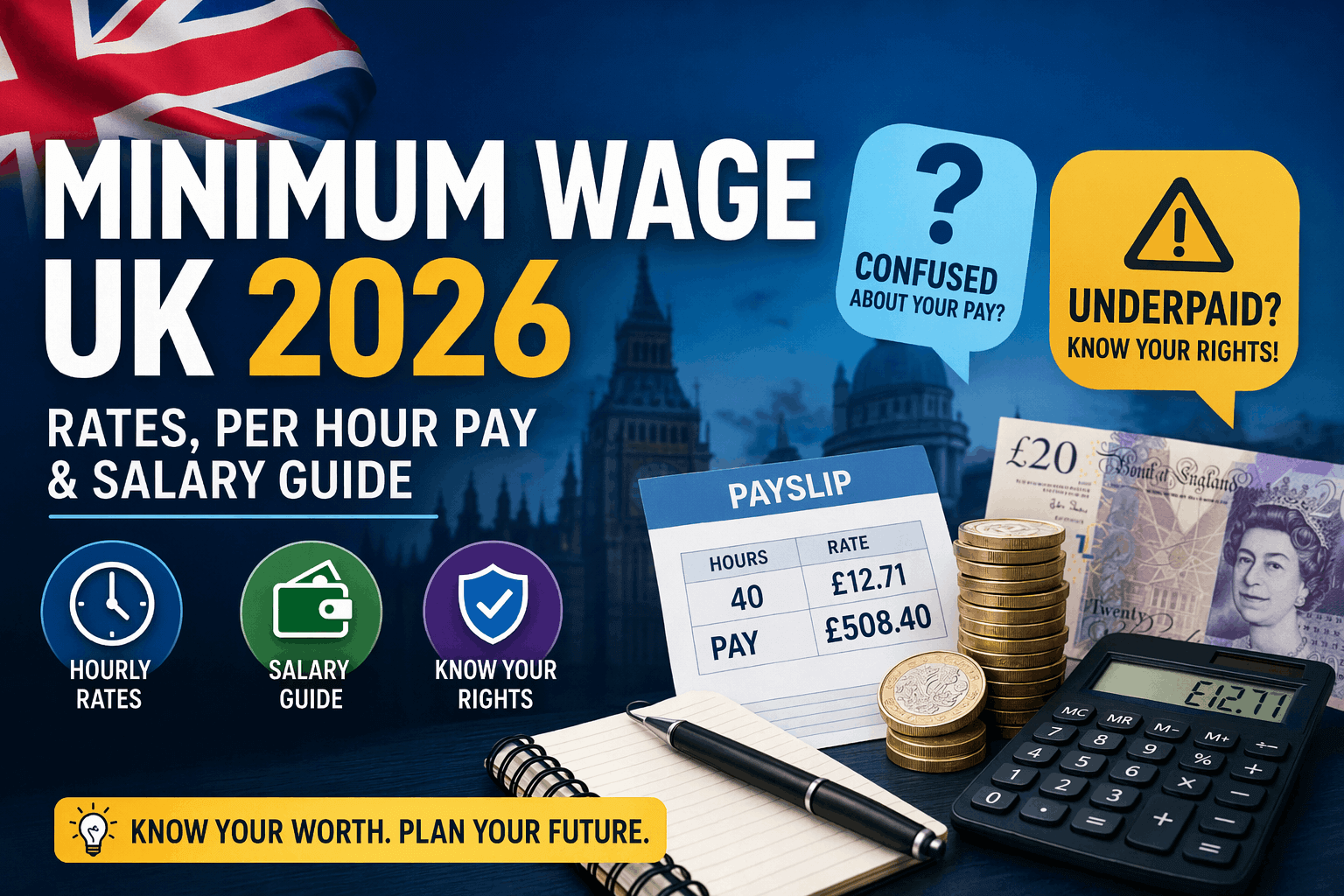
Have you recently heard about the latest wage increase in the UK and wondered if your salary actually reflects it? With rising rent, food prices, and bills, many workers are now questioning whether the minimum wage UK is truly enough to live on.
At the same time, every April brings new updates, yet confusion still remains. So, what is the minimum wage UK 2026, and how much should you really earn per hour, month, or year?
In this guide, we will break everything down clearly. Moreover, you will understand official rates, real salary estimates, and what it means for your daily life. Most importantly, you will learn how to move beyond minimum wage and improve your earning potential.
Table of Contents
What is Minimum Wage UK and Why It Matters
The minimum wage UK is the legal minimum pay that employers must provide. In other words, it protects workers from being underpaid.
However, not everyone earns the same rate. Instead, pay depends on age and employment type. For example, apprentices earn less because they are still training. Meanwhile, experienced workers receive higher pay.
Moreover, the government updates the minimum wage UK every year. As a result, rates usually increase to reflect inflation and living costs. Therefore, staying updated is essential.
You can always check official figures directly on GOV.UK, which provides the latest confirmed rates.
Minimum Wage UK 2026 Rates Per Hour
Understanding the latest hourly rates is one of the most important steps for any worker. Many people hear about wage increases, yet they are often unsure how those changes actually affect their own pay. Therefore, before looking at monthly or yearly income, it is essential to clearly understand the official hourly structure of the minimum wage UK. This gives you a solid foundation to check whether your employer is paying correctly and whether your earnings match legal standards.
Official Minimum Wage UK 2026 Rates
According to official government updates, the hourly rates are expected to be:
Age Group | Hourly Rate (2026) | Explanation |
21 and over | £12.71 | This is the National Living Wage, which is the highest legal rate. |
18–20 | £10.85 | A slightly lower rate designed for younger workers gaining experience. |
Under 18 | £8.00 | Entry-level pay for young workers starting employment. |
Apprentice | £8.00 | A training wage for those learning while working. |
Source: https://www.gov.uk/national-minimum-wage-rates
What These Rates Mean in Practice
Firstly, workers aged 21 and over receive the highest legal pay. This rate reflects the government’s effort to support adults with higher living costs. As a result, most full-time workers fall into this category and benefit from the National Living Wage.
Secondly, workers aged 18 to 20 earn a slightly lower rate. Although this may seem unfair at first, it is designed to reflect early career stages where individuals are still gaining skills and experience. However, this rate still ensures a fair minimum standard of pay.
Meanwhile, workers under 18 receive an entry-level wage. This allows young people to enter the workforce while balancing education or training. Therefore, this category focuses more on opportunity rather than high earnings.
In addition, apprentices are paid a specific training rate. Since apprentices combine work with learning, their wage reflects both employment and skill development. Over time, as their skills improve, their earning potential increases significantly.
Why Understanding These Rates Is Important
Understanding the minimum wage UK is not just about knowing numbers. Instead, it helps you take control of your financial situation. For example, if your hourly pay is below your age category, you can identify the issue quickly and take action.
Moreover, knowing these rates helps you plan your career. As you move from one age group to another or gain new skills, your earnings should increase. Therefore, awareness of wage structure allows you to track your progress and set realistic goals.
In conclusion, the hourly rates form the backbone of the minimum wage UK system. They determine how much you earn daily and shape your monthly and yearly income. Therefore, staying informed about these figures is essential for every worker. Once you clearly understand your hourly rate, you can confidently assess your earnings, protect your rights, and plan your next financial steps.
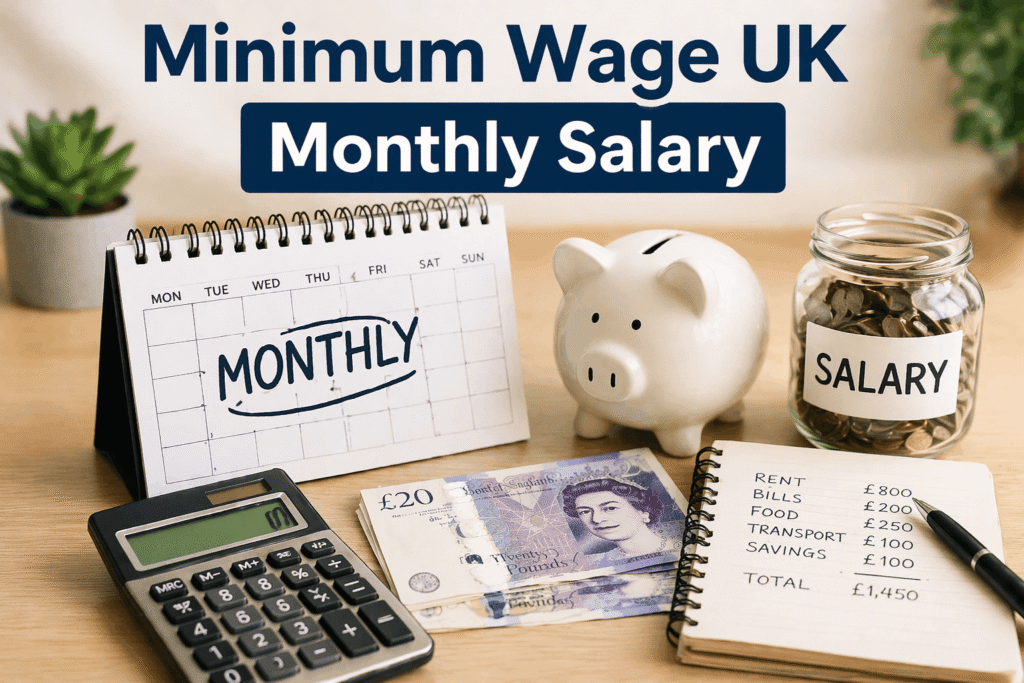
Minimum Wage UK Monthly Salary
While hourly pay is often discussed, it does not always reflect your real financial situation. In daily life, most expenses such as rent, bills, and groceries are paid monthly. Therefore, understanding how the minimum wage UK translates into monthly income is far more useful. It allows you to see what you actually earn and how far that income can support your lifestyle.
To make this clearer, let us convert the official hourly rates into weekly and monthly earnings based on a standard full-time schedule of 40 hours per week.
Estimated Monthly Salary Based on Minimum Wage UK
Hourly Rate | Weekly Pay (40 hrs) | Monthly Pay (Approx.) | Explanation |
£12.71 | £508 | £2,200 | Full adult rate for workers aged 21 and over. |
£10.85 | £434 | £1,880 | Mid-level rate for workers aged 18 to 20. |
£8.00 | £320 | £1,380 | Entry-level rate for under 18s and apprentices. |
These figures are estimated using full-time hours. The hourly rates are based on official government data available at:
https://www.gov.uk/national-minimum-wage-rates
Understanding Each Salary Level
Firstly, a worker earning £12.71 per hour can expect around £2,200 per month before tax. This level of income is considered the standard for adult workers. It provides a basic level of financial stability, although rising living costs may still limit savings.
Secondly, workers earning £10.85 per hour will take home approximately £1,880 per month before deductions. This is common for younger workers who are still building experience. While it covers essential expenses, budgeting becomes more important at this level.
Meanwhile, those earning £8.00 per hour receive around £1,380 per month. This applies mainly to apprentices and younger workers. At this stage, the focus is often on gaining skills rather than earning a high income. However, this lower salary highlights the importance of career progression.
Why Monthly Salary Matters
Although hourly wages are easy to understand, they do not show the full picture. In contrast, monthly salary directly connects to real-life spending. For example, rent, transport, and utility bills are all paid monthly. Therefore, calculating your income in this way helps you plan more effectively.
In addition, knowing your monthly earnings allows you to:
Plan rent, bills, and essential expenses with more accuracy
Track savings and set financial goals
Manage your lifestyle and avoid overspending
As a result, understanding the monthly impact of the minimum wage UK makes your financial situation clearer and more practical.
In conclusion, converting hourly pay into monthly income gives you a realistic view of your earnings. It helps you understand not only how much you earn, but also how that income supports your daily life. Therefore, when evaluating the minimum wage UK, always look beyond hourly figures and focus on what you actually receive each month. This approach allows you to make better financial decisions and plan for future growth.

Minimum Wage UK Yearly Salary
Looking at hourly pay is useful, but yearly salary gives a much clearer picture of what the minimum wage UK means in real life. Most people do not plan their finances only by the hour. Instead, they think about annual income when comparing jobs, budgeting for rent, or deciding whether a role offers enough financial stability. Therefore, converting hourly pay into yearly earnings helps readers understand the bigger picture.
The yearly salary examples below are estimated using a standard full-time pattern of 40 hours a week for 52 weeks a year. That means the calculation is:
Hourly rate × 40 hours × 52 weeks
Because of that, these figures should be presented as estimated gross annual pay before tax and National Insurance.
Estimated Yearly Salary Based on Minimum Wage UK
Hourly Rate | Estimated Yearly Salary | How it is Calculated | Who it Applies To |
£12.71 | £26,436.80 | £12.71 × 40 × 52 | Workers aged 21 and over |
£10.85 | £22,568.00 | £10.85 × 40 × 52 | Workers aged 18 to 20 |
£8.00 | £16,640.00 | £8.00 × 40 × 52 | Under 18s and apprentices |
The official hourly rates used above come from GOV.UK’s National Minimum Wage and National Living Wage rates page. (GOV.UK)
What These Yearly Figures Actually Mean
Firstly, a worker aged 21 and over on the legal minimum would earn about £26,436.80 a year before deductions if they worked full-time all year. This is the highest legal minimum pay band in the current structure. However, this does not mean that amount goes straight into your bank account, because tax and National Insurance may reduce your final take-home pay.
Secondly, a worker aged 18 to 20 would earn about £22,568 a year before deductions on the same full-time schedule. This amount may look close to the adult rate, yet the yearly difference becomes more noticeable when you compare total earnings across 12 months. Therefore, age-based wage bands can have a real effect on long-term financial planning.
Meanwhile, under-18 workers and apprentices on £8.00 an hour would earn about £16,640 a year before deductions if they worked full-time for the full year. In practice, many apprentices and younger workers do not work a full 40-hour paid schedule every week, so their real annual earnings may be lower. GOV.UK also explains that apprentice pay rules depend on age and whether the apprentice is in the first year of the apprenticeship.
Why Yearly Salary Is Not What You Take Home
When you look at yearly earnings from the minimum wage UK, the numbers may seem quite reasonable at first. However, it is important to understand that these figures are not the amount you actually receive in your bank account.
This is because the yearly salary is shown as gross pay, which means it is calculated before any deductions. In reality, your take-home pay will be lower after taxes and National Insurance contributions are applied.
For example, if you earn around £26,000 per year on the minimum wage UK, you will not receive the full amount. Instead, a portion will be deducted automatically depending on your tax band and personal circumstances.
Therefore, while yearly salary gives a useful estimate, it should not be treated as your final income. Instead, it is better to think of it as a starting point for understanding your earnings.

Living Wage vs Minimum Wage UK
Many people use the terms living wage and minimum wage as if they mean the same thing. However, they are actually quite different, and understanding this difference can change how you view your income and career choices.
What is the Minimum Wage UK?
The minimum wage UK is the legal amount employers must pay. In simple terms, it is the lowest pay allowed by law.
This means:
Employers must follow it
Workers are legally protected
Underpaying can lead to penalties
For example, if you are over 21, your employer cannot legally pay you below the official hourly rate set by the government. Therefore, the minimum wage UK acts as a safety net for workers.
What is the Living Wage UK?
The living wage, on the other hand, is not set by law. Instead, it is an estimate of what people actually need to live comfortably.
It considers real-life costs such as:
Rent and housing
Food and groceries
Transport
Basic lifestyle needs
Because of this, the living wage is usually higher than the minimum wage UK. However, employers are not required to pay it unless they choose to.
The Real Difference
Think of it like this:
Minimum wage UK → “You must be paid at least this much”
Living wage UK → “You need at least this much to live properly”
This small difference explains why many workers still struggle financially even when they are paid the legal minimum.
Why This Difference Matters
Although the minimum wage UK protects workers, it does not always reflect the true cost of living. For example, someone earning minimum wage in a major city may still find it difficult to cover rent and daily expenses.
As a result, many people aim to earn above the minimum wage. They often look for better-paying roles, promotions, or new skills that can increase their income over time.
If you are currently earning the minimum wage UK, it is important to see it as a starting point rather than a long-term goal. While it ensures basic protection, it may not provide financial comfort.
Therefore, understanding the difference between minimum wage and living wage helps you make better decisions about your career, spending, and future plans.
What to Do If You Are Underpaid
Have you ever checked your payslip and felt something was not right? Many workers realise too late that they are being paid below the minimum wage UK. However, this can happen due to simple mistakes or outdated pay records. Therefore, it is important to act early and check your earnings regularly.
If your pay seems lower than expected, do not panic. Instead, follow a few clear steps to understand the issue and fix it properly.
First, Check Your Payslip
Start by reviewing your payslip carefully. Although it seems basic, this step often reveals the problem.
Look for:
your hourly rate
total hours worked
your age category
any deductions
For example, if you recently turned 21 but your rate did not increase, your employer may not have updated your pay. As a result, your earnings may fall below the minimum wage UK.
Keeping records of your payslips is also useful. Moreover, improving basic workplace awareness through platforms like Studyhub can help you understand such details more clearly.
Then, Speak to Your Employer
Once you identify a possible issue, speak to your employer. In many cases, underpayment is due to an error, not intention. Therefore, a simple conversation can solve the problem quickly.
When speaking:
explain the issue clearly
show your payslip
mention the correct rate
For instance, an apprentice who completes training may still be paid at the old rate. In that case, raising the issue can lead to a quick correction.
If you feel unsure about communication, Studyhub offers courses that help improve professional confidence.
If Needed, Report to HMRC
If your employer does not fix the issue, you can report it to HMRC. This step ensures your case is reviewed properly under minimum wage UK law.
Before reporting, gather:
payslips
work hours record
any communication with your employer
Although this step may feel serious, it protects your rights. Therefore, do not hesitate if the issue continues.
Why This Matters
Being underpaid affects more than just your salary. Over time, even small differences can lead to large financial loss.
you may struggle with monthly expenses
savings become difficult
financial stress increases
Therefore, understanding the minimum wage UK helps you stay in control. At the same time, building skills through Studyhub can help you move into higher-paying roles and avoid such issues in the future.
In the end, checking your pay is your responsibility, but you are not alone. If something feels wrong, take action step by step. Moreover, use opportunities like Studyhub to improve your skills and increase your earning potential beyond the minimum wage UK.
How to Earn More Than Minimum Wage UK
While minimum wage is a starting point, it should not limit your future.
Smart Ways to Increase Income
Learn new skills
Gain certifications
Move into higher-paying roles
For example, platforms like Studyhub help learners develop job-ready skills.
Moreover, Studyhub offers flexible courses that fit around work schedules. As a result, many individuals improve their income.
Additionally, Studyhub provides industry-relevant training. Therefore, learning through Studyhub can open better career opportunities.
Access the course library of 3000+ courses for just £149 for a lifetime!

Conclusion
Understanding the minimum wage UK is not just about knowing hourly rates. Instead, it is about knowing your real earnings, your rights, and your future options. As explained throughout this guide, wages vary by age, hours, and experience, and your actual take-home pay can differ after deductions.
Therefore, it is important to regularly check your pay, stay updated with official rates, and plan your finances carefully. At the same time, do not see minimum wage as a long-term limit. Instead, treat it as a starting point. By improving your skills and gaining experience, you can move into better-paying roles and achieve stronger financial stability over time. Platforms like Studyhub make it easier to gain new skills. Moreover, Studyhub supports flexible learning while you work. As a result, many people move beyond the minimum wage UK and achieve better financial stability.
FAQs
No, the minimum wage UK is not the same for everyone. It varies based on age and employment type, such as apprenticeships or entry-level roles.
Yes, part-time workers are entitled to the same hourly minimum wage UK rate. However, their total earnings will be lower due to fewer working hours.
In most cases, employers cannot pay below the minimum wage UK. However, limited exceptions apply, such as certain apprentice conditions or accommodation offsets.
Yes, the minimum wage UK is reviewed annually by the government. Changes usually take effect in April to reflect economic conditions.
- All Courses
- IT & Software388
- Management287
- Teaching and Education250
- Business245
- Health and Fitness227
- Engineering & Technology180
- Health & Safety163
- Health and Social Care143
- Quality Licence Scheme139
- Healthcare137
- Accounting & Finance130
- Psychology112
- Employability112
- Lifestyle105
- Marketing75
- Office Productivity74
- Animal Care63
- Design and Photography55
- Design50
- Beauty & Makeup49
- Accounting & Bookkeeping34
- Web Development27
- Construction26
- Writing20
- Child Care13
- Digital Marketing13
- Environment10
- Bundle8
- Coaching6
- Agriculture5

Awarded By


0 responses on "Minimum Wage UK 2026: Rates, Per Hour Pay and Salary Guide"