



Have you seen a busy team move nowhere? Everyone meets deadlines. However, nobody understands the wider purpose. Another team feels inspired, yet tasks remain unfinished. These problems reveal the difference between leadership and management. Leadership creates direction and belief. Management creates order and reliable results. Therefore, strong workplaces need both. This UK guide uses ten clear examples. It also shows when to lead, manage, or combine both.
Table of Contents
The One-Minute Answer
Leadership sets direction and inspires people. Management turns that direction into organised, measurable work. Therefore, the difference between leadership and management concerns focus and responsibility.
A leader asks: Where are we going, and why does it matter?
A manager asks: How will we get there, and what happens next?
For example, a leader may propose greener deliveries. Meanwhile, a manager sets budgets, roles, deadlines, and checks.
What Is Leadership?
Leadership means guiding people towards a shared purpose. Leaders make a better future feel possible. Moreover, they build trust and support people through change. Therefore, leaders do not always need management titles.
Imagine an experienced colleague calming a worried team. They listen, explain the purpose, and invite honest questions. That is leadership without formal authority.
The CIPD leadership factsheet treats leadership development as a workplace priority. Likewise, Studyhub’s Diploma in Leadership & Management at QLS Level 3 introduces core guidance skills.
What Is Management?
Management organises people, money, time, and tools. Managers convert goals into plans. Next, they assign tasks and monitor progress. They also control risks and protect standards. Consequently, teams deliver consistent work.
Suppose a customer service team receives many complaints. The manager checks staffing, training, response times, and errors. Then, they adjust the rota and review results.
So, the difference between leadership and management is not people versus paperwork. Good managers support people. However, their main responsibility is dependable delivery. Studyhub’s Leadership and Management course connects both areas.
How Leadership and Management Work Together
The roles form one journey. First, leadership provides a destination. Next, management creates a workable route. Finally, both review and learn.
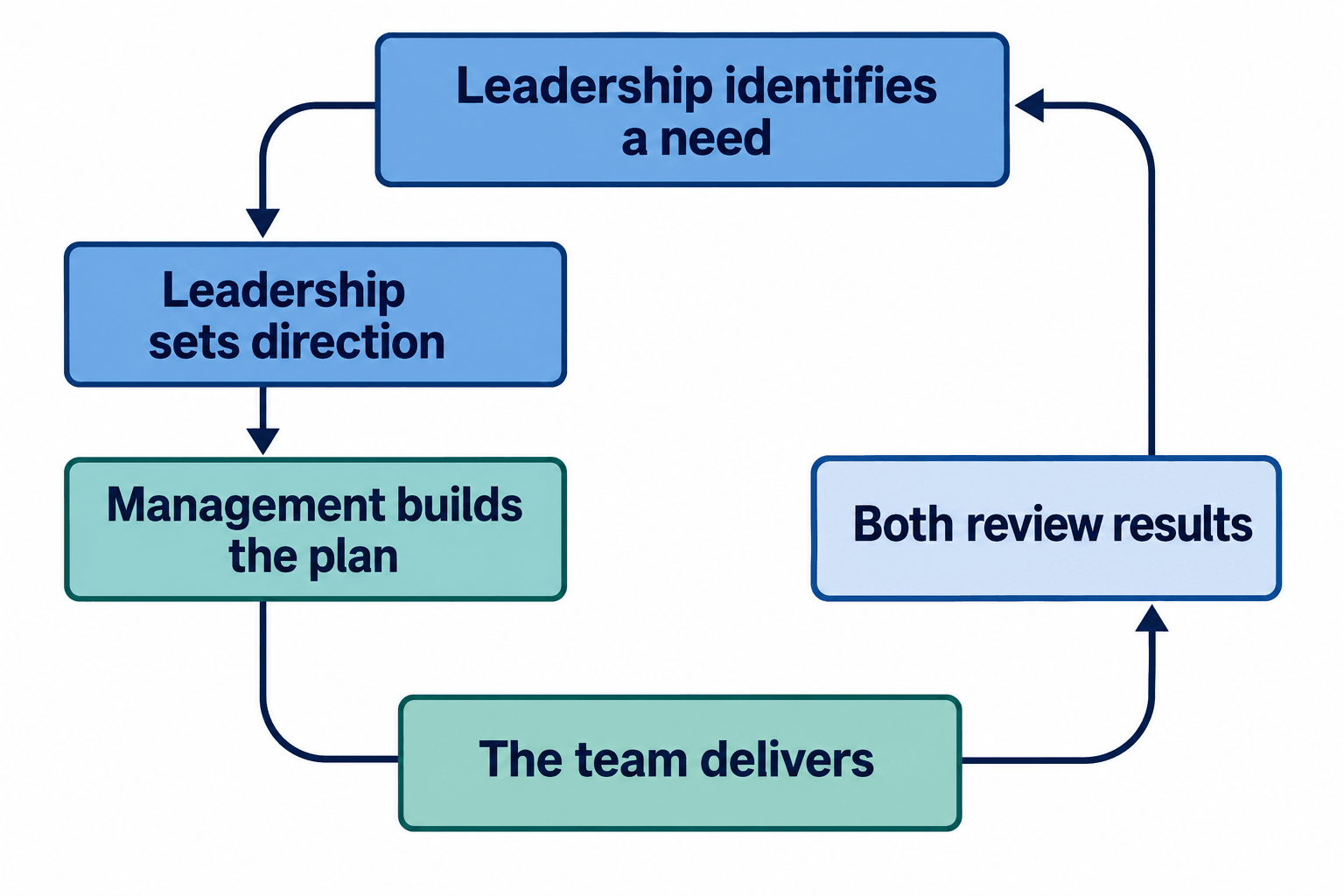
This flow explains the difference between leadership and management clearly. Leadership without management can become empty ambition. In contrast, management without leadership can become purposeless routine. Therefore, balanced teams connect vision with action.
The 10 Key Differences at a Glance
The table offers a clear comparison. However, real roles often overlap.
Area | Leadership | Management | Workplace example |
1. Direction | Defines the destination | Plans the route | Launching a new service |
2. Time | Looks towards future needs | Handles present priorities | Preparing for digital demand |
3. Change | Challenges old methods | Introduces change safely | Starting hybrid work |
4. Power | Builds trust and influence | Uses formal authority | Gaining team support |
5. Focus | Develops people and culture | Organises resources and systems | Improving poor service |
6. Risk | Explores useful possibilities | Controls threats and costs | Testing new software |
7. Communication | Explains purpose | Clarifies tasks | Reducing waiting times |
8. Decisions | Chooses strategic direction | Tests practical limits | Entering a new market |
9. Success | Measures trust and progress | Measures time, cost, and quality | Reviewing a restructure |
10. Team role | Coaches and empowers | Coordinates and monitors | Delivering a busy project |
These points summarise the difference between leadership and management. Now, consider each example.
Ten Differences Explained With Simple Examples
1. Vision Versus Planning
Leaders describe a better future. Managers divide that future into achievable steps. For example, leadership may promise faster patient support. Meanwhile, management sets staffing levels, deadlines, and service measures. This difference between leadership and management connects ambition with action.
2. Future Versus Present
Leaders scan for future needs, threats, and opportunities. Managers focus on today’s workload and resources. However, both time views matter. A retailer may expect more online orders next year. Therefore, management starts training staff today. Studyhub’s Strategic Management and Leadership Development supports this wider perspective.
3. Change Versus Stability
Leaders often challenge habits that no longer work. Managers introduce new methods without losing control. For instance, leadership may support flexible working. Next, management updates rotas, security rules, and reporting systems. This difference between leadership and management makes change both meaningful and safe.
4. Influence Versus Authority
Leaders earn support through trust, credibility, and example. Managers usually hold formal power over work. Therefore, a respected colleague can lead without managing anyone. Conversely, a manager can approve leave and review performance. Yet authority alone rarely creates genuine commitment.
5. People Versus Systems
Leaders watch confidence, relationships, and culture. Managers watch workflows, budgets, resources, and standards. Suppose a team keeps missing targets. Leadership asks whether people feel unheard or afraid. Meanwhile, management checks workload and training. The difference between leadership and management provides two useful views. Studyhub’s Lean Leadership, Culture and Management Online Diploma links culture with efficient systems.
6. Possibility Versus Risk Control
Leaders create space for useful experiments. Managers examine cost, safety, law, and disruption. For example, leadership may suggest an artificial intelligence trial. Management then checks data protection, training, and expected benefits. Therefore, the difference between leadership and management can prevent careless innovation.
7. Purpose Versus Instructions
Leaders explain why work matters. Managers explain who does what, and when. Consider a report due Friday. The manager confirms its sections and deadline. However, the leader explains how it protects an important client relationship. Together, purpose and clarity strengthen effort.
8. Strategic Choices Versus Practical Limits
Leaders choose the broader direction. Managers test that choice against facts and limits. Before entering a new market, leadership explains the opportunity. Next, management checks staff, money, law, and timing. This difference between leadership and management improves decision quality. Studyhub’s Leadership & Management Training Course can strengthen practical decision-making.
9. Cultural Progress Versus Measured Performance
Leaders shape normal behaviour through their own actions. Managers track targets, delays, costs, absence, and quality. However, numbers never tell the whole story. Complaints may fall because staff fear reporting problems. Therefore, leaders must examine trust while managers examine results.
10. Empowerment Versus Coordination
Leaders coach people and encourage responsible independence. Managers allocate work and monitor agreed standards. During a busy project, leadership builds confidence. Meanwhile, management prevents missed tasks and duplicated effort. This final difference between leadership and management shows why teams need both. Studyhub’s Advanced Leadership & Management Diploma suits learners seeking broader responsibility.
When Should You Lead, Manage, or Do Both?
The situation should guide your response. Therefore, use this decision table.
Situation | Lead first when… | Manage first when… | Use both by… |
A new direction | People lack purpose | The goal already exists | Explaining why, then planning how |
A crisis | People feel lost | Immediate control is needed | Giving calm direction and clear actions |
Poor performance | Trust or motivation is low | Tasks or standards are unclear | Listening, correcting, and reviewing |
Major change | People fear the future | Delivery risks are rising | Building commitment and controlling risk |
Daily operations | Culture needs attention | Consistency matters most | Supporting people while tracking results |
A safety incident needs immediate management. However, repeated incidents also need leadership. Someone must challenge the culture. Thus, the difference between leadership and management guides your response.
What Leadership and Management Share
Their focus differs, yet their foundations overlap. Both need communication, judgement, honesty, and responsibility.
Communication: Both listen, explain, question, and give useful feedback.
Decision-making: Both consider evidence, risks, values, and likely results.
Problem-solving: Both identify causes instead of treating surface symptoms.
Emotional awareness: Both notice how decisions affect other people.
Accountability: Both accept results and correct poor choices.
Therefore, the difference between leadership and management is not a contest. Strong professionals adjust their approach when situations change.
Can One Person Be Both?
Yes. Effective managers often lead. Likewise, senior leaders must understand budgets, plans, and delivery. A line manager may inspire confidence during change. Later, they may approve a rota.
However, a title does not prove both abilities. Meanwhile, some organised managers struggle with trust. The difference between leadership and management reveals your development gap. Studyhub’s Leadership and Management Essential Skill offers an accessible starting point.

Build Both Skill Sets in Six Steps
Knowledge becomes valuable through practice. Therefore, follow this plan.
Choose one real problem. Select a delayed project or a worried team.
Diagnose the gap. Ask whether direction, trust, planning, or control is missing.
Explain the purpose. State why improvement matters in two clear sentences.
Build the plan. Set owners, dates, resources, risks, and simple measures.
Ask for feedback. Check how your approach affects colleagues and results.
Review and adjust. Keep one lesson and change one behaviour next time.
Do not study delegation only as theory. Delegate one suitable task this week. Then, agree on the result and review point. Similarly, explain purpose before assigning work. This makes the difference between leadership and management visible daily.
Common Myths That Cause Confusion
Several common beliefs make these roles seem harder than they are.
“Leaders are always senior.” False. Influence can come from any level.
“Managers only control people.” False. Good managers support growth and wellbeing.
“Leaders take every risk.” False. Responsible leaders consider consequences.
“Management blocks change.” False. Managers make useful change workable.
“You must choose one role.” False. Many jobs require both approaches.
Consequently, the difference between leadership and management describes functions, not fixed personalities. A person can become stronger in both areas through feedback and repeated action.
UK Career Value and Salary Examples
Both skill sets support careers across business, education, health, retail, and charities. However, pay depends on the job, region, sector, and experience.
The National Careers Service lists business project manager salaries from £29,000 to £75,000. It lists business development manager salaries from £28,000 to £80,000. Meanwhile, school business managers may earn £26,000 to £52,000. These figures are guides, not promises.
Importantly, these roles combine both abilities. Project managers lead teams and control delivery. Business development managers influence people and manage targets. Therefore, explaining the difference between leadership and management can strengthen interviews and development plans.
Access the course library of 3000+ courses for just £149 for a lifetime!

Final Thoughts
The difference between leadership and management becomes clear through the team’s need. Does it lack direction or trust? Then lead. Does it lack structure or control? Then manage. If both are missing, combine them.
Therefore, stop asking which role is better. Instead, choose the response needed. Set a worthwhile direction. Next, build a practical route. Finally, listen, measure, and improve.
FAQs
No. Leadership gives purpose and movement. Management provides order and delivery. Therefore, organisations become weaker when either side is missing.
Yes. Managers can develop influence, empathy, vision, and coaching skills. However, improvement needs feedback, reflection, and repeated practice.
Yes. A colleague can guide others through knowledge, trust, and example. Formal authority is not required.
Managers often track time, cost, quality, and output. Leaders also examine trust, learning, alignment, and readiness for change.
Leadership decides where to go and why. Management decides how, when, and with what resources.
- All Courses
- IT & Software388
- Management287
- Teaching and Education250
- Business245
- Health and Fitness227
- Engineering & Technology180
- Health & Safety163
- Health and Social Care143
- Quality Licence Scheme139
- Healthcare137
- Accounting & Finance130
- Psychology112
- Employability112
- Lifestyle105
- Marketing75
- Office Productivity74
- Animal Care63
- Design and Photography55
- Design50
- Beauty & Makeup49
- Accounting & Bookkeeping34
- Web Development27
- Construction26
- Writing20
- Child Care13
- Digital Marketing13
- Environment10
- Bundle8
- Coaching6
- Agriculture5

Awarded By


0 responses on "Difference Between Leadership and Management: 10 Key Differences"