



Every hospital stay in the UK leaves a trail of notes, test results and operation records. Clinical coders turn that trail into standardised codes the NHS relies on for planning services, tracking public health and funding hospitals. If that kind of detailed, behind-the-scenes work appeals to you, an online course is often the most practical place to start.
So, can you study clinical coding online in the UK? Yes. A good online course covers medical terminology, the ICD-10 and OPCS-4 classifications and the confidentiality rules coders work under, at your own pace and usually for much less than classroom study.
What it won’t do on its own is make you a qualified NHS coder. Most NHS coders are hired as trainees and trained by their employer, with the professional qualification, the NCCQ, coming later.
This clinical coding course online UK guide sets out what online study covers, how it stacks up against classroom and employer-led training, and where it fits on the route into a coding career.
What Does an Online Clinical Coding Course Cover?
Strong courses start with the language of medicine before moving on to codes. A coder who can’t read a discharge summary confidently will struggle with every classification that follows. Expect these core areas:
Medical terminology and anatomy: prefixes, suffixes and body systems, so case notes make sense at first reading.
ICD-10 (5th Edition): the classification used to code diagnoses in NHS hospitals.
OPCS-4: the UK classification for procedures and interventions, from diagnostic tests to major surgery.
SNOMED CT: a clinical terminology used to record care in electronic patient records. It works alongside ICD-10 and OPCS-4 rather than replacing them for hospital coding.
Confidentiality and data protection: how UK GDPR and the Data Protection Act 2018 apply to patient information, plus professional guidance such as the Caldicott Principles.
These classifications aren’t optional extras. NHS England maintains the national clinical classifications and coding standards that NHS hospitals in England work to, and the same core classifications are used across Scotland, Wales and Northern Ireland.
What Coding Looks Like in Practice
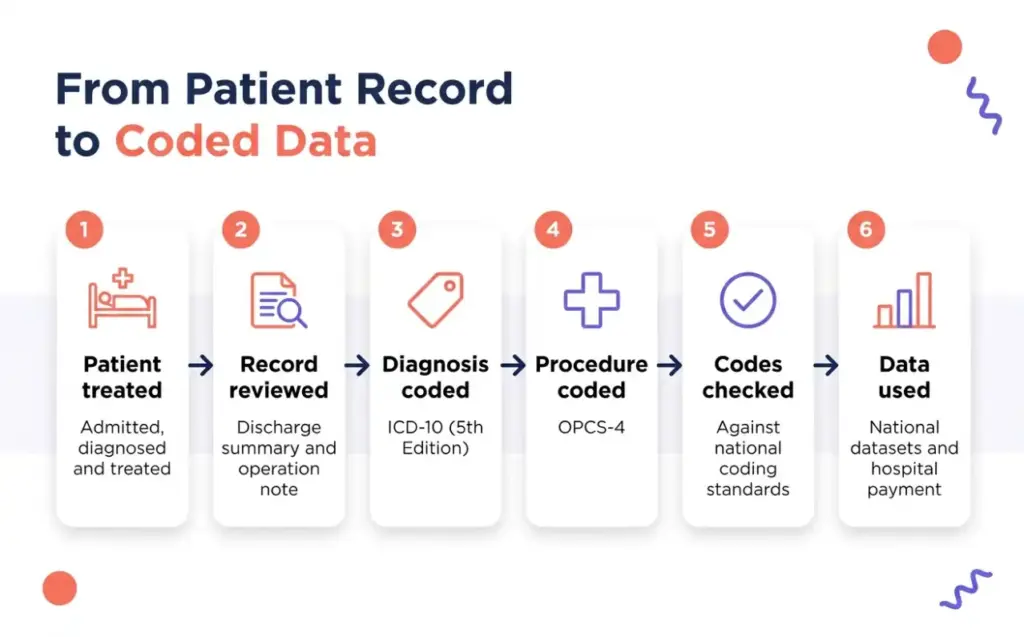
Picture a patient admitted through A&E with abdominal pain, diagnosed with acute appendicitis and taken to theatre for an appendicectomy.
The coder reads the discharge summary and operation note, assigns an ICD-10 code for the diagnosis and an OPCS-4 code for the procedure, then checks both against national coding standards.
That coded record feeds national datasets such as Hospital Episode Statistics and affects how the hospital is paid for the care. One missed detail, such as a complication recorded in the notes, can change both.
UK course titles often use “medical coding” and “clinical coding” interchangeably. Clinical coding and medical coding can overlap, but the terms aren’t always used in the same way. Medical Coding vs Clinical Coding UK: Key Differences clarifies how they relate.
Online, Classroom or Employer-Led Training: Which Route Fits?
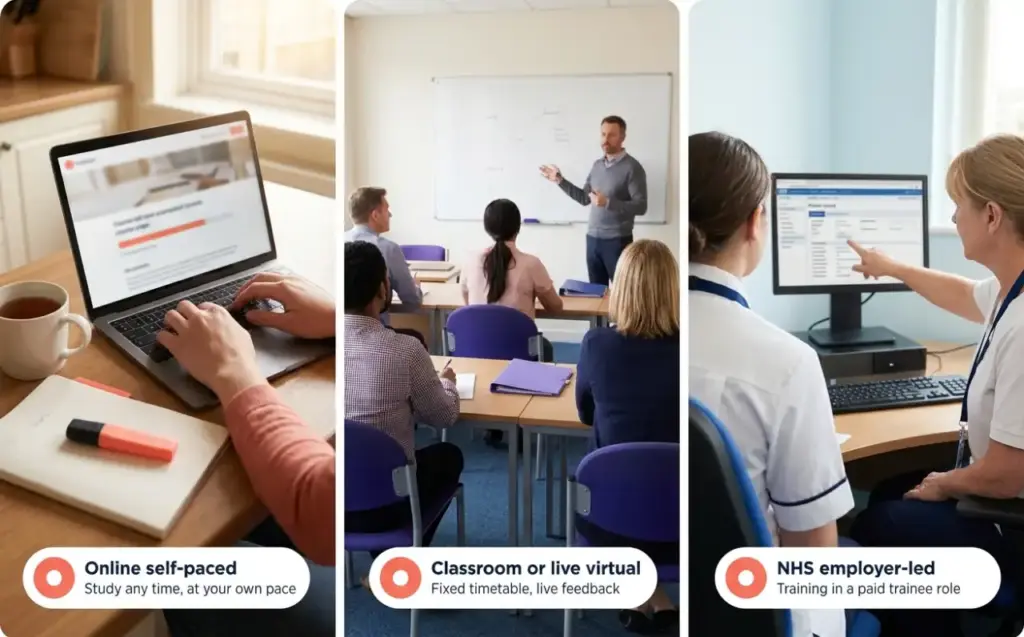
| Feature | Online self-paced course | Classroom or live virtual course | NHS employer-led training |
|---|---|---|---|
| Cost | Typically the lowest | Typically higher, as live tutor time is included | Funded by the employer |
| Flexibility | Study any time, on any device | Fixed dates and times | Part of a paid role, in working hours |
| Pace | Set by you | Set by the course | Set by the employer and national training schedule |
| Tutor contact | Usually by email or message | Live, with real-time questions | Approved trainers plus workplace mentors |
| Practice material | Sample cases and exercises | Sample cases, often with group work | Real patient records under supervision |
| Entry | Often no requirements | Varies by provider | You need a trainee coder post first |
| Best suited to | Getting started and studying around work | People who prefer structure and live feedback | People already hired as trainee coders |
The routes aren’t competing choices. Many people study online first, use that grounding to apply for trainee posts, then complete employer training once hired.
Online study wins on cost and flexibility. Classroom study offers live discussion and a fixed timetable, which some people need to stay on track. Employer-led training is the standard route into NHS coding work, but only after you’ve secured a job.
Before choosing how to study, consider the costs involved. Clinical Coding Course Fees: What to Budget outlines the expenses to plan for before enrolling.
Who Is Online Clinical Coding Study Best Suited To?
Online study works particularly well for:
Career changers from admin, reception or healthcare support roles who want a foothold in health information work.
Shift workers in the NHS or private healthcare who can’t commit to fixed class times.
Curious applicants who want to try the subject before applying for trainee posts.
Health records and data staff looking to add coding to their existing skills.
It’s a harder fit if you rely on live teaching to stay motivated. Self-paced study puts you in charge of the timetable, and that freedom cuts both ways. If deadlines help you, set your own and stick to them.
Not sure whether you need qualifications or experience first? Clinical Coding Course Requirements set out what different routes ask for.
What an Online Course Can and Can't Do for Your Career
This is the part many course pages skip, so here it is plainly. An online course offers a solid foundation and evidence of genuine interest. It is not a licence to practise, and it doesn’t replace the training NHS employers provide.
How NHS Trusts Train New Clinical Coders
NHS trusts usually recruit trainee clinical coders and train them on the job. In England, trainees typically attend a national standards course run by approved trainers, alongside supervised work on real records.
The clinical coder profile on NHS Health Careers outlines this entry route. Scotland, Wales and Northern Ireland have their own NHS organisations and training arrangements, though the core classifications are shared.
For a trainee application, an online course shows a recruiter that you’ve already got to grips with terminology and classifications and that you’re committed to the field.
Want to understand the formal training route in more detail? NHS Approved Clinical Coding Training: Practical Guide explains how national standards training fits into a trainee coder’s development.
Where the NCCQ Fits
The National Clinical Coding Qualification (NCCQ) is the professional qualification for clinical coders in the UK, awarded by the Institute of Health Records and Information Management (IHRIM). Passing it leads to Accredited Clinical Coder (ACC) status. Candidates usually sit the exam after gaining hands-on coding experience, so check IHRIM’s current eligibility rules before planning around it.
An online CPD-accredited or QLS-endorsed course is a different thing: a non-regulated certificate that supports your progress rather than replacing the NCCQ.
An online certificate and the NCCQ serve different purposes. Clinical Coding Certificate vs NCCQ: Key Differences compares their roles in a clinical coding career.
How to Choose an Clinical Coding Course Online UK
A few checks will quickly separate a useful course from a weak one:
UK classifications by name. The syllabus should list ICD-10 5th Edition and OPCS-4. If it mentions CPT, HCPCS or ICD-10-CM, it’s built for the US market.
Transparent accreditation. Look for a clear explanation of what any CPD accreditation or endorsement means and what it doesn’t.
Tutor support and assessment. Find out how you’ll get answers to questions and how your progress is assessed.
The full cost. Course fees and certificate fees are often separate, so confirm both before you pay.
Honest claims. Be cautious of any course promising NHS accreditation, ACC status or a guaranteed job.

Tips for Studying Clinical Coding Online
Start with terminology. Classifications are far easier once words like “cholecystectomy” stop looking like a puzzle.
Set a weekly routine. Two or three focused hours a week usually beats occasional long sessions.
Work through sample cases. Coding is a practical skill; reading about codes isn’t the same as assigning them.
Keep a personal glossary. Note unfamiliar terms and abbreviations as you meet them.
Use your tutor. Questions about coding conventions are normal, and answers save hours of guesswork.
Starting without a coding background? Beginner Clinical Coding Courses highlights study options that can help you build a foundation before tackling more advanced material.
Clinical Coding Jobs and Pay in the UK
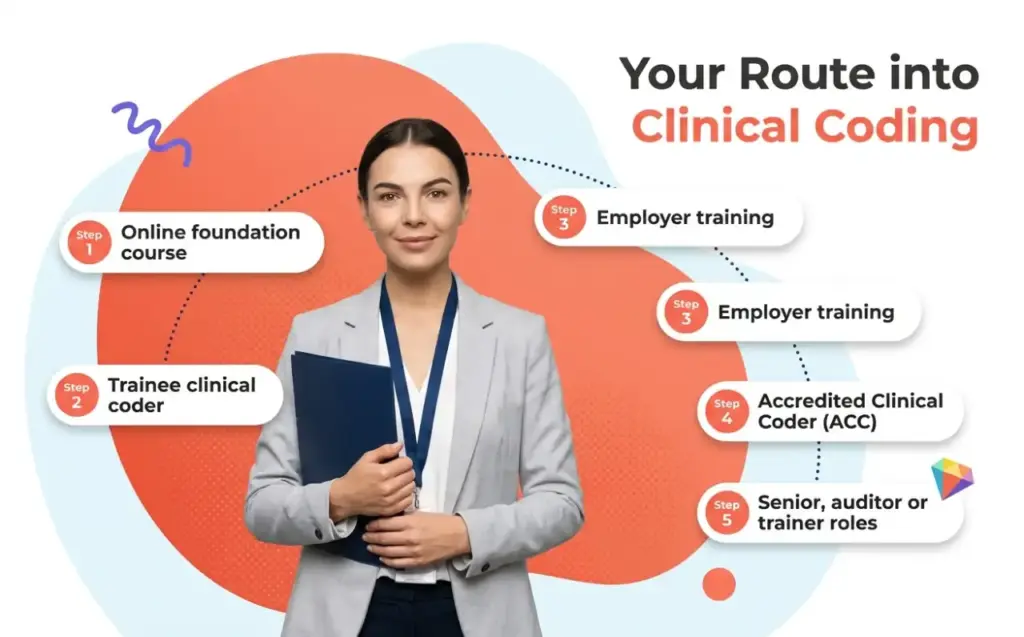
Clinical coders work in NHS trusts, private hospitals and some health data organisations. Typical roles include trainee coder, clinical coder, senior coder, coding auditor and coding trainer. Some employers offer hybrid or home working once coders are fully trained, subject to their data security policies.
In the NHS, pay follows the Agenda for Change pay scales. Trainee posts are commonly advertised at Band 3 and qualified coders at Band 4, with senior, auditor and trainer roles at higher bands. Grading varies by trust, so always check the band on individual job adverts.
For the wider picture of training routes across the UK, read Clinical Coding Courses in the UK: Training Guide.
Your Next Step for Clinical Coding Course Online UK
If clinical coding interests you, an online course is a low-risk, flexible way to find out whether the work suits you before you apply for trainee roles. Pair your study with job applications, and treat the NCCQ as a longer-term goal once you’re working.
When you’re ready, the Clinical Coding Online Course at QLS Level 3 covers the foundations at your own pace.
Frequently Asked Questions
Some can. Hybrid and remote roles exist, usually once a coder has completed training and proven their accuracy. Home working still means following strict data protection and information security rules, as coders handle confidential patient records.
No. Good foundation courses teach terminology from the beginning. That said, it’s the area that makes everything else easier, so spending extra time on it early pays off when you reach the classifications.
No. SNOMED CT is a clinical terminology for recording care in patient records, while ICD-10 and OPCS-4 remain the classifications used for hospital coding. Coders often work with data from both.
It can help your application by showing foundation-level understanding and commitment, but no course can guarantee a job. NHS trusts usually provide their own training once you’re hired.
- All Courses
- IT & Software389
- Management287
- Teaching and Education250
- Business245
- Health and Fitness227
- Engineering & Technology180
- Health & Safety163
- Health and Social Care144
- Quality Licence Scheme139
- Healthcare137
- Accounting & Finance130
- Psychology112
- Employability112
- Lifestyle105
- Marketing75
- Office Productivity74
- Animal Care63
- Design and Photography55
- Design50
- Beauty & Makeup49
- Accounting & Bookkeeping34
- Web Development27
- Construction26
- Writing20
- Child Care17
- Digital Marketing13
- Environment10
- Bundle8
- Coaching6
- Agriculture5

Awarded By


0 responses on "Clinical Coding Course Online UK: Practical Guide"