


You don’t necessarily need a degree or previous coding experience to become a clinical coder in the NHS. However, the qualifications you need depend on the position, employer and level of responsibility.
NHS clinical coder qualifications typically involve GCSE-level education or equivalent skills for trainee positions, workplace training and, for some experienced roles, the National Clinical Coding Qualification (NCCQ). There is no single qualification requirement for every NHS clinical coding vacancy.
If you’re considering this career, understanding the difference between introductory training and professional accreditation can help you make informed decisions. For a broader overview, our guide to becoming a clinical coder explains the career pathway.
Course Requirements vs Clinical Coding Job Requirements
NHS clinical coder entry requirements vary between trainee positions and experienced roles. Employers assess education, relevant knowledge and practical experience according to the responsibilities of each vacancy.
GCSEs, A-levels and Degree Requirements
A university degree is not universally required for NHS clinical coding jobs. Employers commonly look for a good standard of education, particularly English, maths and relevant IT skills.
The official NHS clinical coder career guidance highlights GCSEs, including English, maths and science, as useful foundations.
Depending on the vacancy, employers may consider:
✓ GCSEs in English and maths, or equivalent qualifications.
✓ Science qualifications, particularly biology.
✓ A-levels or further education qualifications.
✓ Relevant administrative or healthcare experience.
✓ Computer literacy and attention to detail.
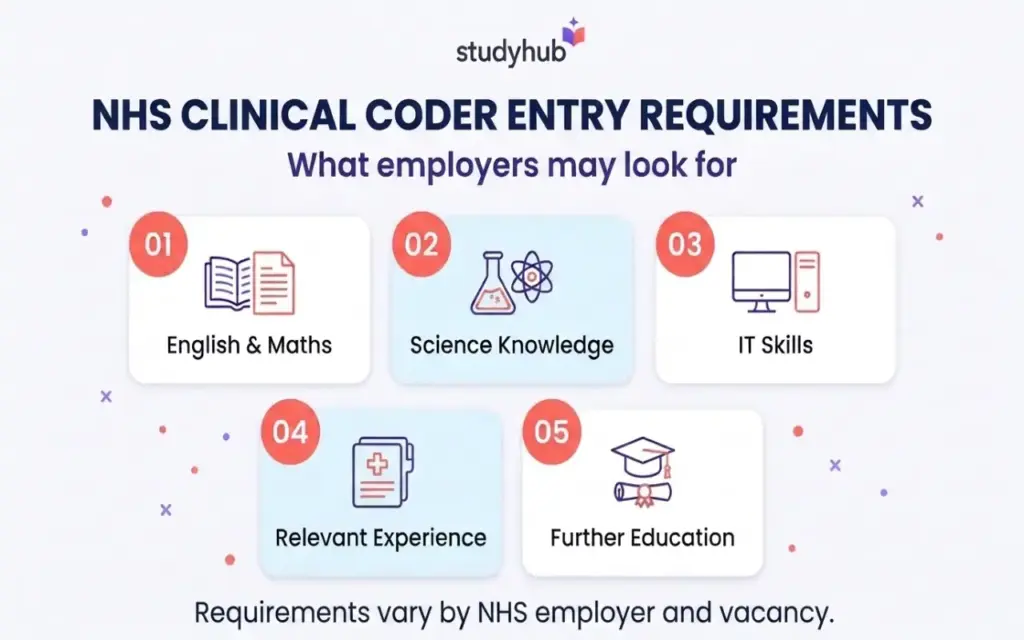
Some positions specify additional qualifications or experience. Always distinguish between essential requirements, which applicants must meet, and desirable requirements, which can strengthen an application.
Can You Become a Trainee Clinical Coder Without Experience?
Yes. Some NHS organisations recruit trainee clinical coders without previous professional coding experience.
These positions allow successful applicants to develop their knowledge through supervised work and structured training.
Experience in healthcare administration, medical records or data entry may be useful, but it isn’t always essential.
NHS Clinical Coding Training and Professional Qualifications
Several training routes can help learners develop clinical coding knowledge. However, introductory courses, apprenticeships and professional accreditation serve different purposes.
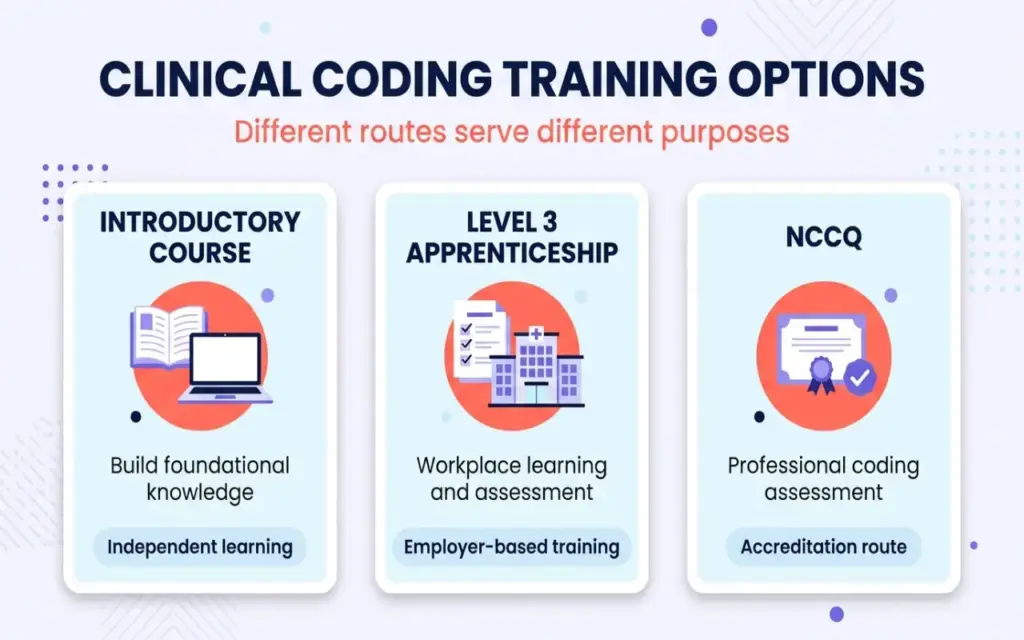
Clinical Coder Level 3 Apprenticeship
England has a formal Clinical Coder Level 3 apprenticeship standard.
The published standard describes a typical training period of 18–24 months, combining workplace learning with structured assessment.
Apprentices develop knowledge of medical terminology, clinical documentation, coding standards and patient information systems.
Individual employers determine their entry criteria. Apprentices must meet the applicable English and maths requirements before completing their end-point assessment, with specific exceptions set out in the apprenticeship standard.
Importantly, a Level 3 apprenticeship is not the same as NHS Band 3. The first refers to an educational training level, while the second describes a pay band.
National Clinical Coding Qualification (NCCQ)
The National Clinical Coding Qualification (NCCQ) is a recognised professional qualification for clinical coders working within the UK healthcare system.
Administered through the Institute of Health Records and Information Management (IHRIM), it assesses professional clinical coding knowledge and competence.
Successful candidates can receive Accredited Clinical Coder (ACC) status.
The National Clinical Coding Qualification is particularly relevant to coders progressing beyond introductory training. Some experienced NHS positions specify NCCQ accreditation as an essential or desirable requirement.
It should not be confused with a general online course completion certificate.
Can an Online Clinical Coding Course Help?
Online training can introduce learners to medical terminology, clinical records and coding systems before they explore NHS opportunities.
Studyhub’s Clinical Coding Online Course covers introductory clinical coding concepts and relevant classification systems.
The course is described as QLS Level 3 training. This should not be interpreted as an NHS clinical coding qualification, a regulated Level 3 qualification or an alternative to NCCQ accreditation.
Independent learning can help build subject knowledge, but NHS employers determine whether an applicant meets their recruitment criteria.
NHS Clinical Coder Bands, Salaries and Requirements
NHS clinical coding positions can fall within different pay bands depending on responsibilities, experience and the employing organisation.
Pay bands are part of the NHS Agenda for Change system. They do not automatically correspond to academic qualification levels.
NHS Band 3 and Band 4 Clinical Coding Roles
Band 3 and Band 4 positions may involve clinical coding support, trainee duties or established coding responsibilities, depending on the organisation.
A Band 3 position might involve administrative support, developing coding knowledge or supervised duties.
A Band 4 position may involve greater independence, coding accuracy and relevant experience.
However, these are illustrative differences rather than fixed NHS-wide requirements. A Band 4 position does not automatically require a Level 4 qualification.
Band 5 and Senior Clinical Coding Positions
More experienced clinical coders may progress into specialist, supervisory, auditing or training positions.
These roles can involve reviewing complex clinical records, checking coding quality and supporting less experienced colleagues.
NCCQ accreditation and substantial practical experience may be requested, depending on the vacancy.
| NHS band | Possible clinical coding responsibilities | Qualification considerations |
|---|---|---|
| Band 3 | Coding support or trainee-related duties | General education, IT skills and willingness to train |
| Band 4 | Established coding duties and greater independence | Relevant coding knowledge, training and experience |
| Band 5 and above | Specialist coding, auditing or supervisory responsibilities | Advanced experience and potentially NCCQ accreditation |
These are illustrative role patterns, not universal NHS qualification requirements.
How Much Do NHS Clinical Coders Earn?
The official NHS Agenda for Change pay scales provide the following basic annual salaries for England from 1 April 2026.
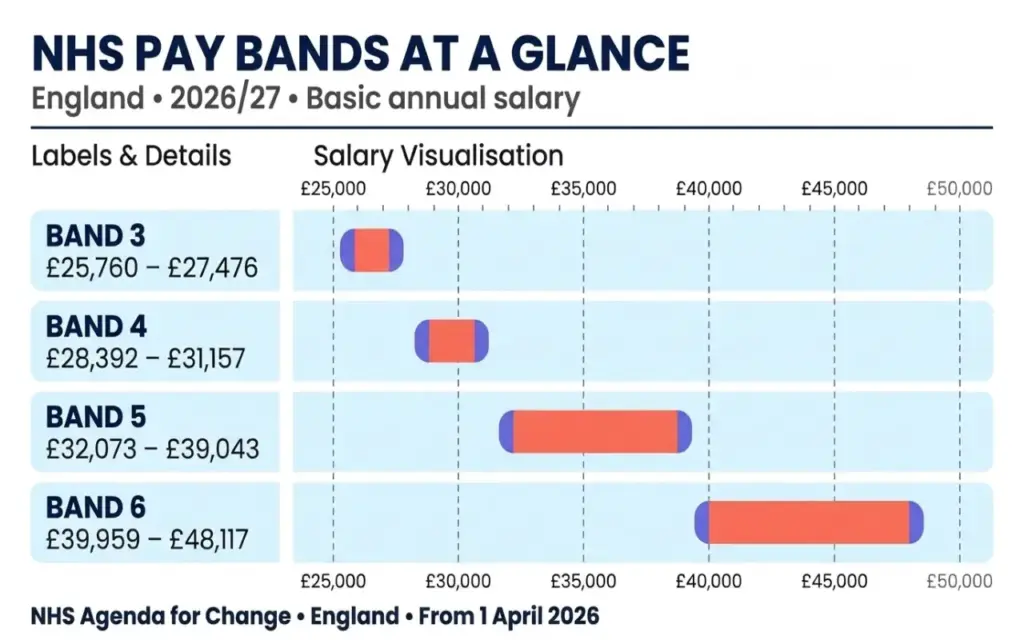
These figures represent NHS pay-band rates, not guaranteed clinical coder salaries. Actual earnings depend on the advertised position, pay point and applicable allowances.
Pay arrangements also differ across England, Scotland, Wales and Northern Ireland.
What Do NHS Employers Look for Beyond Qualifications?
Qualifications matter, but NHS employers also assess whether applicants can work accurately with clinical information.

Clinical coders translate diagnoses and procedures from patient records into standardised codes. This requires technical knowledge, attention to detail and careful judgement.
Relevant skills include medical terminology, anatomy, physiology, digital literacy and confidentiality. Understanding ICD-10 for diagnoses and OPCS-4 for procedures is particularly useful.
When reviewing a clinical coding vacancy, check:
- ↪ Essential qualifications: Which certificates or educational standards must you hold?
- ↪ Experience: Is previous clinical coding experience required, or is training provided?
- ↪ Technical knowledge: Does the employer expect familiarity with coding classifications?
- ↪ Accreditation: Is NCCQ essential, desirable or part of future development?
- ↪ Personal skills: Are communication, confidentiality and accuracy assessed?
Final Thoughts: Choosing the Right NHS Clinical Coding Route
Understanding NHS clinical coder qualifications starts with recognising the difference between entry requirements, training and professional accreditation.
A trainee position may offer the opportunity to develop practical skills, while experienced roles can require greater competence and qualifications such as NCCQ. NHS pay bands reflect job responsibilities rather than course levels.
Before choosing training, review current NHS vacancies and identify the qualifications employers actually request. If you need introductory knowledge, online clinical coding training may provide a useful foundation for further study.
Frequently Asked Questions About NHS Clinical Coder Qualifications
Yes. NHS organisations provide clinical coding training through workplace development programmes, and formal apprenticeship opportunities may also be available. Independent online courses can introduce coding concepts, but they should not be mistaken for NHS professional accreditation. Always check what a particular training programme provides.
No, a university degree is not universally required. Many trainee positions focus on GCSE-level education, relevant skills and the ability to complete workplace training. However, individual employers can set different essential and desirable criteria, so check the specific job advertisement.
Band 3 can be associated with entry-level or support positions in clinical coding, but this is not guaranteed. Some organisations may advertise trainee positions at different bands. The job title, responsibilities and person specification provide a more reliable indication of the requirements than the band alone.
Yes, you may be eligible for trainee clinical coding vacancies without previous coding experience. These roles can provide structured training and supervised practice. However, applicants must still meet the employer’s educational, skills and other recruitment requirements. Relevant administrative experience can strengthen an application.
Do not assume that a paid course is compulsory. Read the advert first: some employers provide structured training for successful applicants. Compare clinical coding course requirements with your learning needs before deciding whether additional study would be useful.
- All Courses
- IT & Software389
- Management287
- Teaching and Education250
- Business245
- Health and Fitness227
- Engineering & Technology180
- Health & Safety163
- Health and Social Care144
- Quality Licence Scheme139
- Healthcare137
- Accounting & Finance130
- Psychology112
- Employability112
- Lifestyle105
- Marketing75
- Office Productivity74
- Animal Care63
- Design and Photography55
- Design50
- Beauty & Makeup49
- Accounting & Bookkeeping34
- Web Development27
- Construction26
- Writing20
- Child Care17
- Digital Marketing13
- Environment10
- Bundle8
- Coaching6
- Agriculture5

Awarded By