



Got an NHS clinical coder interview coming up? You might be wondering what questions you’ll face, whether there’s a written test and how much medical knowledge you need.
Good clinical coding interview preparation involves more than memorising answers. You need to understand the role, revise basic medical terms, learn about UK coding systems and prepare examples of your existing skills.
Some NHS trusts also use practical assessments to check accuracy, medical terminology and attention to detail.
This guide covers common clinical coder interview questions, sample answers and practical assessment advice. Whether you’re applying for a trainee position or changing careers, you’ll learn how to prepare with greater confidence.
✓QLS Level 3
Clinical Coding Online Course
Check the modules, assessment and current certificate options before you enrol.
What Happens at an NHS Clinical Coding Interview?
An NHS clinical coding interview may include questions about your experience, communication skills, accuracy and understanding of patient information.
The recruitment process depends on the NHS trust and the position. Some employers arrange a standard interview, while others include a written test or practical assessment.
Your clinical coding interview preparation should therefore begin with the job description and interview invitation.
Trainee vs Experienced Clinical Coder Interviews
Trainee interviews usually focus on your potential to learn and work accurately.
Interviewers may ask about:
- Your interest in clinical coding.
- Basic anatomy and medical terminology.
- Computer skills and attention to detail.
- Confidentiality and teamwork.
- Your ability to follow instructions.
Experienced clinical coder interviews may involve more detailed questions about ICD-10, OPCS-4, national coding standards, audits and resolving complex coding issues.
If you’re applying for a trainee position, don’t assume you need the same knowledge as an accredited clinical coder.
Could You Have a Test Before the Interview?
Yes. Some NHS employers use a short assessment to evaluate candidates’ suitability.
For example, Somerset NHS Foundation Trust’s trainee clinical coder advert specifies a 30-minute pre-interview test covering basic anatomy, physiology and clinical terminology.
University Hospitals Dorset also advertised an October 2026 recruitment event involving screening exercises, a short assessment and interviews for candidates who met the required standard.
These are individual recruitment examples, not a standard assessment used by every NHS trust.
A useful part of clinical coding interview preparation is practising medical terminology, careful reading and simple record-checking exercises.
Common Clinical Coder Interview Questions and Answers
Interviewers want to understand how you think, communicate and approach detailed work.
The following questions are examples of what you might encounter. The sample answers demonstrate useful approaches, but you should adapt them to your actual experience rather than memorising them word for word.
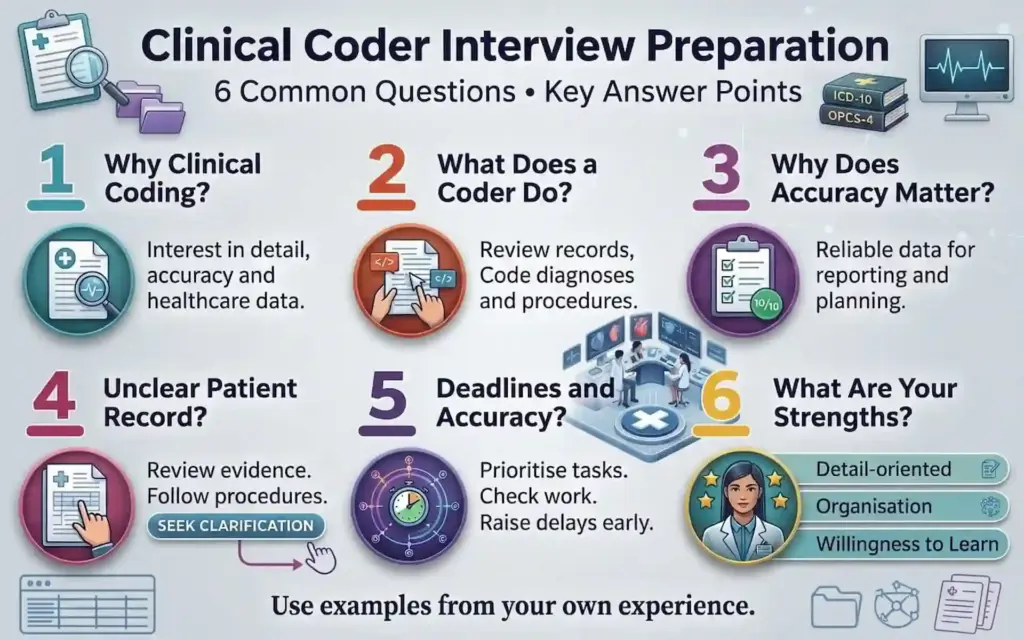
1. Why Do You Want to Work in Clinical Coding?
What interviewers assess: Your understanding of the profession and reasons for applying.
Sample answer:
“I’m interested in clinical coding because I enjoy working with detailed information and ensuring records are accurate. I understand that clinical coding helps the NHS organise information about diagnoses and procedures. I’d like to develop these skills through structured training and contribute to reliable healthcare data.”
Tip: Connect your interests to the job instead of focusing only on salary or working hours.
2. What Does a Clinical Coder Do?
What interviewers assess: whether you understand the main responsibilities.
Sample answer:
“A clinical coder reviews information recorded by healthcare professionals and assigns standardised codes to diagnoses and procedures. These codes support NHS reporting, healthcare planning, research and other uses of hospital data. Accuracy and national coding standards are important parts of the work.”
A strong answer should explain the role clearly without adding unnecessary technical language.
3. Why Is Accuracy Important in Clinical Coding?
What interviewers assess: Attention to detail and understanding of data quality.
Sample answer:
“Accurate coding helps ensure healthcare information is recorded consistently. Errors can affect reports, statistics and how hospital activity is understood. I would follow the relevant standards, check the available documentation and ask for guidance when information is unclear.”
Accuracy is particularly important because the NHS uses coded information for service planning, reporting and analysis.
During your clinical coding interview preparation, practise explaining why careful work matters rather than simply saying you’re detail-oriented.
4. What Would You Do if a Patient Record Was Unclear?
What interviewers assess: Professional judgement and willingness to follow procedures.
Sample answer:
“I wouldn’t guess or make assumptions about unclear clinical information. I would review the available documentation, follow the department’s procedures and seek clarification through the appropriate person or process. My priority would be to produce accurate coding based on the documented evidence.”
Tip: Avoid suggesting that a coder should independently change a diagnosis or make clinical decisions.
5. How Would You Manage a Deadline Without Compromising Accuracy?
What interviewers assess: Organisation, prioritisation and responsibility.
Sample answer:
“I would organise my workload according to the team’s priorities and monitor my progress. If I thought a deadline was at risk, I would raise the issue early. I would avoid rushing through records or skipping important checks simply to finish more quickly.”
If you’ve previously worked in administration, care or another busy environment, use a genuine example of meeting deadlines while maintaining quality.
6. What Strengths Would You Bring to Our Clinical Coding Team?
What interviewers assess: Transferable skills and suitability for the role.
Sample answer:
“I believe my strongest skills are attention to detail, organisation and a willingness to learn. In previous work, I’ve followed procedures carefully and checked information for accuracy. I would bring those habits to clinical coding while developing the specialist knowledge required.”
If you haven’t worked in clinical coding before, focus on relevant skills you can demonstrate.
For career changers, Clinical Coding Career Change Practical Guide provides additional guidance on transferable skills and preparing for NHS trainee roles.
Clinical coding interview preparation becomes more effective when every answer includes a clear reason, a realistic example and an explanation of how your approach fits the job.
Technical Questions to Revise Before Your Interview
Technical knowledge is another important part of clinical coding interview preparation, particularly when employers include a terminology test.
You don’t need to memorise an entire classification system for a beginner interview. Start by understanding the purpose of the main UK coding systems.
ICD-10, OPCS-4 and SNOMED CT Explained
These three terms are commonly discussed in UK clinical coding training.
| System | Main Purpose |
|---|---|
| ICD-10 | Classifies diagnoses and health conditions |
| OPCS-4 | Classifies clinical interventions and procedures |
| SNOMED CT | Provides structured clinical terminology for electronic health records |
NHS England identifies ICD-10 and OPCS-4 as nationally mandated clinical classifications. SNOMED CT serves a different purpose as a clinical terminology.
You can review the official NHS clinical classifications guidance to understand these differences.
Possible interview question: What is the difference between ICD-10 and OPCS-4?
Suggested answer: “ICD-10 classifies diagnoses and health conditions, while OPCS-4 classifies clinical procedures and interventions. Both help the NHS record hospital activity consistently.”

Medical Terminology, Anatomy and Clinical Records
Medical terminology helps clinical coders understand the information recorded by healthcare professionals.
For clinical coding interview preparation, revise common terms such as:
- Diagnosis: The condition identified by a clinician.
- Procedure: An intervention or treatment carried out.
- Acute: A condition with a sudden onset or relatively short course.
- Chronic: A condition that continues over a longer period.
- Bilateral: Affecting both sides of the body.
Also learn basic body systems, including the respiratory, cardiovascular and digestive systems.
If you need structured introductory learning, StudyHub’s Clinical Coding Online Course at QLS Level 3 covers medical terminology, clinical records, ICD-10, OPCS-4 and confidentiality.
The course provides non-regulated introductory learning. It does not award the National Clinical Coding Qualification or guarantee interview success.
How to Handle Unclear or Missing Documentation
A clinical coder must follow the relevant national standards and local procedures when information is missing or unclear.
For example, imagine a patient record contains two conflicting descriptions of the same condition.
A sensible approach would be to:
- Review the relevant documentation.
- Check the applicable coding guidance.
- Identify the information requiring clarification.
- Follow the approved process for raising a query.
- Avoid assigning unsupported codes.
This type of reasoning is useful for clinical coding interview preparation because it demonstrates accuracy, responsibility and an understanding of professional limits.
The key principle is straightforward: Never guess when the documented information is insufficient.
How to Prepare for a Clinical Coding Assessment Test
Some NHS trusts use written or practical tests to check whether applicants have the skills needed for clinical coding.
These assessments may cover basic anatomy, medical terminology, accuracy and the ability to follow instructions. The format varies between employers.
For effective clinical coding interview preparation, focus on understanding information rather than memorising complex medical codes.
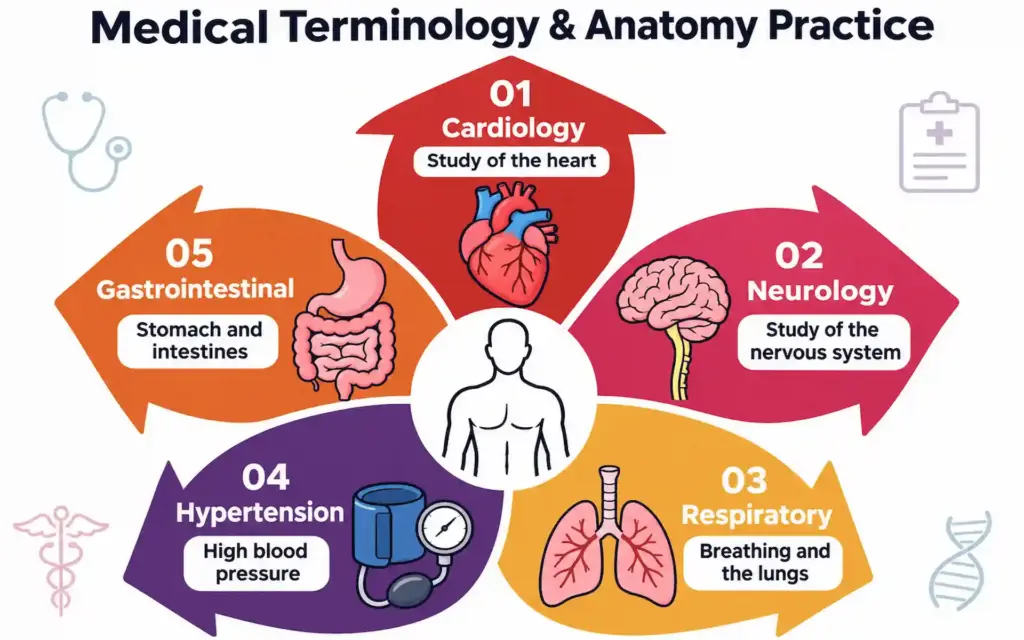
Medical Terminology and Anatomy Practice
Start with common medical terms and body systems. For example:
- Cardiology: The study of the heart.
- Neurology: The study of the nervous system.
- Respiratory: Relating to breathing and the lungs.
- Hypertension: High blood pressure.
- Gastrointestinal: Relating to the stomach and intestines.
Try matching medical terms to their meanings or identifying which body system a condition affects.
This type of practice can help you prepare for a clinical coding assessment test, particularly when applying for trainee positions.
Accuracy, Record Checking and Following Instructions
Clinical coding requires careful reading and accurate use of documented information.
Practice exercise:
Imagine you’re reviewing a fictional patient record containing these details:
- Admission date: 12 October 2026.
- Discharge date: 10 October 2026.
- Recorded diagnosis: Pneumonia.
- Treatment information: Antibiotics prescribed.
Question: What should you check before processing the record?
Suggested answer: The discharge date comes before the admission date. You should flag this inconsistency and follow the appropriate process to clarify the information rather than changing it yourself.
This is an illustrative exercise, not an actual NHS recruitment question.
How to Approach a Timed Assessment
A timed assessment can feel challenging, especially when you’re unfamiliar with clinical terms.
During your clinical coding interview preparation, practise completing short exercises carefully within a reasonable time.
Follow these steps:
- Read the instructions before answering.
- Identify exactly what the question asks.
- Check important details, including dates and terminology.
- Avoid guessing when information is unclear.
- Review your answers if time remains.
The aim is to demonstrate accuracy and sound judgement, not simply speed.
NHS Values-Based Interview Questions
NHS employers may assess how your behaviour reflects their organisation’s values, including respect, teamwork, responsibility and commitment to quality.
According to NHS Employers’ values-based recruitment guidance, employers may assess values through interviews, written responses and practical exercises.
For clinical coding interview preparation, think about situations where you’ve demonstrated these qualities in previous work, education or volunteering.

How to Answer Using the STAR Method
The STAR method helps you organise an answer to a question about your experience.
It involves four parts:
- Situation: Explain what happened.
- Task: Describe your responsibility.
- Action: Explain what you did.
- Result: Describe the outcome.
Example question: Tell us about a time you identified a mistake at work.
Illustrative answer:
“While working in an administrative role, I noticed that two records contained different contact details for the same customer. I needed to ensure the information was correct before processing the request. I checked the available records and followed our procedure to confirm the details. The information was corrected before the request was completed.”
A clear example like this demonstrates attention to detail and responsible working.
The NHS Professionals interview advice also recommends using the STAR method when answering competency-based questions.
Confidentiality, Teamwork and Handling Mistakes
Patient confidentiality is especially important in clinical coding because coders work with sensitive health information.
Interviewers may ask:
- How would you protect confidential patient information?
- What would you do if you noticed an error in a record?
- How would you respond if a colleague disagreed with you?
Your answers should show that you understand professional boundaries, follow workplace procedures and know when to ask for guidance.
Health information is treated as special category data under UK data protection law. The Information Commissioner’s Office guidance explains the additional conditions involved in handling this information.
For beginners, clinical coding interview preparation should include practical examples of confidentiality and teamwork, even if those examples come from jobs outside healthcare.
Your Seven-Day Clinical Coding Interview Preparation Plan
Preparing a little each day can make a clinical coder interview feel more manageable.
Use this simple seven-day plan to organise your revision.
| Day | Preparation Task |
|---|---|
| Day 1 | Review the job description and person specification. |
| Day 2 | Research the NHS trust and clinical coder responsibilities. |
| Day 3 | Revise basic anatomy and medical terminology. |
| Day 4 | Learn the purposes of ICD-10, OPCS-4 and SNOMED CT. |
| Day 5 | Practise common clinical coder interview questions. |
| Day 6 | Complete a mock accuracy and terminology assessment. |
| Day 7 | Check interview arrangements and review key notes. |
This clinical coding interview preparation plan is flexible. If you’re unfamiliar with medical terminology, spend more time revising that area.
Avoid trying to memorise every possible interview answer. Focus instead on understanding the role and preparing genuine examples of your abilities.
Seven days of preparation cannot replace professional clinical coding training, but it can help you approach an interview in a more organised way.
What to Do on Clinical Coding Assessment Day
Good clinical coding interview preparation includes knowing what to do before, during and after your interview.
Small practical steps can help you concentrate on the questions and assessments.
Before the Interview or Test
Check your interview invitation carefully.
Confirm the time, location, required documents and whether the interview is online or in person.
Before attending:
- Review the job description.
- Prepare suitable identification if requested.
- Allow enough time for travel.
- Test your internet connection if attending online.
- Bring any documents specified by the employer.
If the invitation mentions an assessment, check whether any preparation materials or instructions have been provided.
During the Interview and After It Ends
Listen carefully to each question and take a moment to think before answering.
If you don’t understand a question, politely ask for clarification.
During a written test, follow the instructions and work accurately rather than rushing.
At the end of the interview, you could ask:
- What training is available for new clinical coders?
- How is trainee progress assessed?
- What opportunities are available for professional development?
Afterwards, follow any instructions about the next stage of recruitment.
Can an Online Clinical Coding Course Help You Prepare?
Yes. Introductory online training can support clinical coding interview preparation by helping beginners understand medical terminology, clinical records and basic coding principles.
StudyHub’s Medical Coding Certification: Clinical Coding Online Course at QLS Level 3 covers topics including ICD-10, OPCS-4, SNOMED CT, confidentiality and the legal and ethical aspects of clinical work.
The course offers flexible online study and a written assignment assessment. It may be useful if you’re new to clinical coding and want structured introductory learning.
However, QLS endorsement relates to non-regulated training. The course does not award the National Clinical Coding Qualification (NCCQ), replace NHS workplace training or guarantee interview success.
Before enrolling, review the course modules, assessment and certificate options to decide whether they match your learning needs.
✓QLS Level 3
Clinical Coding Online Course
Check the modules, assessment and current certificate options before you enrol.
Final Thoughts
Effective clinical coding interview preparation starts with understanding what the NHS employer expects.
Review the job description, practise common interview questions and build confidence with medical terminology, UK coding systems and accuracy exercises.
Prepare genuine examples of teamwork, confidentiality and problem-solving. If an assessment is included, read the instructions carefully and avoid guessing when information is unclear.
Most importantly, remember that trainee interviews assess your potential to learn as well as your existing abilities.
With a clear revision plan and realistic expectations, you can approach your clinical coding interview feeling more prepared and confident.
Frequently Asked Questions
Common NHS clinical coder interview questions may cover accuracy, confidentiality, teamwork, medical terminology and your reasons for applying.
Experienced candidates may also face technical questions about coding standards and classifications. The exact questions depend on the employer and position.
Some NHS trusts include written or practical assessments. These may test basic anatomy, medical terminology, accuracy or attention to detail.
For example, Somerset NHS Foundation Trust has advertised a 30-minute pre-interview test for trainee clinical coders. Other employers may use different assessments or no separate test.
For clinical coding interview preparation, focus on basic anatomy, medical terminology, patient confidentiality and the purposes of ICD-10 and OPCS-4.
Also practise reading information carefully and identifying inconsistencies in fictional records. Check the employer’s instructions because assessment content varies.
Yes. Some NHS trainee clinical coder positions welcome applicants without previous coding experience.
However, candidates must meet the education and skills requirements listed in the job description. Relevant IT skills, accuracy, communication and willingness to learn can strengthen an application.
There is no fixed preparation period.
A week of focused revision may help someone with existing knowledge. Beginners may need longer to become familiar with medical terminology and the role.
Plan your clinical coding interview preparation around the vacancy requirements, your current knowledge and the time available.
Toggle Content
- All Courses
- IT & Software389
- Management287
- Teaching and Education250
- Business245
- Health and Fitness227
- Engineering & Technology180
- Health & Safety163
- Health and Social Care144
- Quality Licence Scheme139
- Healthcare137
- Accounting & Finance130
- Psychology112
- Employability112
- Lifestyle105
- Marketing75
- Office Productivity74
- Animal Care63
- Design and Photography55
- Design50
- Beauty & Makeup49
- Accounting & Bookkeeping34
- Web Development27
- Construction26
- Writing20
- Child Care17
- Digital Marketing13
- Environment10
- Bundle8
- Coaching6
- Agriculture5
Awarded By


0 responses on "Clinical Coding Interview Questions and Assessment Day Tips"