


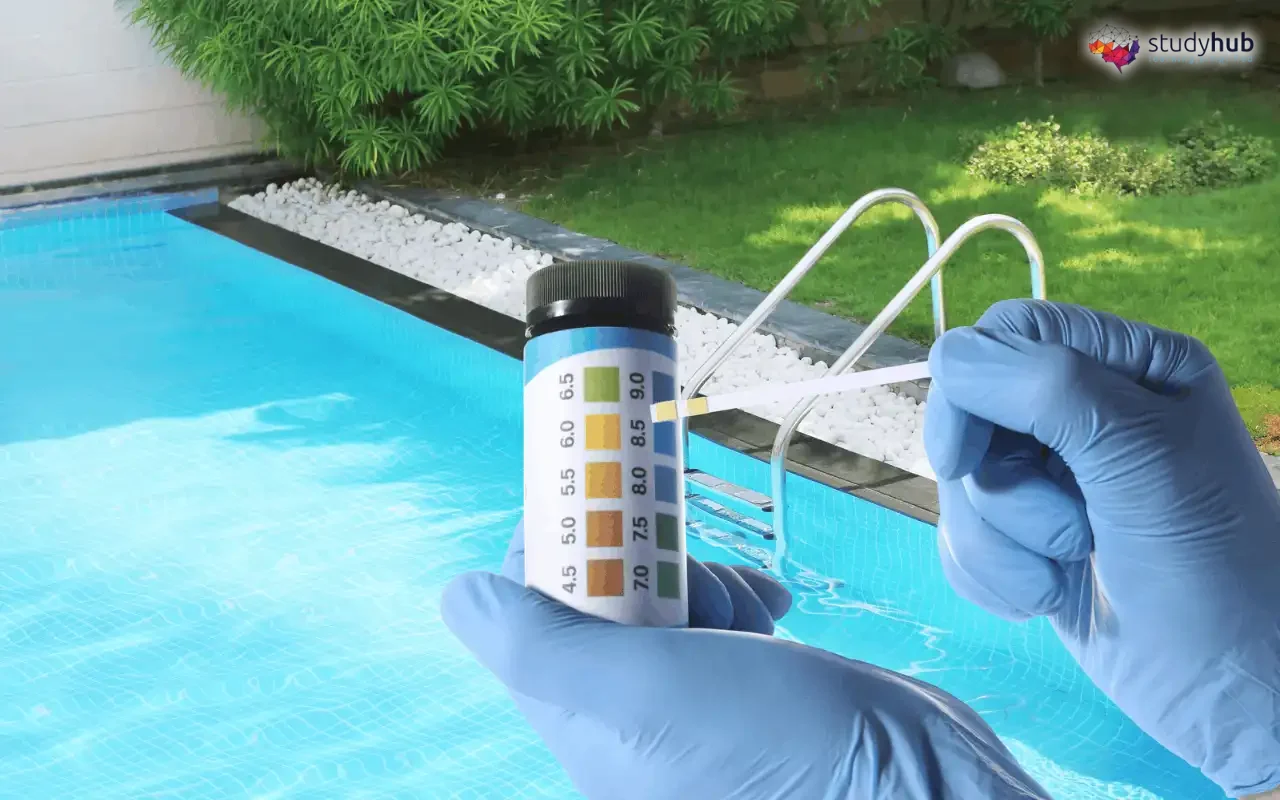
Your swimming pool might look clean, but are the chlorine levels within the recommended range? Incorrect chlorine levels can affect disinfection, water quality and swimmer comfort.
Understanding swimming pool chlorine levels in the UK starts with knowing the difference between free chlorine and combined chlorine. You also need to check pH because it affects how effectively chlorine works.
The Pool Water Treatment Advisory Group (PWTAG) provides guidance for managing swimming pool water in the UK. Its recommendations help pool operators maintain suitable disinfection and water quality.
This guide explains the recommended chlorine levels, how to test pool water, what affects chlorine performance and how to maintain a suitable chemical balance.
Free resource: download our printable Pool Water Testing Log to record chlorine, pH and the action you take each time you test.
Quick Answer: What Are The Recommended Swimming Pool Chlorine Levels In The UK?
There is no single chlorine target that applies to every swimming pool. The correct level depends on the disinfectant system, pool type, pH, water treatment equipment and microbiological quality.
For conventional pools using hypochlorite, published UK guidance gives an indicative free chlorine range of around 0.75–3 mg/L, subject to the relevant operating conditions and satisfactory microbiological quality. PWTAG advises that free chlorine should be kept as low as is consistent with effective disinfection.
Key points to remember:
- Free chlorine: Measures the chlorine available for disinfection.
- Combined chlorine: Forms when chlorine reacts with contaminants and should be kept as low as possible.
- pH: PWTAG recommends 7.0–7.4 for chlorine-based disinfection, ideally 7.0–7.2 for improved disinfectant activity.
- Water testing: Check chlorine and pH regularly using suitable, maintained equipment.
- Chemical safety: Never mix chlorine products with acids or other incompatible chemicals.
These figures are not a universal dosing instruction. Public pool operators must follow their current operating procedures and the relevant PWTAG guidance.
If you are new to pool care, StudyHub’s Pool Maintenance course introduces water quality, chemical balance, cleaning and general pool safety.
Want to Understand Pool Water Chemistry Properly?
Studyhub's Pool Maintenance Training covers the chemical balance of water, water quality and pool safety in structured online modules.
- Includes a dedicated Chemical Balance of Water module
- Covers Water Quality Maintenance and Pool Safety
- Digital certificate, transcript and student ID included
★ 4.9/5 (17 reviews)👥 65 students🎓 CPD accredited∞ Unlimited access
What Do Swimming Pool Chlorine Levels Mean?
Swimming pool chlorine levels show how much chlorine remains in the water after it has reacted with contaminants.
Chlorine is commonly used to disinfect swimming pools. It helps control harmful microorganisms and maintain suitable water conditions.
However, not all chlorine in a pool performs the same role. The two main measurements are:
Free Chlorine
Free chlorine is the available chlorine that provides disinfection. It includes hypochlorous acid (HOCl) and hypochlorite ions (OCl⁻).
Hypochlorous acid is the more effective disinfecting form. The balance between these forms depends largely on the water’s pH.
Combined Chlorine
Combined chlorine forms when chlorine reacts with substances such as ammonia and other contaminants introduced by swimmers.
It includes chloramines, which can contribute to unpleasant smells and irritation.
PWTAG recommends keeping combined chlorine as low as possible. It should not exceed 1 mg/L or half the free chlorine level, whichever limit is lower.
Total Chlorine
Total chlorine is the combined measurement of free and combined chlorine.
The relationship can be expressed as:
Total Chlorine = Free Chlorine + Combined Chlorine
To calculate combined chlorine:
Combined Chlorine = Total Chlorine − Free Chlorine
For example, if a test shows total chlorine of 1.8 mg/L and free chlorine of 1.5 mg/L, the combined chlorine level is 0.3 mg/L.
What Are The Recommended Pool Water Levels In The UK?
Pool water quality depends on several chemical measurements working together. Checking chlorine alone does not provide a complete picture.
The following table summarises useful PWTAG reference guidance for relevant pool systems.
| Water Parameter | PWTAG Reference Guidance |
|---|---|
| Free chlorine | Depends on the disinfectant system, pH and microbiological quality. There is no single target for every pool. |
| Combined chlorine | Ideally zero; no more than 1 mg/L or half the free chlorine level, whichever is lower. |
| pH | 7.0–7.4 for chlorine-based disinfectants; ideally 7.0–7.2 for improved disinfection. |
| Total alkalinity | 75–150 mg/L as CaCO₃ in the relevant PWTAG guidance. |
| Calcium hardness | Ideally above 75 mg/L and up to around 150 mg/L as CaCO₃, with higher levels sometimes acceptable depending on the water supply and pool conditions. |
Important: These are reference points, not a universal chemical treatment plan. Pool construction, disinfectant type, source water, temperature and operating conditions can affect the appropriate targets.
A reading within a quoted range does not automatically prove that the pool is safe for swimming. Filtration, circulation, microbiological quality and proper operation also matter.
For further details, consult the PWTAG Code of Practice and its standards and guidance.
Why Is pH Important For Swimming Pool Chlorine Levels?
pH measures how acidic or alkaline pool water is. It is important because it affects the form of chlorine available for disinfection.
PWTAG recommends keeping the pH between 7.0 and 7.4 for pools using chlorine-based disinfectants, ideally between 7.0 and 7.2 for improved disinfectant activity.
When pH rises, a smaller proportion of free chlorine is present as the more effective hypochlorous acid. This can reduce the disinfecting effect even when the chlorine test result appears unchanged.
For example, PWTAG explains that at 25°C:
- At pH 7.0, around 75% of the measured free chlorine is active free chlorine.
- At pH 7.5, around 50% is active free chlorine.
- At pH 8.0, around 25% is active free chlorine.
This is why checking pH alongside chlorine is essential.
Read PWTAG’s Technical Note 60 on active free chlorine for a more detailed explanation.
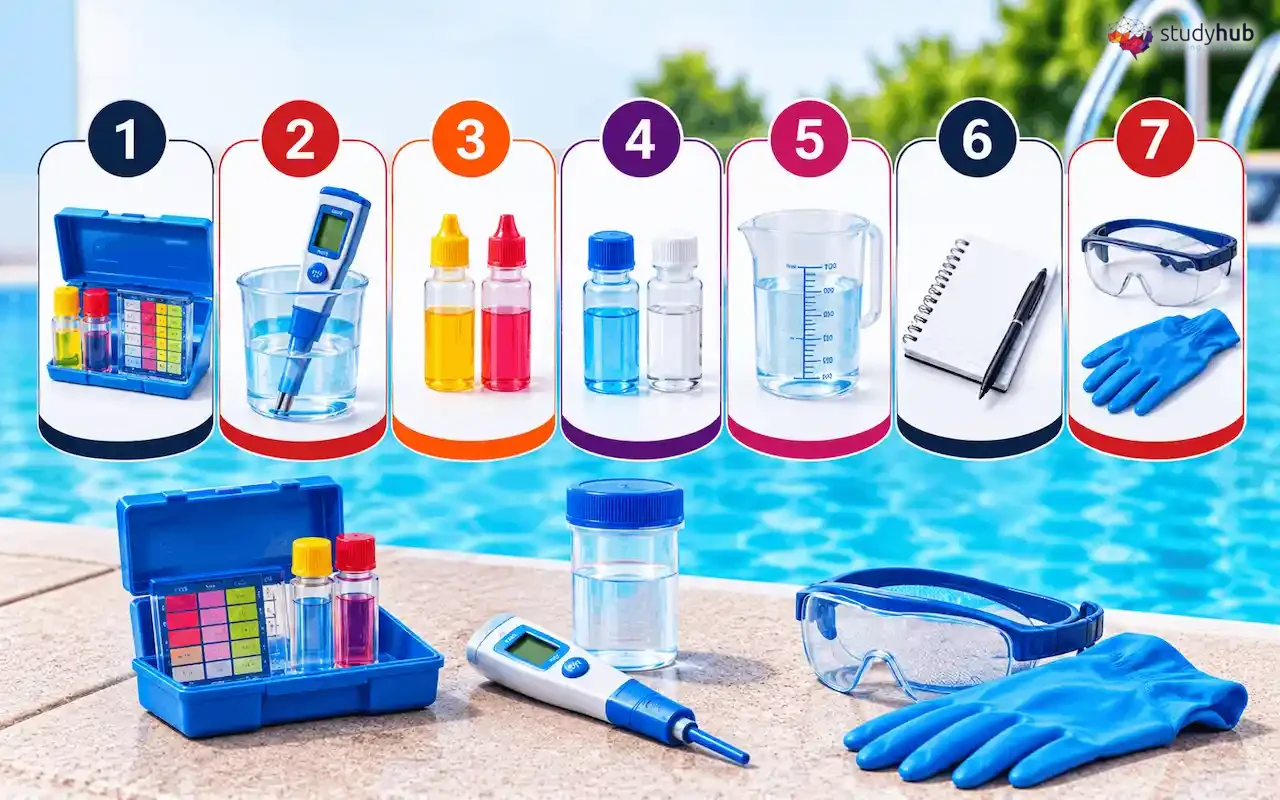
What Equipment Do You Need To Test Pool Water?
Accurate testing helps you understand whether the swimming pool chlorine levels are suitable for the treatment system.
You will usually need:
- A suitable swimming pool water testing kit.
- A reliable pH test.
- Free and total chlorine tests.
- Total alkalinity and calcium hardness tests.
- A clean sample container, where required.
- A notebook or water quality logbook.
- Appropriate protective equipment when handling chemicals.
DPD test kits and photometers can be used to measure chlorine, provided the equipment and reagents are suitable for the test.
A photometer measures the colour response of a prepared water sample and displays a result. Test strips may be useful for basic checks in some domestic settings, but they should not replace the equipment and procedures required for professional pool operation.
For public pools, operators need suitable testing equipment, training and documented procedures. PWTAG’s Swimming Pool Technical Operator training guidance covers sampling, testing, equipment use and record keeping.
Practical tip: If a test result looks unusual, repeat the test using the correct method before making any chemical adjustments.
How To Test Swimming Pool Chlorine Levels Step By Step
Testing should always come before chemical adjustments. It helps you identify what needs attention rather than adding products based on guesswork.
Step 1: Collect a Water Sample
Follow the instructions supplied with your testing equipment.
For public pool monitoring, PWTAG training guidance identifies sampling from the pool’s weakest point, around 100–300 mm below the water surface.
Avoid collecting a sample directly beside a chemical dosing inlet unless the sampling procedure specifically requires it.
Step 2: Test Free Chlorine
Use the appropriate DPD test or photometer method to measure free chlorine.
Record the result in mg/L. For dilute pool water, mg/L and ppm are approximately equivalent.
Compare the reading with the target specified in the pool’s operating procedure.
Step 3: Test Total Chlorine
Use the correct test procedure to measure total chlorine.
This result includes both free and combined chlorine.
Step 4: Calculate Combined Chlorine
Subtract free chlorine from total chlorine.
For example:
- Total chlorine: 1.8 mg/L
- Free chlorine: 1.5 mg/L
- Combined chlorine: 0.3 mg/L
This helps identify whether chlorine is reacting with contaminants and forming combined chlorine.
Step 5: Check pH
Test pH using a suitable kit or meter.
Compare the result with the target for your pool and disinfectant system. If pH is outside the required range, follow the approved treatment procedure.
Step 6: Record and Review the Results
Record the date, time, test results and any action taken.
For professional pool operation, records should follow the site’s monitoring and reporting procedures.
How To Maintain Suitable Swimming Pool Chlorine Levels
If a chlorine reading is outside the required range, investigate the cause before changing the chemical dose.
The right action depends on the pool’s treatment system, current water conditions and operating procedure.
When Free Chlorine Is Too Low
Low free chlorine can reduce the water’s ability to control harmful microorganisms.
Possible causes include:
- High swimmer numbers or contamination.
- Strong sunlight affecting outdoor pool chlorine.
- Incorrect dosing.
- Poor water circulation.
- Dirty filters or reduced water flow.
- Faulty or poorly calibrated testing equipment.
Check the dosing system, filtration and circulation before following the approved corrective procedure.
When Free Chlorine Is Too High
Excessive free chlorine can cause discomfort and may indicate a dosing or control problem.
Possible causes include:
- Incorrect chemical dosing.
- A faulty sensor or automatic controller.
- A dosing pump that continues running.
- An inaccurate test result.
Repeat the test to confirm the reading. If the level is outside the required operating range, follow the pool’s corrective procedure and keep swimmers out until the water meets the required conditions.
When Combined Chlorine Is Too High
Combined chlorine can increase when chlorine reacts with swimmer pollution and other contaminants.
PWTAG recommends keeping combined chlorine as low as possible and not allowing it to exceed 1 mg/L or half the free chlorine level.
Investigate possible causes such as:
- Excessive swimmer loading.
- Poor water treatment performance.
- Inadequate circulation.
- Detergents or other contaminants entering the water.
- Insufficient fresh water dilution.
Do not try to solve the problem by adding more chlorine without first identifying the cause.
PWTAG’s Technical Note 61 on combined chlorine explains how to investigate and manage elevated readings.
Common Pool Water Balance Problems And How To Fix Them
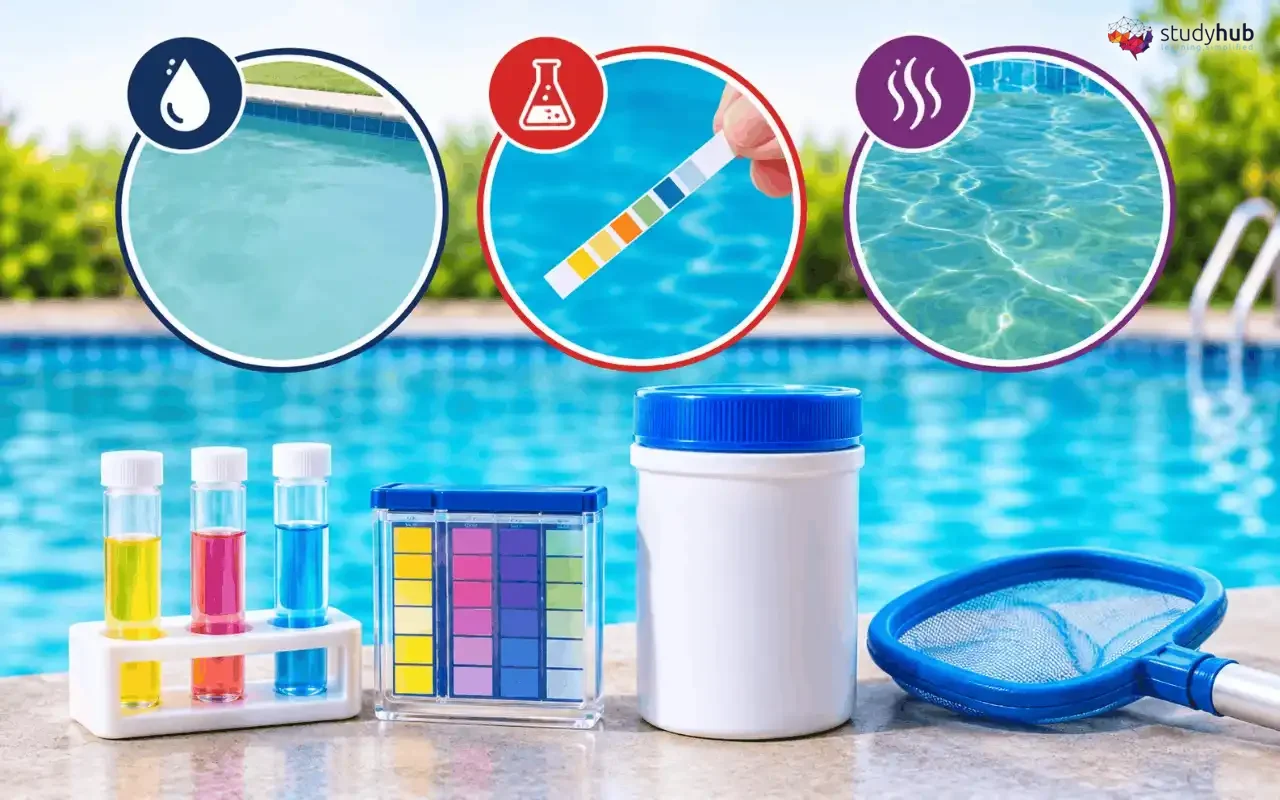
Pool water may become cloudy, develop a strong smell or show unstable pH readings even when regular maintenance is carried out.
These problems can have several causes. Check the water and treatment equipment before choosing a corrective action.
Why Is My Swimming Pool Water Cloudy?
Cloudy water can result from poor filtration, incorrect chemical balance, high swimmer use or fine particles in the water.
Start by checking:
- Free chlorine and pH.
- Filter condition and water circulation.
- Total alkalinity and calcium hardness.
- Whether the water has been tested correctly.
Avoid adding several treatment products at once. Identify the likely cause before taking action.
If visibility is poor, keep swimmers out until the problem has been investigated and the water is suitable for use.
See PWTAG’s cloudy water guidance for further information.
Why Does My Pool pH Keep Changing?
Unstable pH can make it difficult to maintain suitable pool water conditions.
Possible causes include:
- Low or unsuitable total alkalinity.
- Incorrect chemical dosing.
- Faulty automatic dosing equipment.
- Inaccurate test results.
- Changes in the source water.
Check the alkalinity and dosing system before making further adjustments.
Repeated pH changes should be investigated rather than treated by adding more chemicals each time.
Why Does My Pool Smell Strongly of Chlorine?
A strong chlorine-like smell does not necessarily mean that the pool contains too much free chlorine.
It may indicate elevated combined chlorine, including chloramines formed when chlorine reacts with contaminants. However, high free chlorine, unsuitable pH and other water quality problems can also contribute to irritation and unpleasant smells.
Check free chlorine, combined chlorine and pH. If the smell or irritation continues, investigate the treatment system and follow the pool’s operating procedure.
PWTAG’s typical pool problems guidance explains possible causes and corrective checks.
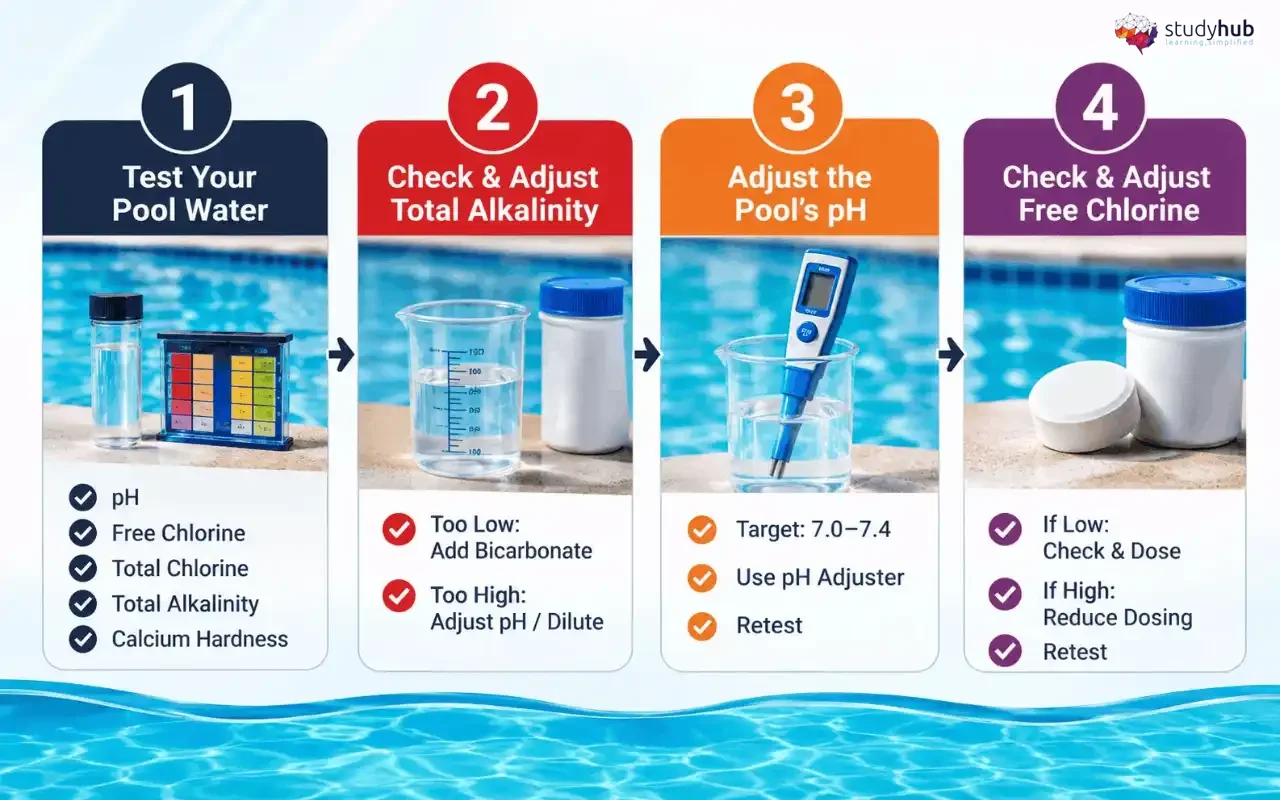
What Is The Correct Order For Balancing Pool Water?
There is no single chemical adjustment order suitable for every swimming pool. However, a consistent testing routine can help prevent unnecessary changes.
For beginners, a sensible approach is:
- Test the water: Measure free chlorine, total chlorine, pH and other required parameters.
- Check the equipment: Confirm that filtration, circulation and dosing systems are working.
- Review alkalinity: Investigate readings that may affect pH stability.
- Correct pH: Follow the approved treatment procedure for your pool.
- Review chlorine: Check that the disinfectant level meets the pool’s operating target.
- Assess hardness: Consider calcium hardness and the overall water balance.
- Retest: Confirm the readings before allowing swimmers to return.
Never mix chlorine products with acids. Mixing incompatible pool chemicals can release dangerous gases or cause other hazardous reactions.
The Health and Safety Executive’s swimming pool guidance explains important responsibilities for managing pool safety.
How Often Should You Test Swimming Pool Chlorine Levels?
Regular testing helps identify problems before they become more serious.
For public swimming pools, testing frequency should follow the current PWTAG guidance, the pool’s risk assessment and its documented operating procedures. Testing may be required before opening, during operating hours and after closing.
Private pool owners should follow the equipment manufacturer’s instructions and test more frequently after:
- Heavy swimming use.
- Hot weather or strong sunlight.
- Rainfall or significant water replacement.
- Chemical treatment changes.
- Unusual smells or changes in water appearance.
Keep a record of the date, free chlorine, total chlorine, pH and any other required measurements. Record the action taken when a result falls outside the target range.
Regular records make it easier to identify repeated problems and review whether the treatment system is working properly.
For wider cleaning and maintenance advice, see our Swimming Pool Maintenance Guide.
Get the free Pool Water Testing Log
A 5-page printable PDF to record chlorine and pH readings, the action you take, and quick PWTAG reference points.
Learn More About Pool Water Maintenance With StudyHub
Understanding swimming pool chlorine levels becomes easier when you know how water chemistry, filtration and cleaning routines work together.
StudyHub’s Pool Maintenance course introduces general pool maintenance topics, including:
- Water quality and chemical balance.
- Pool cleaning methods.
- Maintenance equipment.
- General pool safety.
The flexible online course can help beginners build general knowledge before taking on practical pool maintenance responsibilities.
However, introductory online training does not replace site-specific instruction, professional pool plant training or the competence required for operating a public swimming pool.
Build Your Pool Maintenance Knowledge with Studyhub
Learn maintenance equipment, cleaning, water chemistry, water quality and pool safety at your own pace, fully online.
- 5 modules, from Maintenance Equipment to Pool Safety
- Study online with unlimited access
- Weekday one-to-one support from professionals
★ 4.9/5 (17 reviews)👥 65 students🎓 CPD accredited∞ Unlimited access
Final Thoughts
Understanding swimming pool chlorine levels in the UK is an important part of maintaining suitable water quality. Free chlorine, combined chlorine and pH all affect how well a pool’s disinfection system works.
Start with accurate testing and compare the results with the correct operating targets for your pool. Check the treatment equipment, investigate unusual readings and make adjustments only through an approved procedure.
Remember that chlorine is only one part of pool water management. Filtration, circulation, water balance and regular monitoring also play important roles.
A consistent maintenance routine helps pool operators identify problems early and maintain suitable conditions for swimmers.
Frequently Asked Questions
What Are The Recommended Swimming Pool Chlorine Levels In The UK?
There is no single chlorine level for every pool. Published UK guidance gives an indicative free chlorine range of around 0.75–3 mg/L for conventional pools using hypochlorite, subject to the pool’s operating conditions and satisfactory microbiological quality. Always follow the relevant PWTAG guidance and site operating procedures.
What Is The Difference Between Free Chlorine And Combined Chlorine?
Free chlorine is available for disinfection. Combined chlorine forms when chlorine reacts with contaminants such as ammonia and other substances in the water. Both measurements help operators assess pool water quality.
What Is The Recommended pH Level For A Swimming Pool?
PWTAG recommends a pH range of 7.0–7.4 for pools using chlorine-based disinfectants, ideally 7.0–7.2 for improved disinfectant activity. The correct target should follow the pool’s treatment system and operating procedure.
How Do I Calculate Combined Chlorine?
Subtract free chlorine from total chlorine.
Combined Chlorine = Total Chlorine − Free Chlorine
For example, if total chlorine is 2.0 mg/L and free chlorine is 1.6 mg/L, combined chlorine is 0.4 mg/L.
Why Does My Swimming Pool Smell Strongly Of Chlorine?
A strong chlorine-like smell may be linked to combined chlorine, including chloramines. High free chlorine, unsuitable pH and other water quality problems can also cause irritation. Test the water and investigate the cause rather than assuming that more chlorine is needed.
How Often Should I Test Pool Chlorine Levels?
Public pools should follow their documented monitoring procedures and current PWTAG guidance. Domestic pool owners should follow their testing equipment manufacturer’s instructions and check more frequently after heavy use, hot weather or chemical treatment changes.
Can I Swim Immediately After Adding Chlorine?
Not necessarily. Follow the chemical manufacturer’s instructions and the pool’s operating procedure. Allow the required circulation time, retest the water and reopen the pool only when all relevant operating conditions have been met.
- All Courses
- IT & Software390
- Management287
- Teaching and Education250
- Business245
- Health and Fitness227
- Engineering & Technology180
- Health & Safety163
- Health and Social Care144
- Quality Licence Scheme139
- Healthcare137
- Accounting & Finance130
- Psychology112
- Employability112
- Lifestyle105
- Marketing75
- Office Productivity74
- Animal Care63
- Design and Photography55
- Design50
- Beauty & Makeup49
- Accounting & Bookkeeping34
- Web Development27
- Construction26
- Writing20
- Child Care17
- Digital Marketing13
- Environment10
- Bundle8
- Coaching6
- Agriculture5

Awarded By


0 responses on "Swimming Pool Chlorine Levels in the UK Explained"