


Could the clinical coding course you choose give you useful knowledge but a different certificate from the one you expected? Before enrolling, it helps to understand what those certificate labels actually mean.
When comparing beginner clinical coding courses, you will often see QLS endorsement, CPD accreditation and the National Clinical Coding Qualification (NCCQ). These serve different purposes, and knowing the difference can help you choose with confidence.
Are you exploring healthcare, building your knowledge or preparing for professional progression? Your starting point matters.
This guide compares beginner clinical coding courses by recognition, content and next steps. We also explore common questions: “Will AI replace clinical coders?”, “how much do clinical coders earn?” and which training is “best for medical coding?”
For the wider picture, explore our clinical coding courses UK guide.
QLS vs CPD vs NCCQ at a Glance
QLS endorsement and CPD accreditation relate to learning provision. The NCCQ assesses professional clinical coding competence. They are not equivalent qualifications.
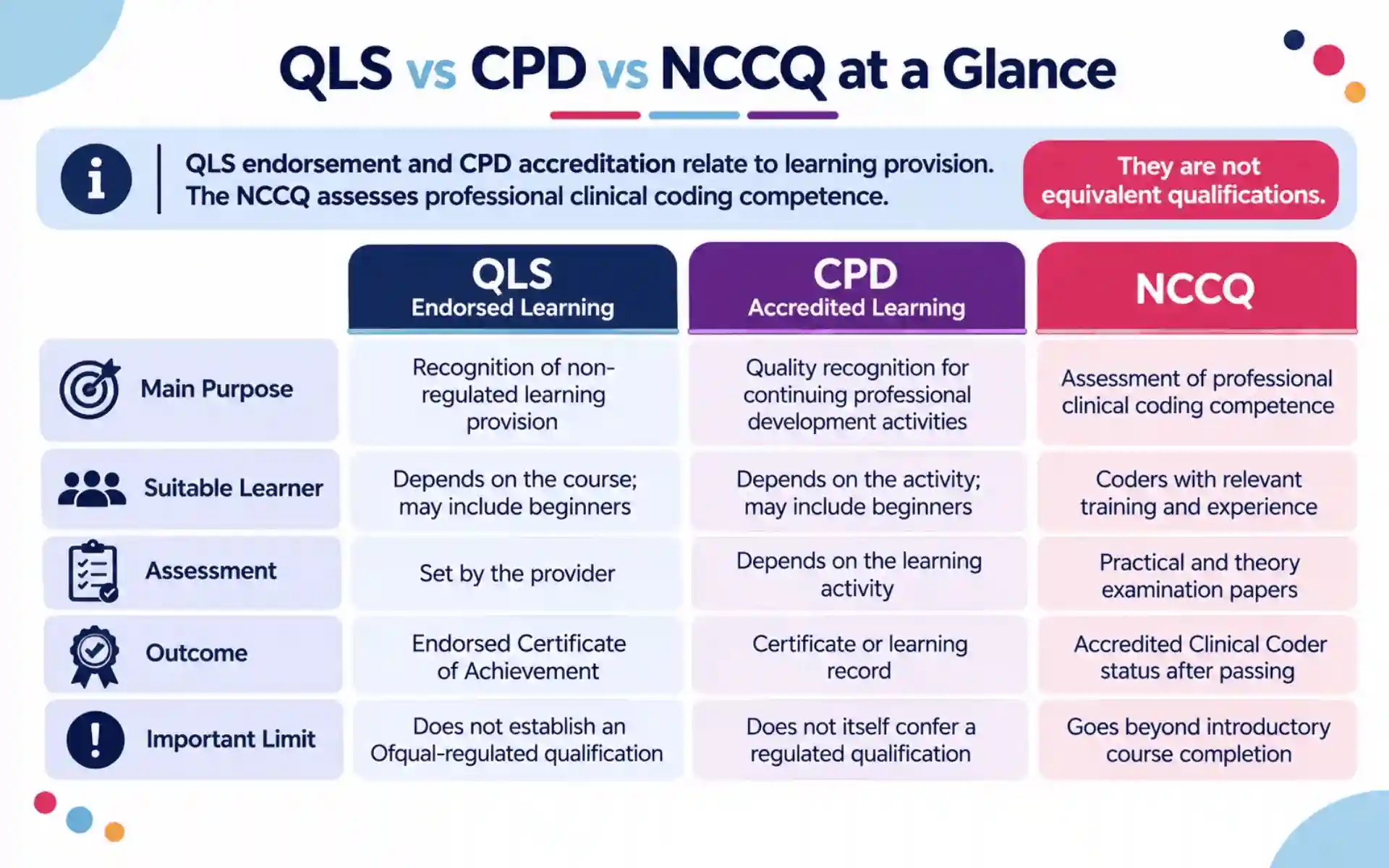
When comparing beginner clinical coding courses, start with what each label actually tells you.
| Comparison | QLS-Endorsed Learning | CPD-Accredited Learning | NCCQ |
|---|---|---|---|
| Main purpose | Recognition of non-regulated learning provision | Quality recognition for continuing professional development activities | Assessment of professional clinical coding competence |
| Suitable learner | Depends on the course; may include beginners | Depends on the activity; may include beginners | Coders with relevant training and practical experience |
| Assessment | Set by the provider | Depends on the learning activity | Practical and theory examination papers |
| Outcome | Endorsed Certificate of Achievement | Certificate or learning record specified by the provider | Accredited Clinical Coder status after passing |
| Important limit | Does not establish an Ofqual-regulated qualification | Does not itself confer a regulated qualification | Goes beyond introductory course completion |
The Quality Licence Scheme’s learner guidance explains its non-regulated status. The CPD Standards Office distinguishes independent CPD accreditation from regulated qualifications, while NHS Wales explains the NCCQ and ACC status.
A course can carry both QLS endorsement and CPD accreditation. You therefore do not always need to choose between those two labels.
Medical Coding Certification: Clinical Coding Online Course at QLS Level 3
Work through ICD-10 5th Edition, OPCS-4 and SNOMED CT in about 14 hours of self-paced online study, with tutor support on weekdays.
What Does QLS Mean for Beginner Clinical Coding Courses?
QLS stands for the Quality Licence Scheme. It recognises learning provision in the non-regulated market through its quality processes.
For beginner clinical coding courses, QLS endorsement can provide useful information about the provision’s quality assurance. However, it does not make the course an Ofqual-regulated qualification.

Is QLS Level 3 the Same as a Regulated Level 3 Qualification?
No. A course described as “QLS Level 3” should not automatically be treated as equivalent to an Ofqual-regulated Level 3 qualification.
QLS explains that providers determine course levels through appropriate benchmarking. Its endorsed courses do not carry formal credit values that automatically transfer to university or further education.
If you need a certificate for a particular job or progression route, ask the employer or receiving institution whether it meets their requirements.
Where Does StudyHub’s Course Fit?
StudyHub’s beginner clinical coding training is described as QLS-endorsed, non-regulated provision.
Its published curriculum covers clinical terminology, records confidentiality, ICD-10, introductory OPCS-4 and SNOMED CT, alongside legal and ethical principles. The page lists no prior qualification or experience requirement, self-paced study and a written assignment.
If you are researching an online Clinical Coding Course, this provides an introductory option to examine. Check the current syllabus, support arrangements and separate certificate charges before enrolling.
As with other beginner clinical coding courses, completing it should not be confused with gaining ACC status or meeting every requirement for an NHS coding role.
What Does CPD Accreditation Mean?
CPD stands for continuing professional development. It describes learning that helps people maintain or develop their knowledge and skills.
Some beginner clinical coding courses carry independent CPD accreditation. This generally concerns the quality of the learning activity against the accrediting organisation’s criteria.
However, “CPD” is not the name of one universal awarding body. Different organisations offer accreditation, so check the organisation named on the course page.
What Should You Check Before Paying?
When comparing beginner clinical coding courses with CPD claims, ask:
- Which organisation accredits the learning?
- Does the accreditation cover this specific course?
- What assessment and feedback are included?
- What certificate will you receive?
- Are certificate charges included in the advertised price?
CPD accreditation alone does not establish professional clinical coding competence. Likewise, a certificate showing that you completed learning is different from an assessment of your ability to code workplace records accurately.
For an online Clinical Coding Course, the content, assessment and support matter alongside the certificate label.
What Is the NCCQ?
The NCCQ is the National Clinical Coding Qualification. Candidates who pass its practical and theory examination papers gain Accredited Clinical Coder status and can use the letters ACC.
Unlike beginner clinical coding courses, the NCCQ assesses professional competence developed through relevant training and practical experience.
IHRIM’s NCCQ guidance describes a typical two-to-three-year development plan for novice NHS coders. This combines learning, workplace experience and preparation for the examinations.
Do You Need an Introductory Course Before Applying for Trainee Jobs?
Do not assume that every trainee vacancy requires a privately purchased course. Read the employer’s essential and desirable criteria before spending money.
Introductory study may help you understand the subject and decide whether it interests you. Employers also assess applicants against their own requirements and provide role-specific training arrangements.
In England, NHS clinical coding training guidance requires eligible novice coders to start the Clinical Coding Standards Course within six months of employment.
When deciding which route is “best for medical coding?”, match the learning to the role and healthcare system you intend to work in.
Career concerns matter too. If you are asking “how much do clinical coders earn?”, compare actual vacancies and current pay bands. If your concern is “Will AI replace clinical coders?”, examine how employers use automation alongside professional judgement. Neither question can be answered by a certificate label alone.
How to Compare Beginner Clinical Coding Courses Before Enrolling
The most useful beginner clinical coding courses explain what you will learn, how your work is assessed and what the certificate represents. Compare these details before choosing by price or course title.
Check the Curriculum and Current Coding Standards
An online Clinical Coding Course should clearly describe its subject coverage. Look for the following areas:
| Subject | What to Check |
|---|---|
| Medical terminology | Explanations of common clinical terms and abbreviations |
| Clinical records | How information is recorded, reviewed and handled confidentially |
| ICD-10 | Diagnosis classification, coding conventions and standards |
| OPCS-4 | An introduction to classifying interventions and procedures |
| SNOMED CT | Its role as clinical terminology and how it differs from classifications |
| Professional responsibilities | Accuracy, confidentiality and ethical practice |
Ask which versions of the classifications and standards the materials address. OPCS-4.11 was implemented in England from 1 April 2026, according to the NHS information standard.
StudyHub’s public syllabus lists OPCS-4 without a version number. Check with the provider if you need confirmation of specific version coverage.

Look Beyond the Certificate
When reviewing beginner clinical coding courses, ask how the learning helps you understand the subject.
Are there sample records or exercises? Does the assessment test understanding? Can you ask a tutor to explain mistakes?
A written assignment, a completion certificate and supervised workplace practice serve different purposes. Check exactly what is included rather than assuming that one replaces another.
Compare the Full Cost
The advertised fee may not include every certificate option. Before paying, check tuition, assessment charges, certificate fees and access terms.
An online Clinical Coding Course may suit your schedule, but its value depends on the learning and support you actually receive.
How Much Do Clinical Coders Earn?
If you are asking “how much do clinical coders earn?”, start with the vacancy’s pay band, location and experience requirements.
For NHS roles in England, the published 2026/27 Agenda for Change base salaries include:
| NHS Pay Band | Annual Base Salary |
|---|---|
| Band 3 | £25,760–£27,476 |
| Band 4 | £28,392–£31,157 |
| Band 5 | £32,073–£39,043 |
These figures come from NHS Employers’ 2026/27 pay scales. They exclude higher cost area supplements. Other UK nations have separate pay arrangements.
These bands are reference points, not guaranteed outcomes from beginner clinical coding courses. Employers determine the band attached to each role.
For a practical example, North Cumbria’s November 2026 trainee advert described Band 3 entry, a development programme and Band 4 on accreditation. Other employers may use different arrangements.
When comparing career routes, “how much do clinical coders earn?” is therefore best answered through current job descriptions alongside the relevant pay scales.
Will AI Replace Clinical Coders?
AI can support parts of clinical coding, but current evidence does not establish that it will replace every clinical coder.

Tools may help find relevant documents, highlight conditions and suggest possible codes. Those suggestions still need appropriate checks.
For example, Digital Health and Care Wales describes a Clinical Coding Workbench designed to assist coding teams. Its approach allows trained coders to review, change or reject suggestions before final decisions.
If you are wondering “Will AI replace clinical coders?”, consider how the work may change as well as which tasks may become automated. Understanding records, checking evidence and applying standards remain useful learning priorities.
Choose beginner clinical coding courses that explain the reasoning behind coding decisions. Learning terminology alone gives you less context for spotting incomplete information or questioning an unsuitable suggestion.
Which Training Route Is Best for Your Goal?
The question “Which course is best for medical coding?” needs a clear starting point: where do you want to work, and what do you need to learn?
UK clinical coding and US medical coding do not use identical training routes or classification systems. A course aimed at US billing and CPC preparation should not automatically be treated as preparation for NHS clinical coding.
| Your Situation | Sensible Next Step |
|---|---|
| You are exploring the subject | Compare introductory content, support and total cost |
| You want to apply for trainee jobs | Read employer requirements and training arrangements |
| You already work in clinical coding | Discuss development and NCCQ preparation with your employer |
| You want to work internationally | Check the destination country’s systems and employer requirements |
When deciding which option is “best for medical coding?”, match the course to your intended role rather than choosing the most impressive certificate label.
For the wider UK training picture, explore our clinical coding courses UK guide.
Choose Your Next Step in Clinical Coding With Confidence
Choosing between beginner clinical coding courses starts with understanding your goal. QLS endorsement and CPD accreditation can help you assess learning provision, while the NCCQ represents a different stage of professional development.
If you are ready to build your knowledge, StudyHub’s online clinical coding course offers structured introductory study. Its curriculum covers medical terminology, clinical records, ICD-10, introductory OPCS-4 and SNOMED CT, alongside legal and ethical principles.
The course page lists self-paced learning, weekday tutor support and a written assignment. The provision is QLS-endorsed and non-regulated, with separately priced certificate options.
Before enrolling, review the syllabus, current fees and assessment details. Choose learning that matches your starting point, then check the workplace training and qualifications needed for your intended role.
Medical Coding Certification: Clinical Coding Online Course at QLS Level 3
Frequently Asked Questions
No. QLS endorsement does not establish Ofqual-regulated qualification status. The QLS learner FAQs explain that its endorsed learning is non-regulated. Check directly with an employer or education provider if you need a particular qualification.
A CPD certificate alone does not establish that you meet every requirement for an NHS clinical coding job. Employers set their own recruitment criteria. Check whether a vacancy is for a trainee or an experienced coder and what training or qualifications it requires.
You can study terminology and introductory concepts independently. However, professional competence also requires applying relevant standards, receiving feedback and gaining appropriate experience. Beginner clinical coding courses can organise your learning, while workplace training develops role-specific skills.
Learning the basics and becoming professionally competent are different goals. Introductory course lengths vary. IHRIM describes a typical two-to-three-year development plan for novice NHS coders preparing for the NCCQ through training and practical experience.
Some beginner clinical coding courses accept learners without medical experience. StudyHub lists no prior qualification or experience requirement. However, course entry requirements differ from the requirements for NHS trainee roles.
Yes. QLS endorsement and CPD accreditation serve different purposes and can apply to the same course. Check the named organisations and certificate details. Neither label alone makes the course equivalent to the NCCQ.
- All Courses
- IT & Software389
- Management287
- Teaching and Education250
- Business245
- Health and Fitness227
- Engineering & Technology180
- Health & Safety163
- Health and Social Care144
- Quality Licence Scheme139
- Healthcare137
- Accounting & Finance130
- Psychology112
- Employability112
- Lifestyle105
- Marketing75
- Office Productivity74
- Animal Care63
- Design and Photography55
- Design50
- Beauty & Makeup49
- Accounting & Bookkeeping34
- Web Development27
- Construction26
- Writing20
- Child Care17
- Digital Marketing13
- Environment10
- Bundle8
- Coaching6
- Agriculture5
Awarded By