


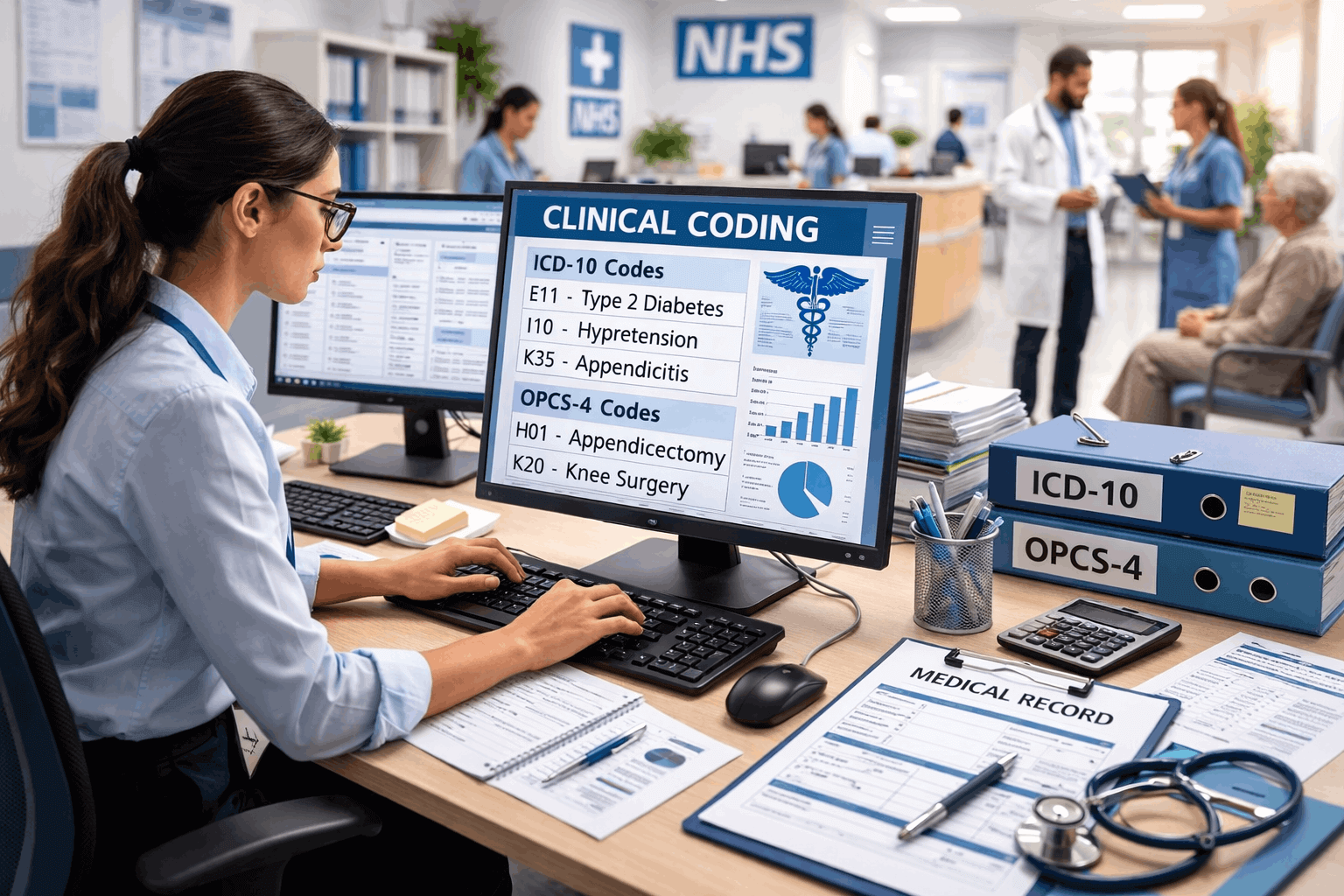
What turns a doctor’s written diagnosis into structured NHS data? And how does a simple condition become a coded record used for funding and reporting? A Clinical Coding Career UK begins with understanding that clinical coding means converting medical terms into standard classification codes such as ICD-10 and OPCS-4. For example, Type 2 diabetes mellitus is coded as E11 in ICD-10. Similarly, acute appendicitis is coded as K35. These codes ensure consistency across NHS systems. Therefore, accurate classification is essential. In a Clinical Coding Career UK, learning how diseases translate into official codes is the foundation of professional practice.
If you are considering this path, you need clear information. This guide explains how clinical coding works, how much NHS clinical coders earn, what NCCQ means, and how you can build a long-term career step by step.
Table of Contents
Understanding What a Clinical Coding Career UK Involves
Before thinking about salary or qualifications, it is important to understand the role itself. A Clinical Coding Career UK focuses on translating medical records into nationally recognised codes. These codes follow official classification systems used across the NHS.
The main systems include:
ICD-10 – for diagnoses
OPCS-4 – for procedures
SNOMED CT – for clinical terminology
These classifications are explained by NHS Digital in their clinical coding documentation.
In simple terms, clinical coders read discharge summaries, operation notes, and clinic letters. Then, they apply the correct codes according to national standards. Because funding and reporting depend on those codes, accuracy is essential.
Therefore, a Clinical Coding Career UK is structured, rule-based, and detail-focused. It is not guesswork. It is professional data interpretation within a healthcare setting.
Why this career is growing across the UK
NHS systems rely more on digital records now. Additionally, reporting demands have increased. Therefore, trusts need more trained coding staff.
Also, coding teams face regular audits. So the NHS needs people who can code safely and consistently. A Clinical Coding Career UK benefits from this reality. Demand stays steady because hospitals always need coded data.
Moreover, many experienced coders are nearing retirement. As a result, trainee and junior roles appear often. That means entry routes are clearer than before.
If you want to see real vacancy patterns, check NHS Jobs here: https://www.jobs.nhs.uk
In short, demand is rising because data has become essential, not optional. That is why a Clinical Coding Career UK is a stable choice.
What Clinical Coders Do in Their Everyday Life
To understand how coding fits into NHS systems, it helps to look at a normal working day. A Clinical Coding Career UK is structured around reviewing records, applying classifications, and ensuring national reporting accuracy. Below is a practical breakdown of daily responsibilities, inspired by NHS Digital guidance on classifications and terminology.
1. Reviewing Patient Documentation Carefully
Each day begins with accessing patient records. These include discharge summaries, operation notes, and clinic letters. The clinical coder reads the documentation thoroughly.
For example, if a doctor records Type 2 diabetes mellitus, the coder must confirm the diagnosis details. According to ICD-10 classification, this condition is coded as E11.
Therefore, attention to wording is critical. If the documentation is unclear, the coder may raise a clinical query for clarification. Accuracy always comes first.
2. Identifying Diagnoses Using ICD-10
After reviewing the notes, the coder identifies the main diagnosis and any secondary conditions. These are classified using ICD-10, the international standard adopted by the NHS.
For instance:
Acute appendicitis → ICD-10 code K35
Essential (primary) hypertension → ICD-10 code I10
However, coding is not just matching words. The coder must follow sequencing rules. The primary diagnosis must reflect the main reason for treatment. Therefore, clinical judgement within coding standards is required.
3. Assigning Procedures Using OPCS-4
If surgery or procedures were performed, the coder applies OPCS-4 codes.
For example:
Appendicectomy → OPCS-4 code H01
These procedure codes ensure hospitals record surgical activity correctly. Consequently, procedure coding directly influences NHS activity reporting and funding models.
4. Checking Terminology and Classification Rules
Clinical coders do not work in isolation. They use official NHS classification manuals and digital coding systems.
According to NHS Digital documentation, classifications like ICD-10 and OPCS-4 are structured systems designed to standardise data across healthcare settings.
Therefore, coders must check inclusion notes, exclusion notes, and cross-references before finalising codes. This prevents errors and maintains compliance.
5. Entering Data into NHS Information Systems
Once codes are confirmed, they are entered into hospital information systems.
This step connects patient care to national reporting. The workflow often looks like this:
					Patient Care
      ↓
Clinical Notes Written
      ↓
Coder Reviews & Classifies
      ↓
Codes Entered into NHS System
      ↓
National Data Reporting
      ↓
Funding & Audit Review
Because coding links medical care to financial and statistical systems, accuracy remains essential.
6. Supporting Audits and Quality Checks
Clinical coders often review past cases during audits. Senior coders may check for consistency and guideline compliance.
If discrepancies are found, corrections are made. Therefore, quality assurance is part of everyday responsibility in a Clinical Coding Career UK.
7. Staying Updated with Coding Standards
Coding standards change regularly. NHS Digital releases updates and guidance.
Therefore, coders dedicate time to learning new rules, classification updates, and national changes. Continuous development ensures professional competence.
Why This Daily Workflow Matters
Because clinical coding sits between patient care and national reporting, it directly affects funding, research data, and service planning. If codes are incomplete, NHS data becomes unreliable.
As digital health systems continue to expand, skilled professionals remain essential. Therefore, a Clinical Coding Career UK offers structured daily responsibilities, clear standards, and long-term stability within the NHS framework.

NHS Clinical Coder Salary in the UK
Salary is one of the most common questions. NHS clinical coders are paid under the Agenda for Change pay framework. Official band pay scales are published here: https://www.nhspayband.uk/.
Clinical coding roles typically fall into these bands:
Band | Typical Position | Approximate Annual Salary Range |
Band 3 | Trainee Clinical Coder | £22,000 – £24,000 |
Band 4 | Accredited Clinical Coder | £25,000 – £27,000 |
Band 5 | Senior Clinical Coder | £28,000 – £34,000 |
Band 6 | Team Leader / Auditor | £35,000 – £42,000 |
However, salaries vary by region. London weighting increases pay. In addition, private healthcare providers may offer different packages.
Importantly, salary growth is linked to competence and accreditation. Therefore, in a Clinical Coding Career UK, progression is structured rather than random.
Steps to Building a Clinical Coding Career UK
A career does not start with promotion. It starts with preparation. Below is a clear seven-step pathway that reflects real NHS progression.
Step 1: Understand Medical Terminology
Before learning codes, you must understand medical language because coding requires interpreting clinical notes accurately.
Foundation knowledge includes:
Anatomy basics
Common conditions
Procedure terminology
Structured online learning helps at this stage. For example, Studyhub offers introductory medical coding courses at QLS Level 3. These build essential understanding before you enter NHS systems.
Starting with fundamentals reduces confusion later in your Clinical Coding Career UK.
Step 2: Learn ICD-10 and OPCS-4 Classifications
After terminology, you must understand coding classifications. ICD-10 covers diagnoses. OPCS-4 covers procedures.
These systems follow strict rules. Therefore, training is essential. Studyhub’s Certificate in Medical Coding – ICD-10-CM supports structured learning of diagnostic coding principles.
Because NHS coding follows national standards, familiarity with classification manuals strengthens applications.
Step 3: Develop Practical Coding Confidence
Understanding theory is one part. Applying it is another.
Practical confidence involves:
Reading discharge summaries
Identifying primary diagnoses
Applying sequencing rules
Avoiding common errors
Studyhub’s Diploma in Learn Medical Coding Using 3M Software introduces workflow systems often used in hospitals. While not a replacement for NHS training, it builds confidence in structured environments.
Confidence reduces errors early in your Clinical Coding Career UK.
Step 4: Apply for NHS Trainee Roles
Once you have foundation knowledge, you can apply for trainee positions. Vacancies are listed on NHS Jobs: https://www.jobs.nhs.uk
At this stage, employers look for:
Attention to detail
Basic coding knowledge
Understanding of confidentiality
Commitment to professional standards
Entry roles usually begin at Band 3. However, structured training improves your application strength.
Step 5: Gain Workplace Experience
After securing a trainee role, real learning begins. NHS coding teams provide supervised practice.
During this phase, you will:
Code real patient episodes
Receive feedback
Learn national standards
Prepare for accreditation
Experience builds credibility in a Clinical Coding Career UK. Without practice, progression slows.
Step 6: Prepare for NCCQ
The National Clinical Coding Qualification (NCCQ) confirms professional competence. It is awarded by IHRIM:
https://ihrim.co.uk/education-and-cpd/uk-students/nccq
Most coders attempt NCCQ after two to three years of experience. Passing NCCQ often supports Band 4 progression and beyond.
Preparation includes revision, standards review, and consistent coding accuracy.
NCCQ is not mandatory at entry. However, it is a respected milestone in a Clinical Coding Career UK.
Step 7: Progress to Senior and Audit Roles
With experience and accreditation, progression continues.
Senior coders may:
Handle complex cases
Support junior staff
Participate in audits
Lead coding quality checks
Band 6 roles often involve leadership and compliance oversight.
Therefore, long-term growth in a Clinical Coding Career UK is structured and measurable.
Access the course library of 3000+ courses for just £149 for a lifetime!

Skills That Strengthen a Clinical Coding Career UK
Technical knowledge alone is not enough. Employers also value:
Accuracy under pressure
Logical thinking
Ability to follow standards
Strong written communication
Confidentiality awareness
Moreover, consistency matters more than speed at early stages.
Because coding errors affect funding, careful work builds trust.
Challenges, Rewards, and Who This Career Suits
Every career has two sides. On one side, there are pressures and learning curves. On the other, there is growth and stability. A Clinical Coding Career UK is no different. However, understanding both sides early helps you decide with confidence.
The Challenges You Should Expect
High Accuracy Required
You must follow strict standards like ICD-10 and OPCS-4.
Even small coding errors can affect hospital funding and reports.Complex Medical Language
Clinical notes often contain detailed medical terms.
However, with practice and training, understanding improves steadily.Working to Deadlines
Coding teams work within reporting timeframes.
Therefore, you must balance speed with careful checking.Regular Updates to Standards
Coding rules change over time.
As a result, continuous learning is part of a Clinical Coding Career UK.
The Rewards That Make It Worthwhile
Structured Salary Progression
NHS pay bands allow steady growth.
As skills increase, earning potential improves.Long-Term Job Stability
Healthcare data is always needed.
Therefore, demand for skilled coders remains consistent.Professional Recognition
Achieving NCCQ boosts credibility.
Consequently, promotion opportunities become stronger.Meaningful NHS Contribution
You support healthcare systems without direct patient care.
Your work still impacts funding and service planning.
Who This Career Suits Most
A Clinical Coding Career UK is ideal for individuals who:
Prefer organised and rule-based work
Pay attention to detail
Feel comfortable reading and analysing documents
Work well independently
Value stability over unpredictability
Additionally, it suits career changers from administrative, data, or healthcare support backgrounds. Because the role is skill-based rather than degree-dependent, entry is possible with the right training.
However, if you dislike desk-based roles or struggle with concentration, this career may feel restrictive. It requires focus for long periods.
In conclusion, a Clinical Coding Career UK suits careful thinkers who appreciate structure and long-term growth. While it demands discipline, it rewards consistency. For the right person, it offers a balanced mix of challenge and stability within the NHS framework.
Final Thoughts
A Clinical Coding Career UK offers structured growth, clear salary progression, and professional recognition. While it is not a patient-facing role, it directly supports healthcare delivery.
Because NHS systems depend on accurate coded data, skilled coders remain essential. With proper preparation, entry into the field is achievable. Studyhub provides structured foundational training for those beginning their journey, while NHS workplace experience develops advanced skills.
If you value precision, structure, and long-term progression, then a Clinical Coding Career UK may be a strong choice.
FAQs
NHS clinical coders usually start at Band 3 (£22,000–£24,000). With experience and accreditation, they can progress to Band 4–6 (£25,000–£42,000+) depending on role and region.
Yes, it offers stable NHS employment and structured salary progression. It suits people who prefer detailed, office-based healthcare work.
Start by learning medical terminology and ICD-10 coding basics. Then apply for NHS trainee roles and gain experience toward accreditation like NCCQ.
Most trainee coders start at Band 3. Accredited and senior coders usually work at Band 4–6, depending on responsibility.
AI can assist with coding suggestions. However, human coders are still needed for accuracy, complex cases, and compliance checks.
It can feel challenging at the beginning due to medical terminology. However, with training and practice, it becomes structured and manageable.
- All Courses
- IT & Software378
- Management277
- Teaching and Education249
- Business234
- Health and Fitness213
- Health & Safety160
- Engineering & Technology151
- Quality Licence Scheme138
- Health and Social Care137
- Healthcare131
- Accounting & Finance126
- Employability105
- Psychology100
- Lifestyle92
- Marketing75
- Office Productivity65
- Animal Care56
- Design and Photography53
- Design44
- Beauty & Makeup42
- Accounting & Bookkeeping34
- Web Development27
- Writing20
- Construction15
- Digital Marketing13
- Child Care11
- Environment9
- Bundle8
- Agriculture5
- Coaching1

Awarded By


0 responses on "Clinical Coding Career UK: Salary, Training, NCCQ & NHS Job Guide"