


Could you start learning clinical coding today and what would stand between you and your first trainee role? The answers may be different.
Some introductory courses welcome complete beginners, while employers may ask for specific qualifications, computer skills and a commitment to further training. Understanding clinical coding course requirements helps you spot that difference before investing your time and money.
Perhaps you are changing careers, returning to learning or exploring healthcare work. Wherever you begin, knowing what is essential and what is simply helpful makes your next step clearer.
This guide compares clinical coding course requirements with the criteria for clinical coding jobs. It also explains what to check about Clinical Coding Certification and Clinical Coding Course Cost before enrolling.
For an overview of training routes, explore our clinical coding courses UK guide.
Medical Coding Certification: Clinical Coding Online Course at QLS Level 3
Work through ICD-10 5th Edition, OPCS-4 and SNOMED CT in about 14 hours of self-paced online study, with tutor support on weekdays.
What Are Clinical Coding Course Requirements?
Clinical coding course requirements depend on the provider and the level of training. Some introductory courses accept learners without previous qualifications or coding experience. Professional training and job vacancies have different conditions.
For example, StudyHub’s beginner clinical coding course lists no prior qualification or experience requirement. Its published prerequisites specify an internet connection and a compatible device.
This means you can explore the subject without already working as a coder. It does not mean that completing the course meets every employer’s recruitment criteria.
Before enrolling, check clinical coding course requirements on the individual course page rather than relying on the course title alone.
Course Requirements vs Clinical Coding Job Requirements
The main difference is purpose: course requirements determine whether you can join the learning, while job requirements determine whether you meet an employer’s criteria.
| Area | Introductory Course | Trainee Job | Experienced Job |
|---|---|---|---|
| Qualifications | Set by the provider; some accept beginners | May include GCSEs or equivalent qualifications | May include professional qualifications |
| Coding experience | May not be required | Some roles accept applicants without it | Relevant experience may be essential |
| Computer skills | Needed to access online materials | Accurate computer use and data entry may be assessed | Relevant systems knowledge may be required |
| Assessment | Depends on the course | Recruitment process and workplace development | Evidence of competence and experience |
| Next step | Further learning or exploring opportunities | Supervised training and study | Independent or specialist responsibilities |
Meeting clinical coding course requirements does not automatically make you eligible for clinical coding jobs. Always read the person specification attached to the vacancy.
Likewise, do not assume that you must buy a private course before applying. Some trainee posts recruit applicants without previous coding experience and provide structured training.
Can You Study Clinical Coding Without Medical Experience?
Yes, some introductory courses allow you to start without a medical background. However, clinical coding course requirements vary, so check before enrolling.
StudyHub’s course introduces medical terminology, clinical records, ICD-10, OPCS-4 and SNOMED CT. It also covers confidentiality and legal and ethical principles.
You do not need to understand every medical term before beginning an introductory course. You should, however, be willing to read carefully, check unfamiliar words and revisit difficult topics.
What Helps You Prepare for Online Study?
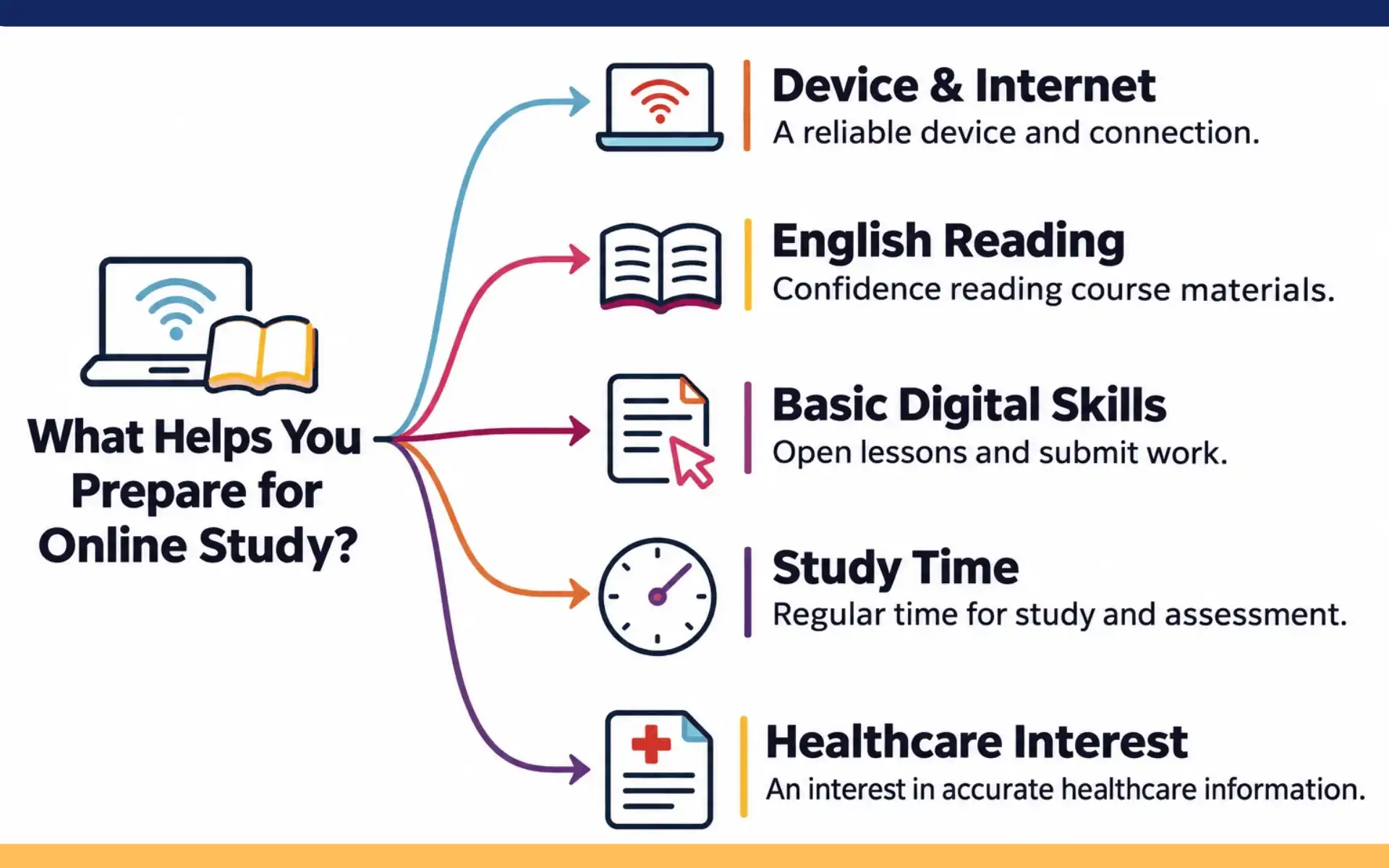
Alongside the published clinical coding course requirements, consider whether you have:
- A reliable device and internet connection.
- Enough confidence reading English to understand the materials.
- Basic skills for opening lessons and submitting work.
- Regular time for study and assessment.
- An interest in accurate healthcare information.
These are practical preparation points, rather than additional formal entry conditions stated by StudyHub.
The course page lists self-paced study, weekday tutor support and a written assignment. Review these details alongside the certificate options to judge whether the format suits you.
What Do Employers Require for Clinical Coding Jobs?
Employers set their own requirements. Some trainee vacancies accept people without coding experience but still ask for school qualifications, computer skills and a commitment to further study.
This is why clinical coding course requirements and recruitment criteria should be checked separately.
Qualifications for Trainee Clinical Coders
The following examples show how requirements can differ.
| Employer | Examples From Its 2026 Recruitment Information |
|---|---|
| Bolton NHS Foundation Trust | Five GCSEs at grade 4/C or above, including maths, English and biology or combined science |
| North Tees and Hartlepool NHS Foundation Trust | GCSE-level education or equivalent, including maths and English; anatomy, physiology and medical terminology qualifications listed as desirable |
Bolton’s trainee clinical coder advert stated that previous coding experience was unnecessary. The North Tees person specification separated essential qualifications from desirable ones.
These are examples of recruitment criteria, not a universal UK standard or confirmation that applications remain open.
Skills Employers May Look For
Qualifications are only part of the picture. Depending on the vacancy, employers may also assess:
- 1. Attention to detail and accurate data entry.
- 2. Clear written and spoken communication.
- 3. Ability to organise work and meet deadlines.
- 4. Understanding of patient confidentiality.
- 5. Willingness to complete training and continue learning.
Use examples from work, education or volunteering to demonstrate the skills requested. Follow the advert’s instructions about acceptable qualifications and equivalent experience.
What Types of Clinical Coding Jobs Are Available in the UK?
Clinical coding careers extend beyond one job title. There is no fixed national number of job types, because employers organise their teams differently. However, roles can be grouped into six useful categories.
| Job Type | Main Responsibilities | Typical Career Stage |
|---|---|---|
| Trainee Clinical Coder | Learns to review records and apply coding standards under supervision | Entry route; requirements vary by employer |
| Clinical Coder | Reviews clinical documentation and assigns diagnosis and procedure codes | Developing or established coding competence |
| Senior or Specialist Clinical Coder | Handles complex cases and supports colleagues with coding queries | Experienced coder |
| Clinical Coding Auditor | Checks coded records, identifies errors and recommends improvements | Experienced coder with relevant audit training |
| Clinical Coding Trainer | Teaches coding standards and supports staff development | Experienced coder with relevant training credentials |
| Team Leader or Clinical Coding Manager | Oversees staff, workloads, quality and service delivery | Experienced professional with leadership responsibilities |
The Skills England clinical coder standard identifies senior coding, supervision, training, audit and management as progression opportunities. Some employers combine responsibilities, such as trainer and auditor.
Why Does Foundational Learning Matter Across These Roles?
Whether someone assigns codes, checks accuracy or teaches colleagues, their work draws on clinical terminology, documentation and coding standards. Understanding these foundations helps learners see how different roles contribute to reliable healthcare information.
StudyHub’s online clinical coding course introduces medical terminology, clinical records, ICD-10, OPCS-4, SNOMED CT, confidentiality and ethical principles. These subjects provide background knowledge relevant to the wider profession.
For beginners exploring clinical coding jobs, the course offers a structured introduction before further training and experience. It is QLS-endorsed, non-regulated provision; it does not replace the NCCQ, supervised practice or specialist development for audit, training and management roles.

Which Roles Should Beginners Look For?
Start with trainee clinical coder vacancies and check each employer’s essential criteria. An entry-level title does not mean there are no qualification or skill requirements.
Compare those criteria with your existing experience and learning needs. Choose introductory study where it addresses a gap, while recognising that senior roles require further professional development.
What to Check Before Choosing Training
Once you understand clinical coding course requirements, look beyond whether you can enrol.
Check what Clinical Coding Certification you will receive, who issues it and what it demonstrates. A course certificate is different from Accredited Clinical Coder status, which follows passing the NCCQ examinations, as explained by IHRIM.
Also check the full Clinical Coding Course Cost, including optional certificates and any assessment charges.
The most useful next step is the one that addresses your actual learning needs or the requirements of the role you want.
Lorem ipsum dolor sit amet, consectetur adipiscing elit. Ut elit tellus, luctus nec ullamcorper mattis, pulvinar dapibus leo.
Which Clinical Coding Certification Do You Need?
The Clinical Coding Certification you need depends on your goal. An introductory certificate can record completed learning, while professional recognition involves a different assessment process.
Before choosing training, check what the certificate represents and whether it meets the requirements of your intended employer.
| Recognition | What It Means | What to Check |
|---|---|---|
| QLS endorsement | Recognition of non-regulated learning provision | The certificate offered and any separate charge |
| CPD accreditation | Recognition of a professional development activity | The named accreditor and learning covered |
| NCCQ | Assessment of professional clinical coding competence | Current examination requirements and preparation arrangements |
The Quality Licence Scheme’s learner guidance confirms that its endorsed courses are not Ofqual-regulated qualifications.
Passing the NCCQ examinations leads to Accredited Clinical Coder status. IHRIM’s qualification guidance explains the professional training and experience involved.
When reviewing clinical coding course requirements, distinguish eligibility to enrol from readiness for professional assessment. A course certificate alone does not prove that you meet every requirement for clinical coding jobs.
What Should You Learn Before Applying?
Useful preparation includes understanding clinical language, accurate records and the purpose of coding systems. The depth of knowledge required depends on the vacancy.
StudyHub’s online clinical coding course introduces the following areas:
- 1. Medical terminology: Helps you understand common clinical words and expressions.
- 2. Clinical records: Introduces how healthcare information is documented.
- 3. ICD-10: Explains diagnosis classification and coding principles.
- 4. OPCS-4: Introduces the classification of interventions and procedures.
- 5. SNOMED CT: Introduces structured clinical terminology.
- 6. Confidentiality and ethics: Builds awareness of responsible information handling.
These subjects provide background knowledge. Applying standards to workplace records also requires appropriate training, practice and feedback.
Compare clinical coding course requirements with the subjects you need to develop. For example, a vacancy may ask for anatomy and physiology knowledge, so check whether a course covers that subject in enough detail.
Clinical Coding Course Cost and Certificate Fees
Clinical Coding Course Cost should include the charges relevant to your chosen learning and certificate options. Do not compare tuition prices without checking what they include.
StudyHub’s course page listed the following prices when checked on 3 November 2026:
- 1. Course tuition: £20 excluding VAT.
- 2. PDF certificate option: £9.99.
- 3. Hard-copy certificate option: £19.99.
- 4. QLS-endorsed certificate option: £85.
- 5. Additional international postage for the QLS certificate: £10.
Certificate options are separately priced. They should not all be added together as though every certificate is compulsory. Confirm the current prices, applicable taxes and exact certificate arrangements on the course page before paying.
When comparing Clinical Coding Course Cost, also check assessment charges, access duration, tutor support and any additional materials.
Meeting clinical coding course requirements tells you whether you can join. Understanding the full cost helps you decide whether the course suits your budget and purpose.
Your Clinical Coding Eligibility Checklist
Use these checks to separate your learning needs from your job application requirements.
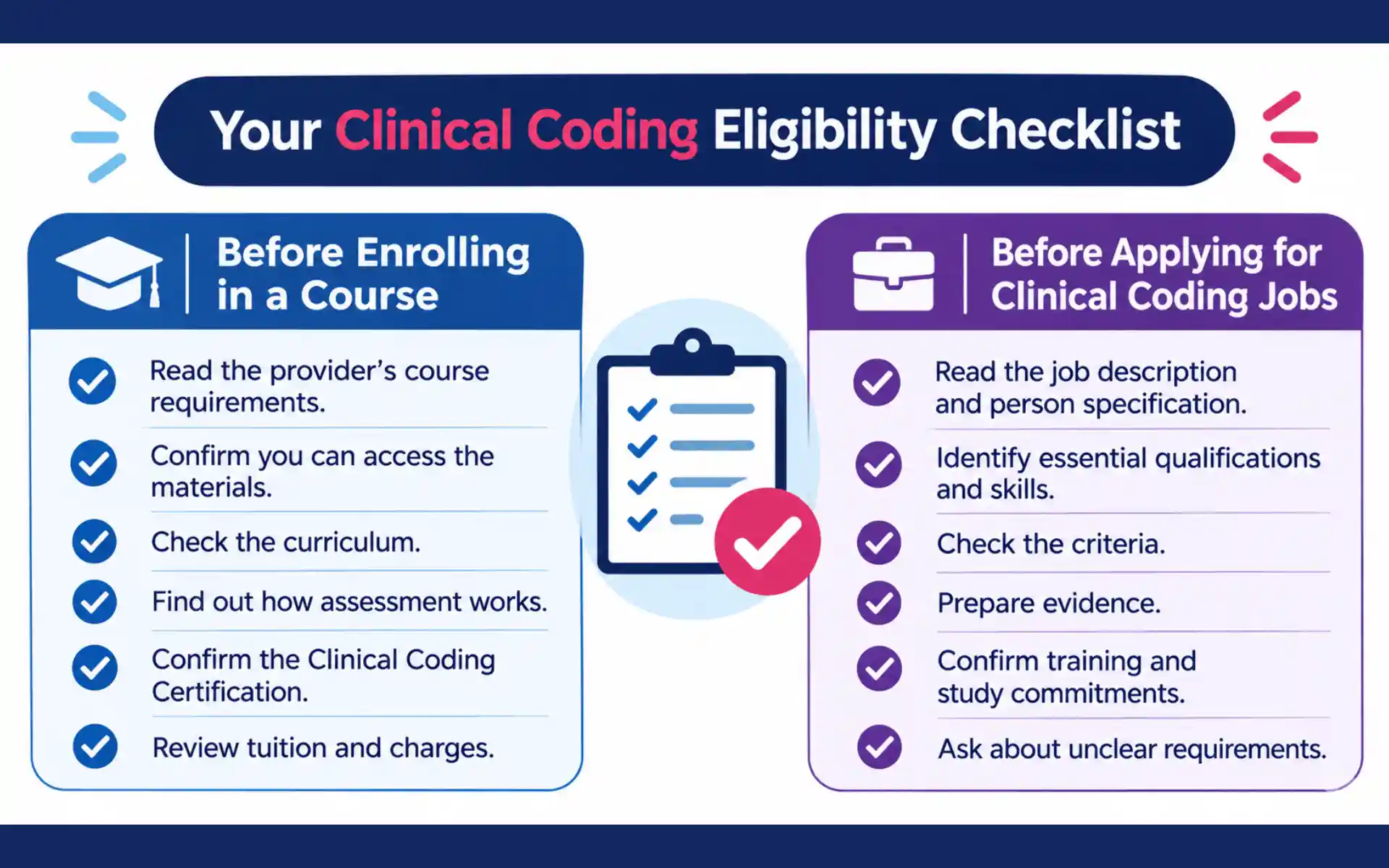
Before Enrolling in a Course
- 1. Read the provider’s clinical coding course requirements.
- 2. Confirm that you can access and understand the materials.
- 3. Check the curriculum against your learning goals.
- 4. Find out how assessment and feedback work.
- 5. Confirm the Clinical Coding Certification offered.
- 6. Review tuition, optional certificates and other charges.
Keep a copy of the course information so you know what was offered when you enrolled.
Before Applying for Clinical Coding Jobs
- 1. Read the full job description and person specification.
- 2. Identify every essential qualification and skill.
- 3. Check which criteria are desirable rather than compulsory.
- 4. Prepare evidence from work, education or volunteering.
- 5. Confirm the training and study commitments.
- 6. Ask the recruitment contact about unclear equivalency requirements.
Checking clinical coding course requirements is useful preparation, but an employer’s person specification remains the reference for that application.
Build Your Knowledge With a Clear Goal
Understanding clinical coding course requirements can help you take a realistic first step. You may be ready for introductory study, eligible to apply for a trainee role or better served by developing a particular skill first.
StudyHub’s beginner clinical coding training offers structured introductory learning without a prior qualification or experience requirement. Its published curriculum covers terminology, records, coding systems and professional responsibilities.
Review the current syllabus, support and certificate options before enrolling. Choose training that addresses your learning needs, then check individual employer requirements when planning your next move.
Medical Coding Certification: Clinical Coding Online Course at QLS Level 3
Frequently Asked Questions
Not every introductory course requires GCSEs. StudyHub lists no prior qualification requirement. However, clinical coding course requirements vary by provider, and employers may ask for GCSEs or equivalent qualifications when recruiting trainees.
Yes, some trainee roles accept applicants without previous coding experience. Bolton’s 2026 recruitment information provided one example. You must still meet the vacancy’s other essential criteria.
A degree is not required by every employer. The trainee examples discussed in this guide used GCSE-level criteria. Always check the vacancy rather than assuming that one qualification standard applies across the UK.
No. Introductory course completion does not award Accredited Clinical Coder status. ACC follows passing the NCCQ examinations, which assess professional coding competence.
Do not assume that a paid course is compulsory. Read the advert first: some employers provide structured training for successful applicants. Compare clinical coding course requirements with your learning needs before deciding whether additional study would be useful.
- All Courses
- IT & Software389
- Management287
- Teaching and Education250
- Business245
- Health and Fitness227
- Engineering & Technology180
- Health & Safety163
- Health and Social Care144
- Quality Licence Scheme139
- Healthcare137
- Accounting & Finance130
- Psychology112
- Employability112
- Lifestyle105
- Marketing75
- Office Productivity74
- Animal Care63
- Design and Photography55
- Design50
- Beauty & Makeup49
- Accounting & Bookkeeping34
- Web Development27
- Construction26
- Writing20
- Child Care17
- Digital Marketing13
- Environment10
- Bundle8
- Coaching6
- Agriculture5

Awarded By