


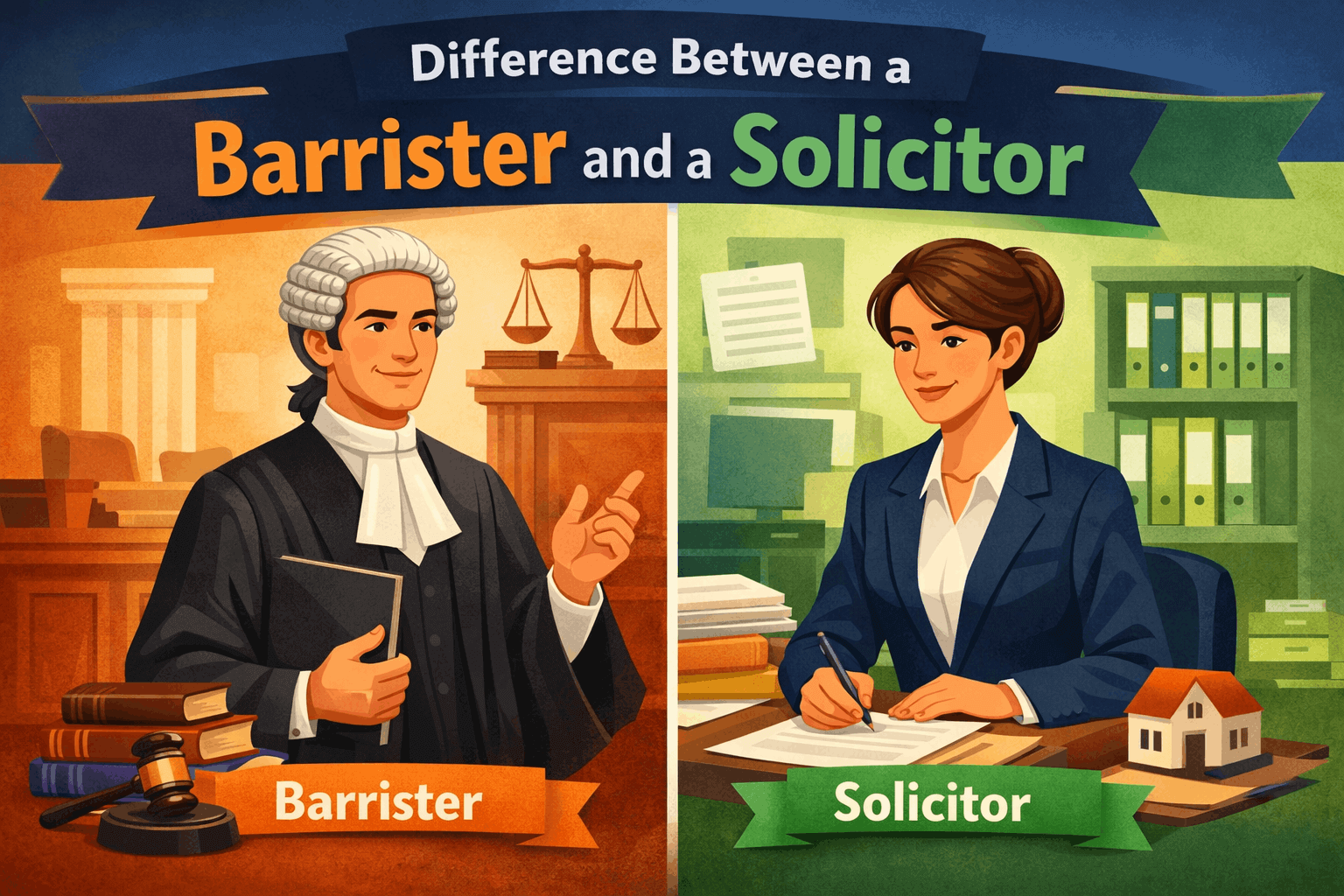
Court delays and legal backlogs have become a regular topic in the UK. As cases take longer and legal costs rise, people are paying closer attention to how the justice system works. Many now ask who actually handles legal matters behind the scenes. Some professionals prepare cases quietly, while others speak in court. This confusion often leads to one important question: what is the difference between barrister and solicitor? Understanding this difference helps people make better legal and career decisions. Therefore, this guide explains everything clearly, using plain UK English.
Table of Contents
Understanding the UK Legal System
The UK legal system separates legal responsibilities carefully. This structure exists to maintain high professional standards. Because of this separation, legal roles are clearly defined. However, many people still misunderstand who does what.
In simple terms, the system divides preparation work and courtroom advocacy. Solicitors manage cases from the start, while barristers focus on courtroom arguments. This separation has existed for centuries and continues today. As a result, understanding the system is the first step to understanding the difference between barrister and solicitor.
This distinction protects clients, courts, and legal outcomes. Therefore, clarity matters.
What Is a Solicitor?
A solicitor is usually the first legal contact. Therefore, most legal journeys start here. Solicitors manage cases from beginning to end. However, they rarely argue in higher courts.
Solicitors focus on preparation, advice, and communication. They work closely with clients and ensure legal matters progress smoothly. Because of this, their role demands organisation and clarity.
Typical responsibilities of a solicitor include:
Advising clients on legal options and risks
Drafting contracts and legal documents
Managing conveyancing and property transactions
Negotiating settlements and agreements
Preparing evidence and case files
Instructing barristers when court advocacy is required
Because solicitors remain client-facing, communication skills matter deeply. This client-focused role forms a key part of the difference between barrister and solicitor.
If you want structured solicitor training, StudyHub offers a dedicated course:
https://studyhub.org.uk/course/solicitor/
What Is a Barrister?
Barristers specialise in courtroom advocacy. Therefore, their work looks very different. They usually receive instructions from solicitors. However, their responsibility level remains high.
Barristers focus on legal argument and interpretation. They prepare opinions, analyse case law, and present arguments before judges. Because of this, courtroom confidence is essential.
Typical responsibilities of a barrister include:
Representing clients in higher courts
Presenting oral legal arguments
Drafting specialist legal opinions
Interpreting complex legislation and case law
Cross-examining witnesses
Advising solicitors on legal strategy
Because of this advocacy focus, barristers train differently. This distinction sits at the heart of the difference between barrister and solicitor.
Education and Training Pathways
Although both roles require legal education, training routes differ early. This difference shapes future work styles and responsibilities.
Solicitors qualify through the Solicitors Qualifying Examination (SQE). This route includes practical work experience and professional assessments. It focuses on real-world legal application and client care. Official guidance is available from the Solicitors Regulation Authority: https://www.sra.org.uk/become-solicitor/sqe/
Barristers follow a different route. After academic training, they complete the Bar Practice Course and a competitive pupillage. This process focuses heavily on advocacy skills and courtroom readiness. Official information is provided by the judiciary:
https://www.judiciary.uk/about-the-judiciary/judges-career-paths/
Because training paths differ, they clearly reflect the difference between barrister and solicitor in practice.

Work Environment and Daily Routine
Daily work environments vary greatly between these roles. This difference affects lifestyle, workload, and stress levels.
Solicitors usually work in law firms or corporate offices. Their days involve meetings, emails, document preparation, and client discussions. While deadlines exist, schedules are often predictable. This environment suits those who prefer structure and stability.
Barristers, however, work around court schedules. Their days depend on hearings, case preparation, and travel. Court sessions can be intense and unpredictable. Therefore, flexibility and resilience are essential. This contrast further highlights the difference between barrister and solicitor.
Rights of Audience in Court
Court access marks a key distinction. Not all lawyers can argue in every court.
Court Level | Solicitor | Barrister |
Magistrates’ Court | ✔ | ✔ |
County Court | ✔ | ✔ |
Crown Court | Limited | ✔ |
High Court | Limited | ✔ |
Official source:
https://www.gov.uk/government/organisations/hm-courts-and-tribunals-service
Therefore, courtroom rights clearly explain the difference between barrister and solicitor.
Client Interaction Differences
Client access varies greatly. This difference affects trust and communication.
Solicitors deal directly with clients throughout a case. They explain progress, outline options, and manage expectations. Because of this, they maintain strong client relationships.
Barristers usually work behind the scenes. Although direct access exists in limited cases, solicitors remain the main contact. This difference in interaction further highlights the difference between barrister and solicitor.
Salary Comparison in the UK
Income varies based on experience, location, and role. However, official data shows clear patterns.
Solicitors often earn stable salaries. Entry-level roles start modestly, while experienced solicitors earn higher wages. Solicitor salary (UK – National Careers Service) provides guidance:
https://nationalcareers.service.gov.uk/job-profiles/solicitor
Barristers experience wider income variation. Early earnings can be low, especially during pupillage. However, senior barristers can earn significantly more. Barrister salary (UK – National Careers Service): https://nationalcareers.service.gov.uk/job-profiles/barrister
Thus, income structure reinforces the difference between barrister and solicitor.
Career Stability and Risk Levels
Career security differs between these professions. This factor often influences career decisions.
Solicitors usually work as employees. They receive steady income, benefits, and predictable progression. This stability appeals to those seeking long-term security.
Barristers operate as self-employed professionals. Income depends on reputation and case volume. While potential rewards are high, financial risk remains greater.
Because of this contrast, risk tolerance defines another difference between barrister and solicitor.
Skills Required for Each Role
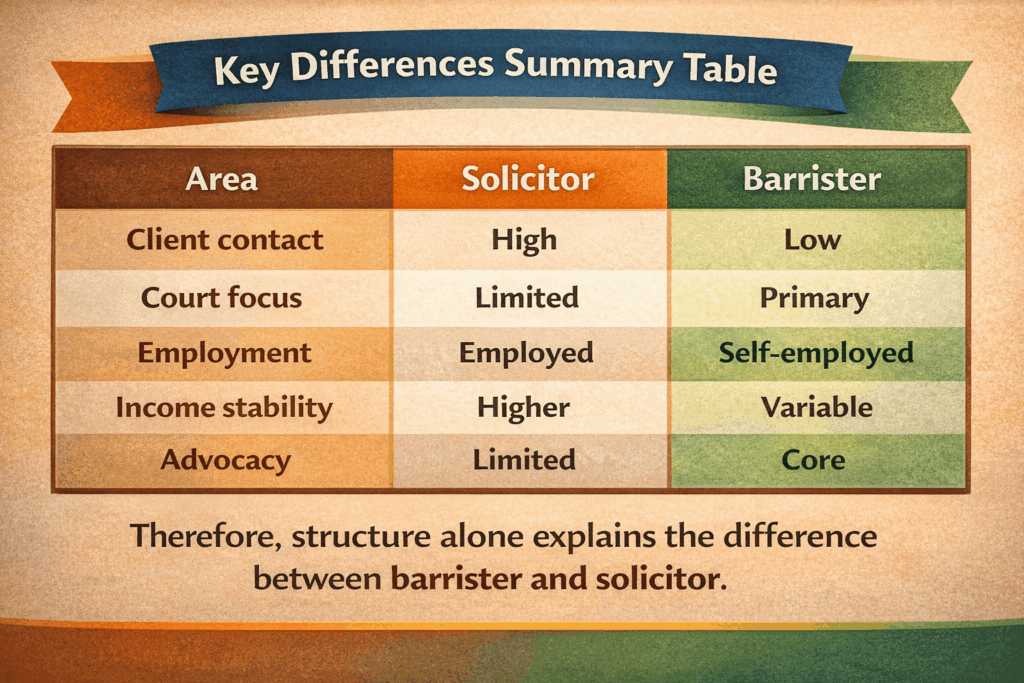
Both roles demand high standards and constant professional development. However, the skills required for each path differ in focus and daily use. Understanding these skill differences helps explain how solicitors and barristers contribute in distinct ways. It also helps individuals choose a role that suits their strengths. This contrast further highlights the difference between barrister and solicitor beyond formal training routes.
Solicitor skills
Organisation
Solicitors manage multiple cases at the same time. Therefore, strong organisation is essential. They track deadlines, documents, and communications to ensure cases progress smoothly and without delay.Client communication
Solicitors communicate regularly with clients. They explain legal options clearly and manage expectations throughout a case. As a result, clear and calm communication builds trust and confidence.Negotiation
Many legal matters settle outside court. Because of this, solicitors negotiate agreements, contracts, and settlements. Strong negotiation skills help resolve disputes efficiently and cost-effectively.Case management
Solicitors oversee cases from start to finish. They coordinate evidence, instruct barristers, and monitor progress. This role requires planning, attention to detail, and consistent follow-through.
Barrister skills
Public speaking
Barristers present arguments in court. Therefore, confident and clear public speaking is essential. They must explain complex legal points persuasively to judges and juries.Legal analysis
Barristers interpret legislation and case law in depth. They analyse legal principles and apply them to specific cases. This analytical skill supports strong courtroom arguments.Confidence under pressure
Courtrooms can be intense environments. Barristers often respond to unexpected questions or challenges. Staying calm under pressure allows them to adapt quickly and defend their position effectively.Argument construction
Barristers build structured legal arguments. They organise facts, law, and reasoning into clear submissions. This skill helps courts understand the case clearly and reach informed decisions.
In summary, solicitors rely on organisation, communication, and coordination, while barristers depend on advocacy, analysis, and courtroom presence. These contrasting skill sets reinforce the difference between barrister and solicitor and explain why each role remains essential within the UK legal system.
Final Thoughts
Choosing the right legal career depends on personal strengths, work preferences, and long-term goals. Some people prefer structured roles with steady client contact and ongoing case management, while others are drawn to courtroom advocacy and independent legal debate. Understanding the difference between barrister and solicitor helps clarify which path aligns best with individual skills and expectations. Alongside these roles, related legal routes such as conveyancing offer practical, property-focused career options for those interested in transactional law. Ultimately, the UK legal system relies on clearly defined professional responsibilities to maintain quality and fairness. As legal services continue to evolve and demand grows, making informed career and legal choices becomes increasingly important. Therefore, knowing who does what within the legal profession remains essential for confident decision-making.
FAQs
Neither role is more powerful overall. Solicitors control case management and client decisions, while barristers hold authority in higher court advocacy. Their power lies in different responsibilities.
No. In the UK, they are separate legal roles. Solicitors manage cases and advise clients, while barristers specialise in courtroom advocacy and legal argument.
British lawyers are not all called barristers. The term “barrister” refers specifically to advocates who argue cases in court, historically separated from solicitors.
Yes. A solicitor can retrain as a barrister by completing the Bar training course and pupillage, subject to meeting entry requirements.
It depends on experience and success. Solicitors usually earn more early on due to stable salaries, while senior barristers can earn significantly more at higher levels.
- All Courses
- IT & Software378
- Management277
- Teaching and Education249
- Business234
- Health and Fitness212
- Health & Safety160
- Engineering & Technology151
- Quality Licence Scheme138
- Health and Social Care137
- Healthcare131
- Accounting & Finance126
- Employability105
- Psychology100
- Lifestyle92
- Marketing75
- Office Productivity65
- Animal Care56
- Design and Photography53
- Design44
- Beauty & Makeup42
- Accounting & Bookkeeping34
- Web Development27
- Writing20
- Construction15
- Digital Marketing13
- Child Care11
- Environment9
- Bundle8
- Agriculture5
- Coaching1

Awarded By


0 responses on "Difference Between a Barrister and a Solicitor (UK Explained)"