


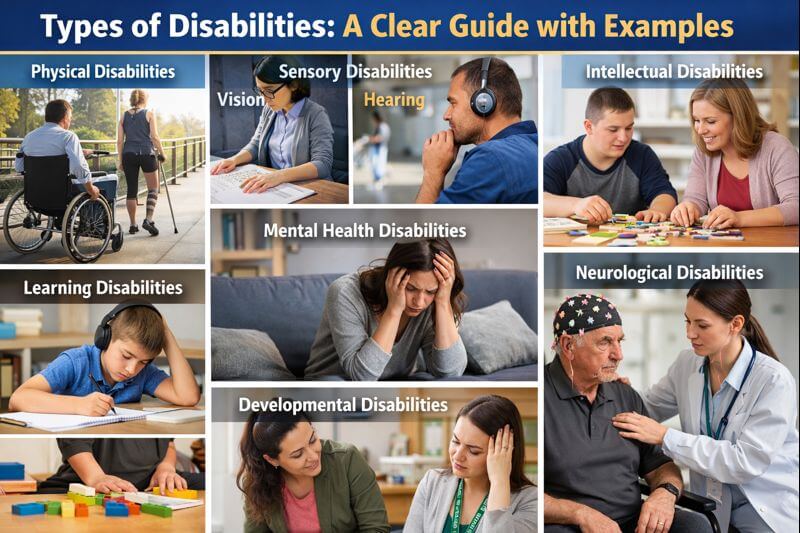
A normal day can feel safe and predictable. However, one small barrier can change everything. A crowded space becomes overwhelming. Written instructions feel confusing. Movement feels painful or slow. As a result, everyday tasks take more effort. Moreover, the worry of being judged adds pressure. Therefore, support and understanding become essential. Disabilities are long-term conditions that affect how people move, learn, communicate, or cope with daily life. In the UK, many disabilities are visible, while others are hidden. This guide explains the types of disabilities clearly and respectfully. It also shares real examples to help build awareness, inclusion, and confidence for everyone.
Table of Contents
What Are Disabilities?
Disabilities are long-term conditions that affect how people move, think, learn, or communicate. However, disability is not only about health. It is also shaped by the world around us. For example, a step without a ramp can limit access. Similarly, loud spaces can cause stress. As a result, daily activities may feel harder. In the UK, millions of people live with a disability. Many are visible, while others are not. Therefore, understanding disabilities means looking at both the person and their environment. When barriers are reduced, independence and confidence improve for everyone.
Types of Disabilities Explained
The types of disabilities are often grouped by how they affect life. However, real life can be more complex. Some conditions are visible. Others are hidden. Moreover, many people experience more than one type.
At a glance: the main types of disabilities
Physical disabilities
Sensory disabilities (vision and hearing)
Intellectual disabilities
Mental health–related disabilities
Neurological disabilities
Developmental disabilities
Hidden (invisible) disabilities
Therefore, these categories help communication and planning. In addition, they support better access at school and work. Finally, understanding the types of disabilities reduces stigma. It also improves inclusion in UK communities.
Physical Disabilities
What is a physical disability?
A physical disability affects movement, strength, or physical function. However, the impact depends on the person and setting. For example, stairs without a ramp can limit access. Meanwhile, fatigue can also reduce ability. Therefore, support often includes mobility aids and accessible design.
Common examples of physical disabilities
Mobility impairment after injury
Cerebral palsy
Arthritis that limits movement
Muscular dystrophy
Limb difference or amputation
Spinal cord injury
Chronic pain conditions that reduce function
How physical disabilities can affect daily life
Daily tasks may take more time. Moreover, public transport can be harder without step-free routes. In addition, some people need rest breaks. Therefore, flexible schedules and accessible spaces help. That is why many guides on types of disabilities include physical needs early.
Sensory Disabilities
Sensory disabilities affect how people see, hear, or process sensory input. However, many adjustments are simple. For example, captions help hearing access. Likewise, good contrast helps navigation.
Visual impairments
Visual impairment can range from low vision to blindness. Moreover, lighting and glare can change what feels usable. Therefore, large print, screen readers, and clear layouts matter.
Hearing impairments
Hearing loss can be mild or profound. In addition, background noise can reduce understanding. Therefore, captions, hearing loops, and clear speech help access.
Examples of sensory disabilities
Partial sight or blindness
Colour vision difference
Tinnitus that affects focus
Deafblindness
These examples show why types of disabilities should include communication access.
Intellectual Disabilities
What are intellectual disabilities?
Intellectual disabilities affect learning, reasoning, and everyday problem solving. However, ability varies widely. Moreover, support works best when it is personalised. Therefore, clear instructions and patient pacing help.
Examples of intellectual disabilities
Down’s syndrome
Intellectual disability linked to genetic conditions
Intellectual disability linked to brain injury
Support and accessibility considerations
Support may include structured routines and easy-read information. In addition, consistent support staff can help. Therefore, inclusive teaching and workplace practices matter. Courses on disability awareness can strengthen this approach.

Learning Disabilities
Learning disabilities are often confused with intellectual disabilities. However, they are different. Learning disabilities affect how information is processed. Meanwhile, general intelligence can be average or above.
Difference between learning and intellectual disabilities
Learning disabilities affect specific skills. For example, reading or writing may be harder. Intellectual disabilities affect broader reasoning and daily living skills. Therefore, the types of disabilities need both categories.
Common learning disabilities
Dyslexia (reading and spelling)
Dyspraxia (coordination and planning)
Dyscalculia (numbers and maths)
ADHD (attention and impulse control)
The NHS explains learning disabilities as lifelong learning differences.
Examples in education and work settings
In school, reading-heavy tasks can take longer. In addition, note-taking can be difficult. Therefore, extra time and assistive tools help. At work, clear written steps and checklists support performance. For teaching strategies, Studyhub’s learning-focused training can help staff.
Mental Health–Related Disabilities
Mental health conditions can affect daily life in ways others cannot see. Simple tasks may feel heavy. Concentration may fade quickly. Energy can drop without warning. As a result, work, study, and social life may suffer. Moreover, fear of judgement often stops people from asking for help. Therefore, understanding mental health–related conditions as part of the types of disabilities is essential in the UK. Clear language, empathy, and awareness reduce stigma and improve access.
When mental health conditions are considered disabilities
Mental health conditions may be classed as disabilities when they have a long-term and serious effect on daily activities. This includes challenges with focus, communication, routine, or emotional regulation. However, not every condition is the same. The impact must be ongoing and significant. In the UK, guidance focuses on how the condition affects everyday life, not just the diagnosis. This approach helps ensure fair treatment without forcing people to explain personal details.
Examples of mental health–related disabilities
Some mental health conditions can become disabling when symptoms are persistent. Common examples include:
Severe depression that affects motivation and routine
Anxiety disorders that limit social or work participation
Bipolar disorder with long-term mood disruption
Post-traumatic stress disorder affecting safety and focus
Obsessive-compulsive disorder interfering with daily tasks
These examples show how mental health fits within broader types of disabilities, especially when support is limited.
Workplace and everyday recognition
Support at work can make a real difference. Flexible hours allow recovery time. Clear expectations reduce pressure. Quiet spaces help focus. Therefore, thoughtful adjustments improve confidence and performance. In the UK, many organisations now recognise mental health as part of inclusive practice. This shift helps people remain active in education and employment while managing long-term conditions.
Neurological Disabilities
What are neurological disabilities?
Neurological disabilities affect the brain, spinal cord, or nerves. However, symptoms can change day to day. Therefore, consistent support and flexible planning matter.
Examples of neurological disabilities
Multiple sclerosis
Epilepsy
Parkinson’s disease
Migraine with significant impact
Stroke-related disability
Visible vs invisible neurological conditions
Some neurological conditions are visible. Others are hidden. Moreover, fatigue and pain may not show. Therefore, people may need adjustments even without obvious signs. This is why modern types of disabilities guides include “invisible impact.”
Developmental Disabilities
What are developmental disabilities?
Developmental disabilities begin in childhood. They can affect communication, learning, and daily skills. However, people develop strengths and coping skills too. Therefore, supportive environments matter.
Examples of developmental disabilities
Autism spectrum condition
Global developmental delay
Conditions affecting social communication
Differences between childhood and adult support needs
Support in childhood often focuses on education. Meanwhile, adult support often includes work and independence. Therefore, transitions need planning. Courses that explore disability studies can improve inclusive thinking.
Hidden (Invisible) Disabilities
What are hidden disabilities?
Hidden disabilities are conditions that are not obvious. However, they can still limit daily life. For example, fatigue can end plans early. Meanwhile, sensory overload can cause distress. Therefore, kindness and belief matter.
Common examples of invisible disabilities
Chronic fatigue conditions
Fibromyalgia
Some neurological conditions
Diabetes complications
Epilepsy between seizures
Why awareness matters in the UK
In the UK, many services rely on self-advocacy. Therefore, awareness helps reduce judgement. In addition, workplaces can plan better adjustments. Training in disability awareness and inclusion supports this shift.
Different Types of Disabilities and How They May Overlap
People can have multiple disabilities. Moreover, one condition can affect several areas. Therefore, categories should guide support, not label people.
Multiple disabilities
A person may have mobility limits and hearing loss. In addition, fatigue can affect both work and learning. Therefore, support plans should combine adjustments.
Co-existing conditions
Autism and anxiety may occur together. Likewise, ADHD can overlap with dyslexia. Therefore, the types of disabilities may blend in real life.
Why clear categories still matter
Categories help schools plan support. They also help employers design adjustments. Therefore, they remain useful. Yet, they should stay flexible.
Examples of Disabilities in Everyday Life
At school
Noise can block focus. Meanwhile, reading-heavy tasks can overwhelm. Therefore, extra time and clear instructions help. In addition, assistive tools can improve learning.
At work
Bright lights and open offices can cause stress. Moreover, long meetings can reduce attention. Therefore, structured breaks and clear tasks help. Training on Disability & SEN can support staff confidence.
In public spaces
Crowds can trigger anxiety. In addition, unclear signage can block independence. Therefore, accessible design matters. These examples make the types of disabilities feel real.
Table: Types of disabilities, examples, and helpful supports
Types of disabilities | Examples | Helpful supports (UK-friendly) |
Physical | Arthritis, spinal injury | Step-free access, flexible pacing |
Sensory | Deafness, low vision | Captions, hearing loops, clear contrast |
Intellectual | Down’s syndrome | Easy-read, structured routines |
Learning | Dyslexia, dyspraxia | Extra time, assistive tech, checklists |
Mental health | Depression, PTSD | Flexible hours, clear expectations |
Neurological | MS, epilepsy | Rest breaks, quiet space, safety planning |
Developmental | Autism | Predictable routines, sensory adjustments |
Hidden | Chronic fatigue | Trust, flexibility, reduced stigma |
Therefore, a good guide to types of disabilities always pairs examples with supports.
Access the course library of 3000+ courses for just £149 for a lifetime!

Summary
The types of disabilities are best understood as categories of support needs. However, people do not fit neat boxes. Therefore, use categories with care. Physical and sensory disabilities often need access changes. Learning and intellectual disabilities often need clear teaching support. Mental health and neurological disabilities may need flexibility and reduced stress. Moreover, hidden disabilities need trust and understanding.
If you want to build skills for inclusive practice, Studyhub offers UK-relevant training. For example, disability awareness training supports teams. In addition, disability assessor training supports those moving into assessment roles. Finally, learning disability nursing has clear UK career pathways and salary ranges.
Final note: This guide explains types of disabilities for learning and inclusion. For legal definitions, use GOV.UK.
FAQs
Common categories include physical, sensory, learning, intellectual, mental health–related, neurological, developmental, and hidden disabilities. Therefore, the main types of disabilities cover both visible and invisible needs.
No. Many disabilities are hidden. For example, chronic fatigue and anxiety may not show. Therefore, it helps to avoid quick judgement.
Yes, they can be. However, this depends on impact and duration. For UK workplace guidance, ACAS explains disability under the Equality Act.
Not always. Some disabilities are lifelong. Others may change over time. Therefore, support should stay flexible.
- All Courses
- IT & Software378
- Management277
- Teaching and Education249
- Business234
- Health and Fitness212
- Health & Safety160
- Engineering & Technology151
- Quality Licence Scheme138
- Health and Social Care137
- Healthcare131
- Accounting & Finance126
- Employability105
- Psychology100
- Lifestyle92
- Marketing75
- Office Productivity65
- Animal Care56
- Design and Photography53
- Design44
- Beauty & Makeup42
- Accounting & Bookkeeping34
- Web Development27
- Writing20
- Construction15
- Digital Marketing13
- Child Care11
- Environment9
- Bundle8
- Agriculture5
- Coaching1

Awarded By


0 responses on "Types of Disabilities: A Clear Guide with Examples"