



In 2025, IQ league tables went viral again, and debates followed fast. Meanwhile, one widely shared dataset puts the average IQ in UK at about 99.12, which is close to the global norm. Forbes+1 Yet people still feel pressure, because numbers can sound like judgement. Without clear context, students worry about labels. Likewise, adults compare themselves unfairly at work. Even families second-guess learning struggles at home. Recently, UK headlines even raised ethical alarms about using genetic data to “rank” embryos by predicted traits, including IQ. The Guardian So, this guide explains what the average means, what it cannot prove, and how IQ-style insights can help spot support needs early, improve learning plans, and reduce costly mistakes in education and training.
Table of Contents
Understanding IQ and Why People Care About It
Before looking at numbers, it helps to know what IQ tries to measure. IQ, or intelligence quotient, comes from standardised tests. These tests look at things like logic, patterns, memory, and problem solving.
However, IQ is not a full picture of a person. It does not measure kindness, creativity, resilience, or practical skills. It simply gives a score that shows how someone performed compared with a large group.
People care about IQ for several reasons. First, it seems to offer a simple way to compare abilities. Second, it often appears in debates about schools, jobs, and social policy. Third, many online tests use IQ as a hook to gain attention.
Yet the real value lies not in bragging rights. Instead, it lies in understanding how thinking skills link with education, health, and opportunity across a population.
What Is the Average IQ in UK?
Most modern IQ tests set the global average at 100. Scores follow a bell curve. Therefore, most people fall between 85 and 115. When researchers look at average IQ in UK, they usually find a figure close to that global mean.
Different studies give slightly different numbers. Some suggest the average IQ in UK sits just around 100. Others place it a little below or above. The differences come from methods, samples, and test types. However, the broad message stays the same. The UK, as a whole, sits near the centre of the global distribution.
This means most people in the UK fall within the standard range. They can learn new skills, handle daily tasks, and solve routine problems with support from school and work systems.
So, the headline answer is simple. The average IQ in UK is roughly around 100, within a normal global band. The deeper story is how that score spreads across groups, ages, and regions.
IQ Ranges and What They Usually Indicate
To understand the average, it helps to see the whole spread. IQ scores cluster in ranges. Each band links to general patterns, not fixed labels.
Below 70 – significant learning difficulties
70–84 – below average range
85–115 – average range
116–129 – above average range
130 and above – very high range
These bands help educators and psychologists plan support. However, they do not lock in destiny. For example, someone in the lower range may thrive with practical training and the right environment. Likewise, a person in the higher range may still struggle without discipline, focus, and emotional skills.
Therefore, when we think about the average IQ in UK, we should see it as a central point on this curve. Many people sit around it. Some sit below. Some sit above. The curve matters more than one number.
Simple Table: Average IQ in UK by Broad Age Groups
Exact figures vary by study. Still, many sources suggest that IQ scores, when adjusted, stay fairly stable after childhood. Below is a simple example table to show how people often imagine the spread. It is not a strict measurement but a helpful picture.
Age Group | Typical Adjusted IQ Band | Comment |
Children (8–12) | 90–110 | Still developing core skills |
Teens (13–17) | 95–110 | Strong gains in reasoning |
Young adults | 95–115 | Peak test performance for many |
Adults 30–50 | 90–110 | Stable overall performance |
Adults 50+ | 85–105 | Slight change, wide variation |
In practice, the average IQ in UK remains near 100 across adult ages. However, life experience, education, and health influence how that potential appears in daily decisions and work.
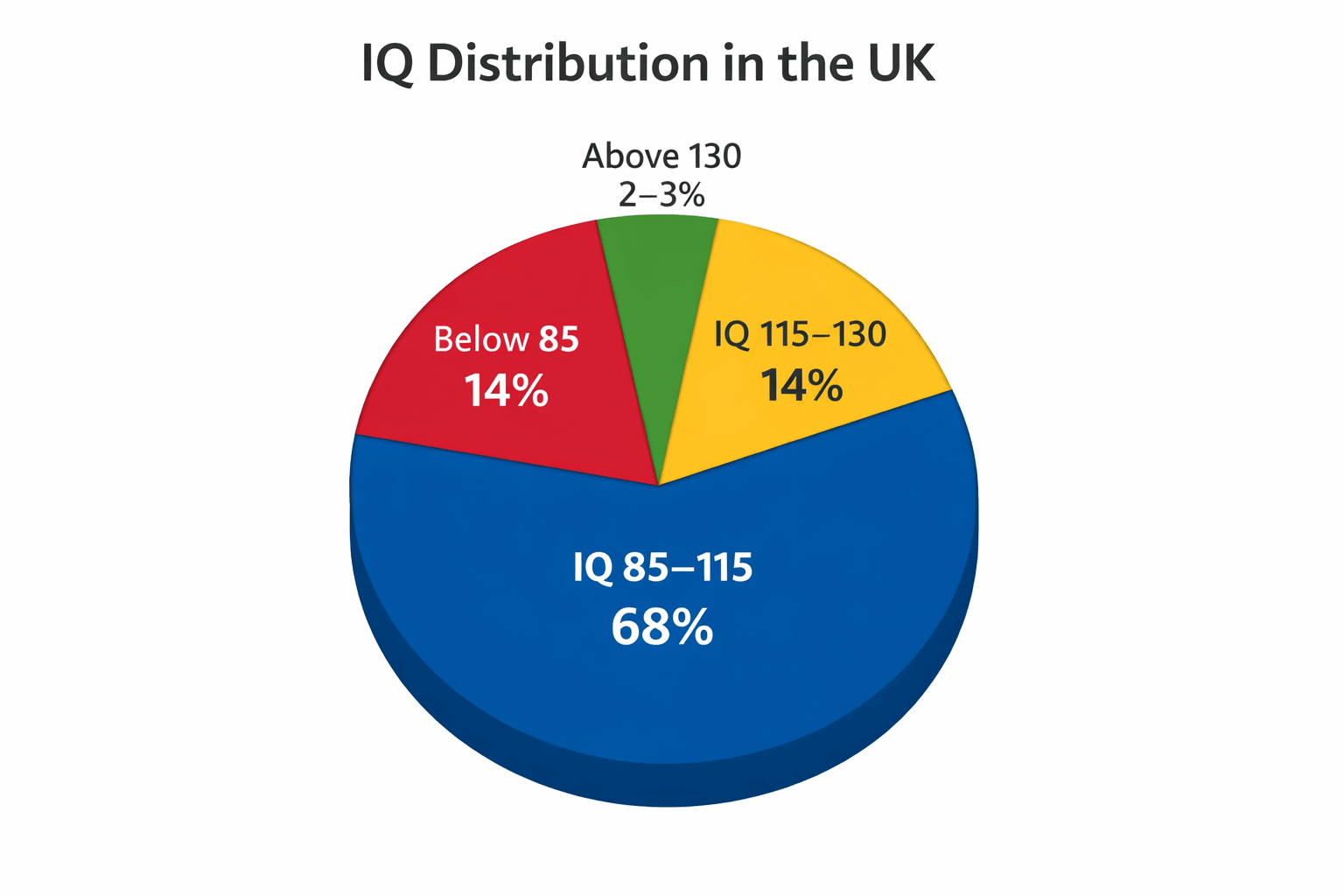
Visual Idea: Pie Chart of IQ Ranges in a Typical UK Sample
A pie chart that shows a sample of UK residents:
About 68% of the pie sits between IQ 85 and 115.
Around 14% falls below 85.
Another 14% lies between 115 and 130.
A small slice, maybe 2–3%, rises above 130.
This kind of chart helps show that most people cluster near the average IQ in UK. A few sit on either side. The shape echoes the classic bell curve but in a circular form, easy to share or explain.
How the UK Compares with Other Countries
Many people only see IQ when countries are ranked. Charts might claim that one nation is “smarter” than another. However, real comparisons are more complex.
First, different studies use different tests. Second, sample quality varies across countries. Third, cultural and language factors affect performance. For example, a test designed in one country may favour certain styles of thinking.
Broadly, the average IQ in UK tends to sit near that of other high-income countries. It may appear slightly higher than some regions and slightly lower than others. Yet the gap is often small. Education systems, childhood health, and access to books and technology matter more than a raw ranking.
Therefore, rather than asking who “wins,” a better question is this. How can the UK make sure as many people as possible reach their full thinking potential?
Factors That Influence the Average IQ in UK
The average IQ in UK does not arise from genes alone. Instead, it reflects a mix of environment, health, and education. Several key factors play a role.
1. Early childhood nutrition
Good nutrition supports brain growth. When children lack key nutrients, their development can slow. In the UK, most children have access to basic food. However, food poverty still exists. This gap can affect attention, growth, and long-term scores.
2. Access to quality education
Education builds vocabulary, logic, and problem solving. Schools that support pupils with clear teaching and safe spaces help raise overall performance. Strong literacy and numeracy programmes can shift the average IQ in UK over time.
3. Health and sleep
Sleep affects memory and focus. Poor sleep patterns can reduce short-term performance. Likewise, chronic illness, untreated hearing or vision issues, and unaddressed mental health needs can lower test scores.
4. Home environment
Homes rich in books, talk, and curiosity tend to support learning. Children who are encouraged to ask questions and explore ideas often show stronger thinking skills. Stable houses, routines, and emotional safety also support brain development.
5. Social and economic factors
Poverty, stress, and limited access to services can hold back performance. Neighbourhood safety, local libraries, and digital access all matter. As these improve, the average IQ in UK may gradually move upward.
Each of these factors does not only change a number. Instead, each shapes how people can study, work, and plan for the future.
How IQ Tests Work in the UK Context
Many people meet IQ only through online quizzes. However, official IQ tests follow strict rules. In the UK, trained psychologists usually supervise proper tests. They choose tools that are standardised and normed for relevant age groups.
Most tests contain several sections, such as:
Pattern and abstract reasoning tasks
Verbal reasoning and vocabulary tasks
Working memory exercises
Processing speed challenges
Scores are then compared with a reference group. The score shows where someone sits relative to that group. This process allows researchers to estimate the average IQ in UK in a careful way.
However, testing has limits. Cultural background, language level, and test anxiety affect results. Therefore, good practitioners never judge a person on a single score. Instead, they look at the whole pattern, plus the person’s story and strengths.
Access the course library of 3000+ courses with unlimited free PDF Certificate for just £149 for a lifetime!

Misconceptions and Myths About IQ
IQ attracts many myths. These myths can harm confidence and fairness.
Common misconceptions include:
“IQ never changes.”
In reality, scores can shift. Education, health, and practice can improve performance, especially in younger years.
“High IQ guarantees success.”
Success also needs resilience, discipline, and social skills. Many high-IQ people still struggle without these.“Low IQ means low value.”
This idea is wrong and harmful. People contribute in many ways. Practical skills, care work, and creativity all matter.“One group is naturally smarter than another.”
Differences between groups often reflect history, access, and environment, not pure ability.
When thinking about the average IQ in UK, it helps to keep these myths in mind. Numbers should inform policy and support, not fuel prejudice or pride.
Building Thinking Skills Beyond IQ Tests
Even if IQ gives a rough measure of problem solving, it does not cover every useful skill. People can grow their abilities through learning and practice. Courses, reading, and real projects can all help.
For example, learners on platforms like Studyhub UK can build digital skills, analysis skills, and decision-making skills. These courses do not change the basic average IQ in UK overnight. However, they help people use their abilities more effectively.
Some practical ways to sharpen thinking include:
Reading regularly, including non-fiction and long-form articles
Solving puzzles, logic games, and number problems
Writing reflections on news stories and workplace issues
Taking structured online courses in areas like data, business, or IT
Joining discussions where ideas are challenged respectfully
Over time, these habits strengthen mental flexibility. They also build confidence, which matters just as much as any test score.
Summary
So, what have we really learned about the average IQ in UK? The number itself sits near 100, close to the global standard. Most people fall within a broad, normal range. Small differences appear between groups and regions. However, those differences often reflect opportunity, not fixed worth.
IQ can support planning in education and health. Yet it must never define a person’s full value. Instead, it should guide support, reduce barriers, and highlight where investment is needed. When children have safe homes, healthy food, strong schools, and fair chances, the whole curve can shift.
For individuals, the message is clear. You are more than a score. You can still grow your skills through study, training, and deliberate practice. Platforms like Studyhub UK exist to help people turn potential into progress, whatever their starting point on the curve.
In the end, the real measure of a society is not only its average IQ. Rather, it is how that society treats people across the whole range, and how well it helps each person use their mind to build a better life.
FAQs
A high IQ is usually considered 130 or above. This level places a person in the top 2–3% of the population. However, a high score does not guarantee success without skills and effort.
First, IQ tests help identify learning needs so people can receive the right educational support. Second, they help psychologists understand cognitive strengths and weaknesses for planning training or intervention.
Based on several international datasets, East Asian countries such as Japan, South Korea, and Singapore often report the highest average IQ scores. However, results vary by method and data source.
IQ test scores can improve through education, practice, good sleep, and mental stimulation. Activities like problem-solving, reading, and structured learning help people perform better over time.
Research shows no meaningful difference in the average IQ of males and females in the UK. While skill profiles may vary slightly, overall intelligence levels are the same on average.
- All Courses
- IT & Software376
- Management275
- Teaching and Education247
- Business234
- Health and Fitness212
- Health & Safety158
- Engineering & Technology150
- Quality Licence Scheme137
- Health and Social Care134
- Healthcare129
- Accounting & Finance126
- Employability105
- Psychology99
- Lifestyle92
- Marketing75
- Office Productivity65
- Animal Care56
- Design and Photography53
- Design44
- Beauty & Makeup42
- Accounting & Bookkeeping34
- Web Development27
- Writing20
- Construction15
- Digital Marketing13
- Child Care10
- Environment9
- Agriculture5
- Coaching1

Awarded By


0 responses on "What is the Average IQ Score in the UK?"