



Being fluent in two languages is a valuable skill. But if you’re thinking about becoming an interpreter, knowing which qualification to choose can be surprisingly confusing.
Some interpreter courses in the UK offer introductory training and a completion certificate. Others lead to formally regulated qualifications that employers may require for particular roles. Both can be useful, but they serve different purposes.
This interpreter courses UK guide explains what Level 3 interpreting qualifications mean, how to check whether a course is recognised, and which training options suit different career goals.
The key distinction is simple: A regulated Level 3 Certificate in Community Interpreting demonstrates achievement against nationally recognised qualification standards. An online course advertised as Level 3 does not automatically award that qualification.
Before enrolling, check the course’s awarding organisation, assessment method, certificate and relevance to the interpreting work you hope to pursue.
What Is a Level 3 Interpreting Qualification in the UK?
A Level 3 interpreting qualification is designed to develop and assess knowledge and skills at a defined level of difficulty. In community interpreting, this can involve helping people communicate across languages in public services and other community settings.
In England and Northern Ireland, regulated vocational qualifications are included in the Regulated Qualifications Framework (RQF). Level 3 is comparable in qualification level to A levels, although the content, assessment and purpose are different.
A genuine Level 3 community interpreting qualification typically involves more than knowing two languages. Learners may need to demonstrate their ability to interpret accurately, prepare for assignments, follow professional standards and handle sensitive communication.
However, not every course carrying the words Level 3 is a regulated qualification.
For a broader comparison of different interpreter qualifications in the UK, Interpreter Qualifications Explained and Compared will provide further context.
What Does a Level 3 Certificate in Community Interpreting Cover?
A regulated Level 3 Certificate in Community Interpreting prepares learners for communication between people who use different languages, particularly in community and public service environments.
For example, the regulated Ascentis Level 3 Certificate in Community Interpreting includes learning about assignment preparation, interpreting practice, professional development and the sectors where community interpreters may work.
The qualification has 200 guided learning hours and a total qualification time of 220 hours. Its qualification number is 610/3039/9.
These figures apply to that particular qualification, not every Level 3 interpreting course.
A recognised qualification may assess practical interpreting competence alongside knowledge of professional responsibilities. This matters because interpreting requires more than translating individual words. The interpreter must preserve meaning, manage communication and recognise when specialist knowledge is needed.
Is Every Level 3 Interpreter Course Ofqual Regulated?
No. A course described as Level 3 is not necessarily an Ofqual-regulated qualification.
Providers may use a level to indicate the intended difficulty or depth of their training. That does not automatically establish a regulated qualification, recognised awarding organisation or specific professional entitlement.
For learners comparing interpreter qualifications, three terms are particularly important:
- Course completion certificate: Evidence that a learner has completed a provider's course or passed its assessment.
- Regulated qualification: A formal qualification awarded by a recognised awarding organisation and recorded on the relevant qualifications register.
- Professional registration: Recognition through a professional register with its own qualification, experience and eligibility criteria.
These distinctions are especially important when comparing introductory online training with programmes intended to meet professional recruitment requirements.
Level 3 Interpreter Courses and Regulated Certificates Compared
Two courses can cover similar interpreting topics while offering very different outcomes.
One may provide a foundation in language skills, interpreting techniques and professional ethics. Another may assess practical competence against a regulated qualification specification.
Neither should be judged solely by its title or certificate design.
| Feature | Introductory Level 3 Online Course | Regulated Level 3 Community Interpreting Certificate |
|---|---|---|
| Main Purpose | Develop foundational interpreting knowledge | Achieve a specified regulated qualification |
| Recognition | Depends on the provider and certificate | Recognised through the relevant qualification regulator |
| Assessment | May use quizzes, assignments or other provider assessments | Must meet the qualification's assessment requirements |
| Awarding Organisation | May not involve a regulated awarding organisation | Identifiable regulated awarding organisation |
| Qualification Number | Not necessarily available | Official qualification number |
| Career Suitability | Useful for introductory development | May satisfy some employers' Level 3 criteria |
| Progression | May support preparation for further study | Can contribute to a recognised qualification pathway |
The right option depends on your reason for studying. If you want to develop confidence and become familiar with interpreting, an introductory course may suit you. If an employer requires a regulated community interpreting qualification, you need to check that the programme awards the specific qualification requested.
Online Training Certificates vs Regulated Qualifications
Online interpreter courses can be convenient for people balancing training with work or family responsibilities.
The delivery format, however, tells you very little about qualification recognition.
A course delivered entirely online may lead to a regulated qualification if it meets the awarding organisation’s requirements. Equally, a self-paced online programme may provide useful professional development without awarding a regulated credential.
StudyHub’s Interpreter Diploma Level 3 is an example of flexible introductory training. Its published curriculum covers language skills, interpreting techniques, specialised fields, cultural competence, technology, ethics and professional challenges.
The course includes a written assignment assessment and optional certificates. Its published information does not establish that it awards an Ofqual-regulated Level 3 Certificate in Community Interpreting.
Before choosing any course, consider what you need the certificate to demonstrate.
For a more detailed explanation of certificate types and recognition, Interpreter course certificate explained: Practical Guide can address the differences between provider certificates and formal qualifications.
How to Check an Interpreter Qualification Before Enrolling
The most reliable approach is to verify the qualification rather than relying on promotional descriptions.
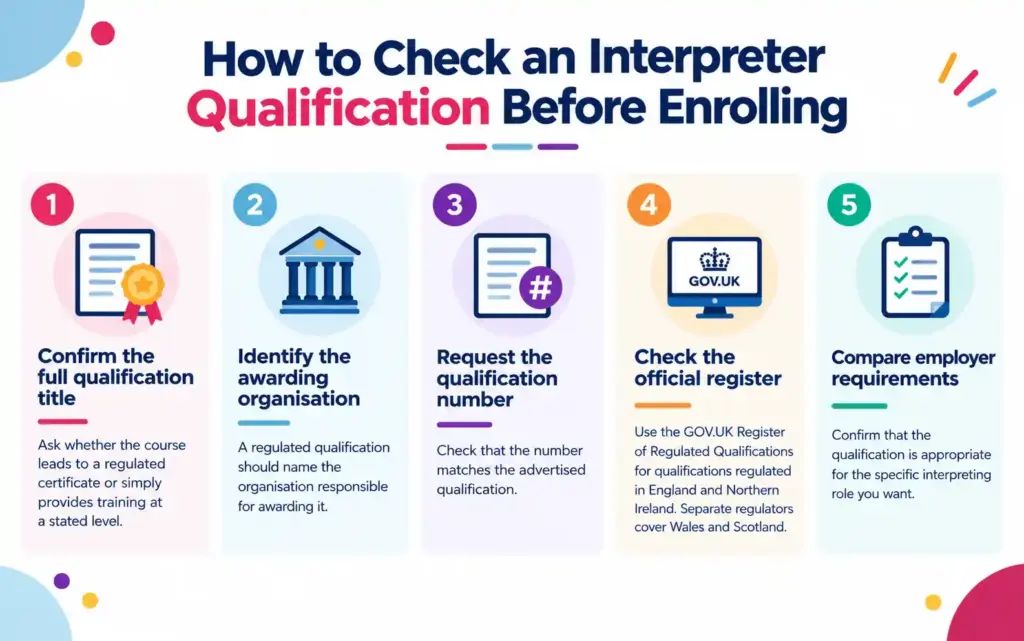
- Confirm the full qualification title. Ask whether the course leads to a regulated certificate or simply provides training at a stated level.
- Identify the awarding organisation. A regulated qualification should name the organisation responsible for awarding it.
- Request the qualification number. Check that the number matches the advertised qualification.
- Check the official register. Use the GOV.UK Register of Regulated Qualifications. for qualifications regulated in England and Northern Ireland. Separate regulators cover Wales and Scotland.
- Compare employer requirements. Confirm that the qualification is appropriate for the specific interpreting role you want.
A legitimate training course may be worthwhile even when it is not regulated. The important thing is understanding exactly what you’re buying.
Who Should Consider a Level 3 Interpreter Course?
Level 3 interpreting training may appeal to bilingual adults who want to develop their communication skills or investigate interpreting as a career.
It can be particularly relevant to:
- Career changers who speak two languages and want to assess whether interpreting suits their strengths.
- Working professionals who regularly communicate with multilingual clients or colleagues.
- Community-minded learners interested in the communication needs of people using local services.
- Jobseekers comparing the qualifications and practical skills requested by interpreting agencies.
- Existing language professionals who want to strengthen their knowledge of interpreting techniques and ethics.
A beginner course can provide useful structure, but being bilingual does not automatically make someone ready to accept professional interpreting assignments.
Professional work requires language proficiency, accuracy, impartiality and an understanding of the setting involved.
If you’re unsure about the overall career route, StudyHub’s guide to becoming an interpreter in the UK covers entry options and the broader steps involved.
For this article, the central question is whether a particular Level 3 course provides the training or qualification your next step requires.
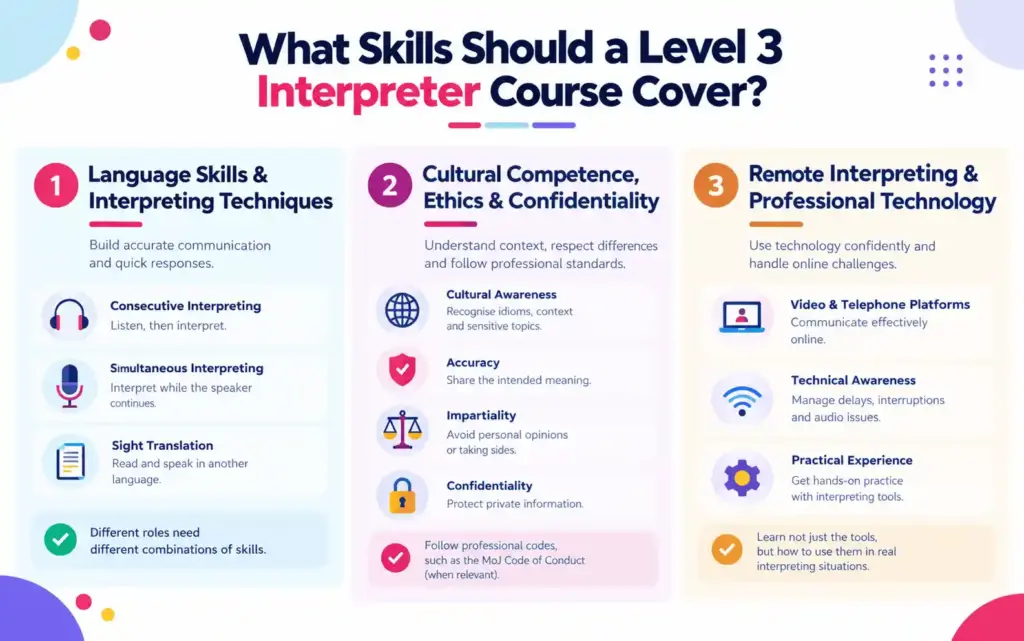
What Skills Should a Level 3 Interpreter Course Cover?
When comparing interpreter courses UK learners should look beyond the course title and examine the actual curriculum.
A useful programme should cover the fundamental skills needed to interpret meaning accurately, behave professionally and communicate across cultural differences.
Language Skills and Interpreting Techniques
Interpreters need strong listening skills, clear spoken communication and the ability to respond accurately under pressure.
Common techniques include:
- Consecutive interpreting: Listening to a speaker and interpreting after they pause.
- Simultaneous interpreting: Interpreting while the speaker continues, with only a short delay.
- Sight translation: Conveying the meaning of written material orally in another language.
Different roles require different combinations of these skills.
A course covering interpreting techniques can introduce learners to the methods used by professionals. However, studying a technique does not necessarily demonstrate the practical competence expected in a specialist interpreting assessment.
When comparing courses, ask whether learners receive opportunities to practise, demonstrate their skills and receive meaningful feedback.
Cultural Competence, Ethics and Confidentiality
Accurate interpreting involves understanding context, not simply replacing words with their nearest equivalents.
An interpreter may need to recognise idioms, cultural differences, sensitive topics and situations where a phrase has several possible meanings.
Professional ethics are equally important.
Three qualities are especially valuable:
- Accuracy: Communicating the speaker's intended meaning without deliberate additions or omissions.
- Impartiality: Avoiding personal opinions or taking sides.
- Confidentiality: Protecting information encountered during interpreting assignments.
For example, an interpreter supporting a sensitive appointment should not independently advise either person or share private information afterwards.
The Ministry of Justice’s Code of Conduct and Ethics for Interpreters provides a useful example of professional expectations for interpreters working under its arrangements.
These requirements apply to the relevant MoJ services; they should not be presented as identical legal obligations for every interpreting role.
Remote Interpreting and Professional Technology
Remote interpreting allows communication to take place through telephone or video services rather than requiring everyone to meet in person.
For remote interpreters, technical reliability and professional communication are particularly important.
They may need to manage audio delays, unclear speech, interruptions and situations where visual cues are limited.
Training in interpreting technology can help learners become familiar with these challenges. It is also worth checking whether the course includes practical remote-interpreting exercises or only introduces the technology theoretically.
For people considering flexible interpreting work, that distinction can influence which training option is most suitable.
Which Interpreting Jobs May Require Further Qualifications?
Not all interpreting careers have the same entry requirements.
A Level 3 qualification may be relevant to some community interpreting opportunities, while court, police and specialist public service assignments can require more advanced qualifications, experience and security checks.
The UK government’s review of spoken-language interpreting qualifications distinguishes community-level interpreting from higher-level professional assignments.
This makes it important to choose training according to the work you want to pursue, rather than assuming one qualification will cover every interpreting setting.
Community and Public Service Interpreters
Community interpreters help people communicate in settings such as local services, education, housing and community organisations.
Public service interpreters may also work in healthcare, legal or other public-sector environments where communication must be particularly accurate.
A regulated Level 3 Certificate in Community Interpreting may meet the entry requirements for certain community-based assignments. Individual organisations can set additional conditions involving language proficiency, experience, safeguarding or background checks.
The National Register of Public Service Interpreters has its own registration criteria. Full registration requires higher-level recognised qualifications and relevant professional experience.
Completing a Level 3 course does not automatically provide NRPSI registration.
NHS, Legal and Business Interpreting Roles
Healthcare interpreting involves communication about symptoms, treatment, appointments and potentially sensitive medical information.
Interpreters working in these environments need appropriate language skills, professional judgement and familiarity with relevant terminology. Employers and language-service providers may require specific qualifications or experience.

Legal interpreting can involve even more demanding requirements.
From 5 October 2026, the Ministry of Justice introduced updated language-service contracts and an Interpreter Qualifications Framework for relevant assignments in England and Wales. The framework distinguishes between community and professional standards, with higher-level qualifications and experience required for more complex work.
Business interpreters may support meetings, negotiations or international communication. Their requirements vary according to the employer, industry and subject matter.
Some organisations also employ technical translators and interpreters who work with specialist terminology in areas such as engineering or technology. Written technical translation and spoken technical interpreting are different activities, even where the subject knowledge overlaps.
For a focused comparison of advanced interpreting pathways, Interpreter Qualifications Explained and Compared can explain how Level 3 and Level 6 qualifications differ.
How to Choose the Right Level 3 Interpreter Course
The best interpreting course is not necessarily the cheapest, longest or most heavily advertised.
It is the course that offers the knowledge, assessment and recognition appropriate for your intended next step.
When evaluating interpreter courses UK providers offer, consider both learning quality and the value of the resulting certificate.
Compare Entry Requirements, Assessment and Course Format
Start by considering your existing language skills and practical experience.
A beginner course may accept learners without previous qualifications. A regulated community interpreting programme may expect strong proficiency in English and another language.
Assessment is another important difference.
Written assignments can test knowledge of interpreting principles, but professional interpreting also involves spoken communication and practical performance.
Before enrolling, ask:
- Does the course require proficiency in two languages?
- Does it assess practical interpreting or mainly theoretical knowledge?
- Are there opportunities to practise interpreting techniques?
- Is the training self-paced, live online or classroom-based?
- Is tutor feedback available?
- What evidence of achievement will you receive?
These questions matter more than promotional descriptions promising a quick route into the profession.
Check Certificate Recognition, Fees and Support
Course prices can vary significantly because training providers offer different levels of teaching, assessment and qualification recognition.
A short introductory programme and a regulated vocational qualification should not be compared on price alone.
Check whether the advertised fee includes assessment, registration, certification and any additional teaching support.
For a regulated qualification, also confirm which awarding organisation issues the certificate and whether the provider is approved to deliver it.
For a non-regulated course, check the provider’s exact certification arrangements and whether the learning outcomes meet your needs.
| What to Check | Why It Matters |
|---|---|
| Qualification Recognition | Determines whether the course meets a specific credential requirement |
| Entry Requirements | Helps establish whether your language ability is suitable |
| Course Content | Shows whether relevant interpreting skills are covered |
| Assessment Method | Indicates how your knowledge or competence will be evaluated |
| Total Cost | Helps avoid unexpected certificate or assessment charges |
| Learning Format | Determines whether study fits your schedule |
| Tutor Support | Shows what assistance is available during training |
| Career Relevance | Helps connect the course to your intended interpreting setting |
For anyone using an interpreter courses UK guide to make an enrolment decision, this checklist offers a more reliable starting point than relying on course ratings or promotional claims.
Is StudyHub's Interpreter Diploma Level 3 Right for You?
StudyHub’s Interpreter Diploma Level 3 is designed for learners who want an introduction to interpreting and its professional principles.
The course is delivered online through a flexible schedule and does not require previous qualifications or experience.
Its eight modules cover interpreting fundamentals, language development, interpreting techniques, specialised fields, cultural competence, technology, ethics, confidentiality and professional challenges.
According to the published course information, learners complete a written assignment test at the end. After passing, they can order a PDF certificate for £9.99 or an original hard-copy certificate for an additional £19.99.
This makes it an option worth considering if your immediate goal is to develop introductory knowledge while studying around existing commitments.
However, it should not be treated as an automatic substitute for a regulated Level 3 Certificate in Community Interpreting or a specialist professional qualification.
If introductory learning suits your goals, you can review the Interpreter Diploma Level 3 course content, assessment and certification details before deciding whether to enrol.
Final Thoughts
Choosing the right interpreter course in the UK means looking beyond the course title and considering your long-term career goals. Whether you’re a bilingual beginner, a working professional or someone changing careers, the right training should build relevant skills and provide a clear route towards your next step.
If you’re starting out, flexible online training can help develop your language skills, interpreting techniques, cultural awareness and professional confidence. However, if you’re aiming for public service, healthcare or legal interpreting, check whether employers require specific regulated qualifications, practical experience or additional assessments.
Remember, interpreter qualifications vary in recognition, assessment methods and career suitability. Before enrolling, compare course content, awarding organisations, certification and overall costs.
Ultimately, a reliable interpreter courses UK guide should help you make an informed decision. Choose training that matches your current abilities, meets your learning needs and supports your intended career pathway.


Frequently Asked Questions
To obtain a regulated Level 3 interpreting qualification, choose a programme leading to an officially recognised award, check the entry requirements and successfully complete its required assessments.
Verify the awarding organisation and qualification number before enrolling. A short course with Level 3 in its title may provide training without awarding a regulated qualification.
Yes. A university degree is not the only route into interpreting.
However, professional suitability depends on language competence, training, experience and the type of work. Some employers require recognised interpreting qualifications, while specialist legal and public service roles can have more demanding requirements.
A beginner course can support initial development but does not guarantee eligibility for professional assignments.
Not necessarily.
A regulated Level 3 qualification has an identified awarding organisation, an official qualification number and defined assessment requirements.
An introductory course labelled Level 3 may teach relevant skills and provide a completion certificate without awarding that regulated qualification.
Always check what the provider actually awards.
Yes. Some interpreting training is available online, including flexible introductory courses and programmes with tutor-led or practical components.
If you need a regulated qualification, check whether the provider delivers the required assessments and practical interpreting activities.
Online delivery alone neither proves nor prevents qualification recognition.
A regulated Level 3 community interpreting qualification may be relevant to certain assignments, but it does not automatically meet every NHS, court or public service interpreting requirement.
Healthcare providers, agencies and justice organisations may require additional qualifications, experience or vetting.
For example, the Ministry of Justice’s 2026 framework distinguishes community-level assignments from more complex professional work.
Check the current requirements for the specific role before choosing a course.
- All Courses
- IT & Software388
- Management287
- Teaching and Education250
- Business245
- Health and Fitness227
- Engineering & Technology180
- Health & Safety163
- Health and Social Care144
- Quality Licence Scheme139
- Healthcare137
- Accounting & Finance130
- Psychology112
- Employability112
- Lifestyle105
- Marketing75
- Office Productivity74
- Animal Care63
- Design and Photography55
- Design50
- Beauty & Makeup49
- Accounting & Bookkeeping34
- Web Development27
- Construction26
- Writing20
- Child Care17
- Digital Marketing13
- Environment10
- Bundle8
- Coaching6
- Agriculture5

Awarded By

0 responses on "Interpreter Courses UK Guide to Level 3 Qualifications"