



Are you fluent in English and another language and thinking about turning your language ability into a career? If so, you may be wondering how to become an interpreter in the UK.
Interpreters help people communicate across different languages by conveying spoken or signed communication clearly and accurately. They can work in business, conferences, public services, healthcare, legal settings and other areas where clear communication is important.
The route into interpreting can vary depending on your language skills, qualifications and the type of interpreting you want to pursue.
In this guide, we explain how to become an interpreter in the UK, what qualifications you may need, which skills can help, where interpreters work and how an interpreter course can support your learning journey.
How Do You Become an Interpreter in the UK?
There is no single route that applies to every interpreter.
Depending on your career goals, you may consider university study, college courses, volunteering, specialist training or professional qualifications.
A simple starting point is to:
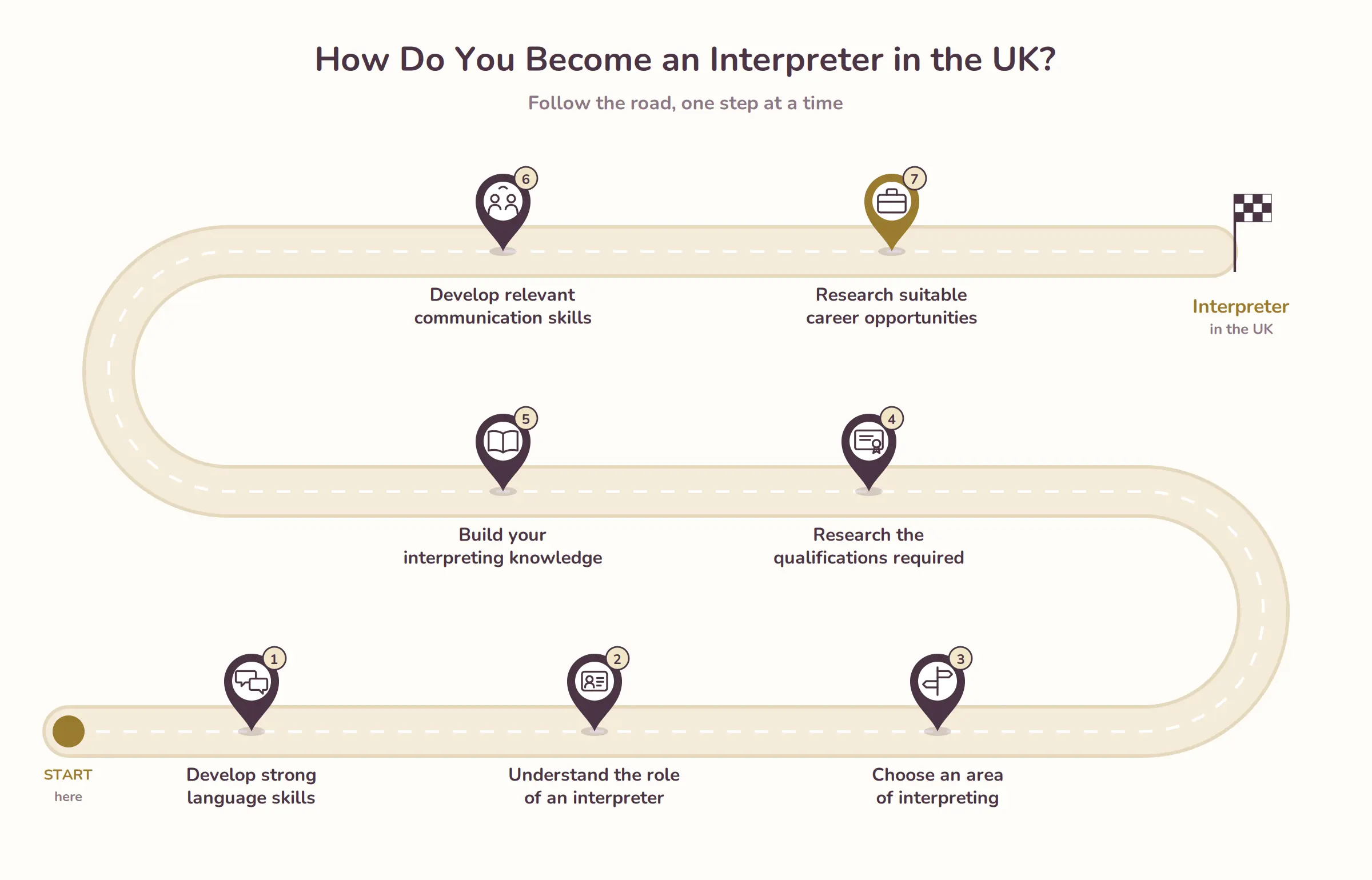
The right route will depend on the type of interpreting you want to pursue.
What Does an Interpreter Do?
An interpreter converts spoken or signed communication from one language into another while keeping the intended meaning clear.
Depending on their role, interpreters may work with individuals, groups, organisations or public services.
An interpreter may work in settings such as:
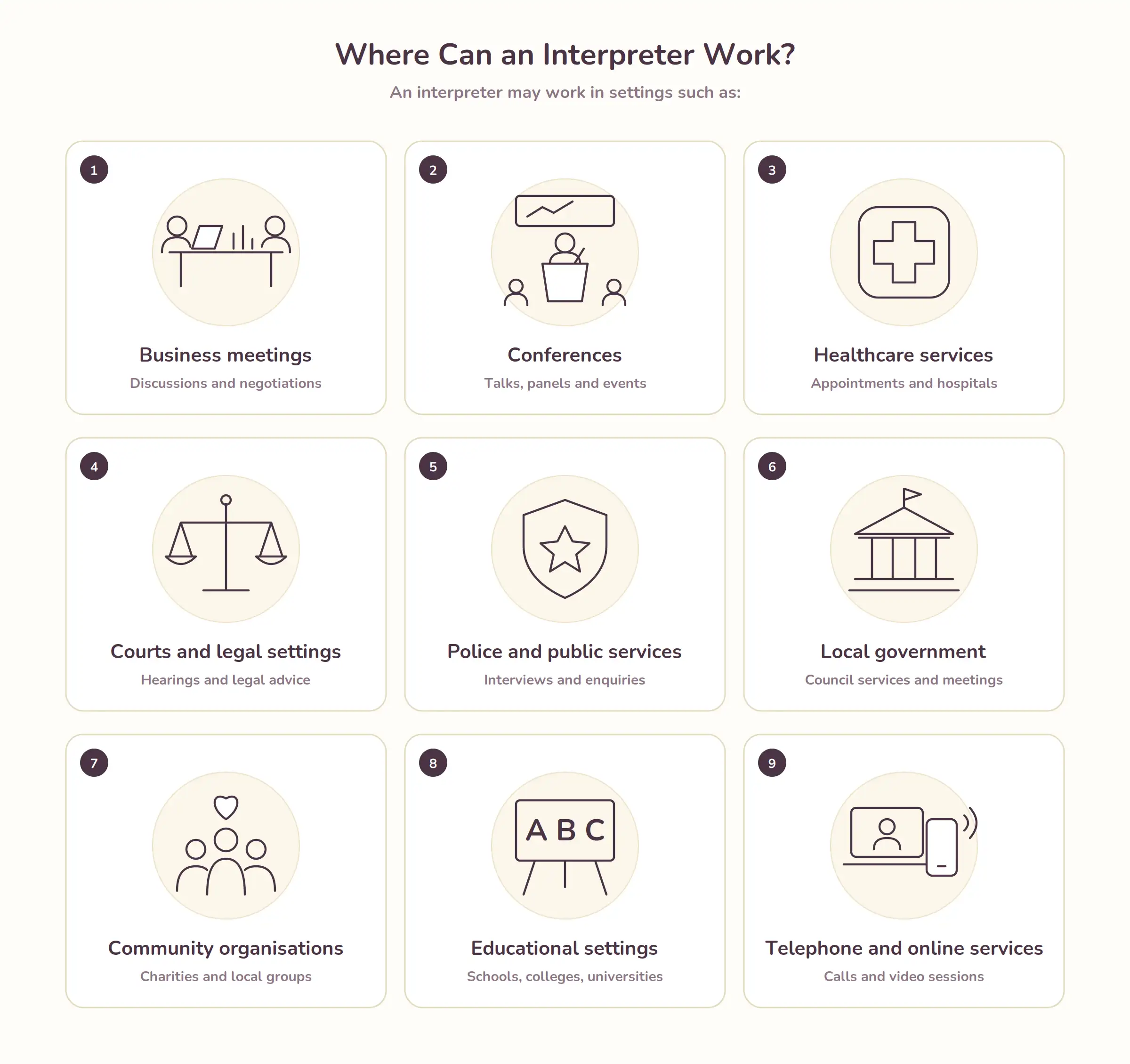
The National Careers Service identifies conference interpreting, business interpreting and public service interpreting as three main areas of professional interpreting.
This means that an interpreter career can involve different types of work rather than one fixed job environment.
Step 1: Develop Strong Language Skills
A strong command of English and another language is an important starting point.
Being able to speak two languages is useful, but interpreting also requires a good understanding of vocabulary, expressions, communication styles and cultural differences.
The National Careers Service highlights foreign language ability, English language knowledge, active listening, verbal communication, attention to detail and memory among the skills associated with interpreting.
If you are considering this career, continue improving both your English and your second language.
Step 2: Understand the Different Types of Interpreting
Before choosing an interpreter course, it is useful to understand the main areas of interpreting.
Conference Interpreting
Conference interpreters work with meetings, conferences, lectures and similar events where participants communicate in different languages.
Business Interpreting
Business interpreters support communication during meetings, events and discussions involving people who speak different languages.
Public Service Interpreting
Public service interpreters can work with legal, health, local government and community services.
The type of interpreting you choose can affect the qualifications and knowledge you may need later in your career.
Step 3: Research Interpreter Qualifications in the UK
One of the most important questions for anyone searching how to become an interpreter is which qualifications are required.
There is no single qualification that covers every interpreting role.
The National Careers Service lists several possible routes, including:
- University courses
- College courses
- Volunteering
- Specialist courses from professional bodies
Relevant university subjects can include interpreting studies, languages and interpreting, translation and interpreting, and modern languages.
Professional qualifications can also be relevant to particular areas of interpreting.
For example, the Chartered Institute of Linguists offers qualifications for public service interpreting, including the Diploma in Public Service Interpreting.
If you are at an earlier stage and want to build your understanding of interpreting, an Interpreter Diploma Level 3 can be one learning option to consider.
Step 4: Can You Become an Interpreter Without a Degree?
Yes, a university degree is not the only route into interpreting.
The route you choose depends on the type of interpreter role you want to pursue.
The National Careers Service lists college courses, volunteering and specialist professional-body courses alongside university study.
However, some specialist roles have specific qualification requirements.
For example, professional public service interpreting has its own qualification routes, while British Sign Language interpreting has separate requirements.
So, if you want to become an interpreter without a degree, research the requirements for the particular area you want to enter before choosing your training route.
Step 5: Build Your Interpreting Knowledge
Language ability alone does not cover everything involved in interpreting.
You also need to understand the role of an interpreter and the different approaches used to support communication.
Areas of knowledge can include:
- Interpreting methods
- Listening and communication
- Language terminology
- Professional communication
- Different interpreting settings
- The responsibilities of an interpreter
- Communication between different language groups
A structured interpreter course can give you a clear way to study these areas and build your knowledge around a defined curriculum.
Looking for an Interpreter Course?
If you want to study interpreting in a structured format, you can explore StudyHub’s Interpreter Diploma Level 3.
It is designed for learners who want to develop their knowledge of interpreting and explore the subject in greater depth.
Explore the Interpreter Diploma Level 3
This can be a useful point to consider if you are researching interpreter training in the UK and want to study the subject before deciding on your longer-term career route.
Step 6: Develop the Skills Needed to Be an Interpreter
If you are asking what skills do you need to become an interpreter, there are several areas worth developing.
Active Listening
Interpreters need to listen carefully and understand the meaning of communication.
Verbal Communication
Clear verbal communication is important when conveying information between languages.
Concentration
Interpreting requires attention to what is being said or signed and the ability to maintain focus.
Memory
Interpreters may need to retain information while communicating it in another language.
Attention to Detail
Small differences in wording can affect meaning, so attention to detail is important.
Language Knowledge
A strong understanding of English and another language provides the foundation for interpreting.
Cultural Understanding
Understanding differences in language and culture can help support clearer communication.
The National Careers Service also identifies independence, customer service and computer skills among the knowledge and abilities associated with interpreting.
Step 7: Consider Volunteering and Other Opportunities
If you are starting your career and want to develop relevant experience, volunteering can be one option to explore.
The National Careers Service highlights volunteering opportunities with organisations such as local councils, health and social services, welfare organisations, legal advice centres and community organisations.
This can help you understand different communication environments and support your longer-term career planning.
You can also monitor interpreter jobs in the UK to understand what employers and organisations are looking for.
Reading current job descriptions can help you identify commonly requested qualifications, languages and areas of knowledge.
Where Can Interpreters Work?
Interpreters can work across a variety of environments.
Depending on their area of work, they may work in:
Interpreters can work across a variety of environments.
Depending on their area of work, they may work in:
- Offices
- Conference centres
- Courts
- Police stations
- Hospitals
- Government services
- Business premises
- Community organisations
- Remote or online settings
The National Careers Service states that interpreters can work in places including businesses, conference centres, police stations, courts, prisons and hospitals.
Some interpreters work for organisations, while others work on a freelance or self-employed basis.
Can Interpreters Work Freelance?
Yes. Freelance work is one career option within interpreting.
The National Careers Service states that interpreters can work freelance or self-employed according to customer demand.
Freelance interpreting can involve working with different clients and organisations.
As your career develops, you may also choose to specialise in an area such as legal, medical, business or diplomatic interpreting. Career progression can also include coordination and management of interpreting services.
Interpreter vs Translator: What Is the Difference?
Interpreter and translator are related but different careers.
An interpreter generally works with spoken or signed communication.
A translator generally works with written communication.
For example, an interpreter may support a conversation between two people who speak different languages, while a translator may convert a document from one language into another.
If you enjoy listening, speaking and supporting communication between people, interpreting may be the area you want to explore.
If you prefer working with written content, translation may be more suitable.
How Much Does an Interpreter Earn in the UK?
Interpreter earnings can vary depending on factors such as language, experience, sector, location, type of work and whether you work freelance or for an organisation.
The National Careers Service currently lists interpreter salaries as variable, rather than giving one fixed national salary figure.
For this reason, anyone researching an interpreter career should check current vacancies and opportunities relevant to their language and chosen area.
Is Interpreting a Good Career Choice?
Interpreting can offer several career directions for people with strong language and communication abilities.
You could work across areas such as business, conferences or public services. With further development, you may also specialise in a particular field, work freelance or move into coordination and management.
Before choosing this career, consider whether you enjoy language, communication, listening and working with people.
It is also important to research the requirements of the specific interpreting field you want to enter.
What Is the Best Way to Start an Interpreter Career?
There is no single starting point for everyone.
A sensible approach is to assess your current language ability, research the type of interpreting you are interested in and identify the qualifications or learning routes relevant to that area.
You can then:
- Improve your language skills
- Study interpreting
- Research professional qualifications
- Explore volunteering opportunities
- Review current interpreter vacancies
- Identify the requirements for your preferred sector
- Continue developing your knowledge
If you are looking for a structured way to begin studying the subject, an Interpreter Diploma Level 3 can be one option to explore.
Start Your Journey with an Interpreter Diploma Level 3
If you have been searching for an interpreter course in the UK because you want to develop your understanding of interpreting, the next step is to choose a course that matches your learning goals.
StudyHub’s Interpreter Diploma Level 3 provides an opportunity to study the subject in a structured format.
Whether you are exploring interpreting as a future career or simply want to develop your knowledge of the field, reviewing the course content can help you decide whether it matches your goals.
Ready to Explore Interpreting?
Explore the StudyHub Interpreter Diploma Level 3 and take the next step in your learning journey.
Final Thoughts
Knowing how to become an interpreter starts with understanding the profession and identifying the route that matches your career goals.
Strong language ability is an important foundation, but interpreting also involves communication, listening, concentration, attention to detail and knowledge of different interpreting settings.
There are several routes into interpreting in the UK, including university study, college courses, volunteering and specialist professional qualifications. The right option depends on the type of interpreting you want to pursue.
If you are ready to build your knowledge of interpreting, exploring an Interpreter Diploma Level 3 can be a useful next step.
Frequently Asked Questions
There is no single qualification for every interpreting role. Possible routes include university courses, college courses, volunteering and specialist qualifications from professional bodies. Requirements can vary depending on the area of interpreting.
Yes. A degree is not the only route. College courses, volunteering and specialist professional-body qualifications are among the routes listed by the National Careers Service. However, some specialist interpreting roles have specific requirements.
Important areas include language knowledge, active listening, verbal communication, concentration, memory and attention to detail.
Interpreters generally work with spoken or signed communication, while translators generally work with written communication.
Some interpreting services can be delivered remotely or online. The working arrangement depends on the role, organisation and type of interpreting.
Yes. Freelance and self-employed work are options within interpreting, although the availability of work can vary.
You can explore relevant courses, college programmes, university study or professional qualifications depending on your career goals. An Interpreter Diploma Level 3 is one option for learners who want to develop their knowledge of the subject.
This depends on your existing knowledge, language ability and career goals. Review the course curriculum and entry information before enrolling to make sure it matches your needs.
- All Courses
- IT & Software388
- Management287
- Teaching and Education250
- Business245
- Health and Fitness227
- Engineering & Technology180
- Health & Safety163
- Health and Social Care143
- Quality Licence Scheme139
- Healthcare137
- Accounting & Finance130
- Psychology112
- Employability112
- Lifestyle105
- Marketing75
- Office Productivity74
- Animal Care63
- Design and Photography55
- Design50
- Beauty & Makeup49
- Accounting & Bookkeeping34
- Web Development27
- Construction26
- Writing20
- Child Care13
- Digital Marketing13
- Environment10
- Bundle8
- Coaching6
- Agriculture5

Awarded By


0 responses on "How to Become an Interpreter in the UK: A Complete Guide"