



Are Level 3 and Level 6 interpreting qualifications equally recognised? No. Their recognition, professional value and progression opportunities depend on the awarding organisation, qualification status and requirements of the role you want to pursue.
A Level 3 interpreting qualification can help you build foundation skills and prepare for further training. However, a general course certificate is not automatically an Ofqual-regulated qualification or a guarantee of employment.
A Level 6 Diploma in Public Service Interpreting (DPSI), awarded by CIOL Qualifications, is a regulated professional qualification with Law and Health pathways. It can support progression towards specialist public-service interpreting roles, subject to employer and professional requirements.
Before enrolling, check the qualification’s awarding organisation, RQF level and recognition status. You can verify regulated qualifications through the Ofqual Register.
Level 3 vs Level 6 Interpreting Qualifications at a Glance
Before choosing between different Interpreter Courses UK, it helps to understand what each qualification offers. The following table gives you a quick comparison of the two routes.
| Comparison | Level 3 Community Interpreting | Level 6 DPSI |
|---|---|---|
| Qualification level | Level 3, where the specific qualification is regulated at this level | Level 6 |
| Main purpose | Community-level interpreting | Professional public-service interpreting |
| Main focus | Basic consecutive interpreting and communication skills | Advanced interpreting and specialist public-service knowledge |
| Typical learning | Language skills, interpreting methods and professional conduct | Consecutive and simultaneous interpreting, sight translation and written translation |
| Specialist knowledge | Depends on the qualification | Law or Health pathway |
| Assessment | Depends on the awarding organisation | Formal oral and written assessment |
| Career direction | Suitable community interpreting opportunities, subject to requirements | Professional public-service interpreting opportunities |
| Further progression | May provide a foundation for further training | May support applications for professional membership and registration, subject to criteria |
The Ministry of Justice (MoJ) uses separate Community Level 3 and Professional Level 6 standards for its contracted justice interpreting services. These standards include qualification and experience requirements. They should not be treated as a universal rule for every interpreting job in the UK.
Which Is Better, Level 3 or Level 6?
Neither qualification is automatically better for every learner.
- Level 3:May suit someone developing community interpreting skills or exploring the profession.
- Level 6: May suit an experienced linguist preparing for professional public-service interpreting.
- Your career goal:The right route depends on the work you want to do and the requirements of the organisation providing it.
If you are researching the level 3 interpreting course vs level 6, remember that the qualification title, awarding organisation and assessment are just as important as the level.
For a wider overview of available routes, you can also explore our guide to interpreter qualifications and professional pathways. This supporting article focuses specifically on NHS and court interpreting.
What Is a Level 3 Community Interpreting Qualification?
A Level 3 Community Interpreting qualification is designed to develop interpreting skills for communication in community settings. It can help learners understand how to transfer spoken messages between languages accurately while following professional standards.
However, not every course with Level 3 in its title is a regulated Level 3 Community Interpreting qualification. Always check the exact qualification title, awarding organisation and regulatory status.

What Does Level 3 Interpreting Cover?
A recognised community interpreting qualification may cover areas such as:
- Consecutive interpreting between two languages.
- Listening and remembering important information.
- Using suitable language and terminology.
- Understanding different cultures and communication styles.
- Maintaining confidentiality and impartiality.
- Preparing for interpreting assignments.
- Communicating clearly in community settings.
These skills can help learners understand the responsibilities of an interpreter and develop a foundation for further professional training.
What Work Can a Level 3 Community Interpreter Explore?
Depending on the qualification, experience and provider requirements, community interpreters may explore opportunities in areas such as:
- Local community services.
- Suitable healthcare communication settings.
- Local authority services.
- Community support organisations.
- Some telephone and remote interpreting services.
For example, a community interpreter may help someone communicate with a local service provider when they cannot speak English confidently.
However, completing a Level 3 course does not guarantee access to NHS, court or police assignments. Each organisation may set its own standards.
Is a Level 3 Interpreting Course Enough to Become a Professional Interpreter?
It depends on the type of interpreting work you want to do.
A recognised Level 3 qualification may be relevant to community-level assignments, but specialist healthcare and legal work can require additional knowledge, experience and professional qualifications.
This is an important point when comparing the level 3 interpreting course vs level 6. A course can help you build knowledge, but it should not be presented as a guarantee of employment or professional registration.
If you are still exploring the profession, our guide on how to become an interpreter in the UK explains the different career routes and skills you may need.
What Is a Level 6 Diploma in Public Service Interpreting?
The Diploma in Public Service Interpreting (DPSI) is a professional qualification for people who want to work in specialist public-service interpreting.
The Chartered Institute of Linguists (CIOL) offers a Level 6 DPSI with Law and Health pathways. The qualification is Ofqual-regulated and assesses professional interpreting and translation skills in public-service settings.
When comparing the level 3 interpreting course vs level 6, the main difference is the depth of professional competence assessed and the complexity of the work each route is designed to support.
What Are the DPSI Law and Health Pathways?
The DPSI has specialist pathways for different public-service environments.
DPSI Law
This pathway focuses on legal and criminal justice interpreting. It is relevant to people who want to work in settings such as:
- Courts and tribunals.
- Police interviews.
- Criminal justice services.
- Other legal and justice-related settings.
CIOL confirms that DPSI Law is accepted by the UK Ministry of Justice for court and wider criminal justice work.
DPSI Health
This pathway focuses on interpreting in healthcare settings. It helps candidates develop the specialist language and interpreting skills needed to communicate in public-service health environments.
Both pathways require strong language skills, accurate interpreting and an understanding of professional responsibilities.
What Skills Does a Level 6 Interpreter Need?
The CIOL DPSI qualification includes five assessment units:
1.Consecutive and simultaneous interpreting.
2.Sight translation into English.
3.Sight translation from English.
4.Written translation into English.
5.Written translation from English.
These assessments help demonstrate a candidate’s ability to interpret and translate accurately in a public-service context.
Professional interpreters also need to understand confidentiality, impartiality, professional boundaries and specialist terminology.
Is Level 6 Equivalent to a Degree?
Level 6 is the same level of the Regulated Qualifications Framework (RQF) as a bachelor’s degree. However, this does not mean that every Level 6 diploma is an academic bachelor’s degree.
The DPSI is a specialist professional interpreting qualification. Its value comes from the professional knowledge and skills it assesses.
If you are considering the level 3 interpreting course vs level 6, check the qualification’s actual title and awarding organisation rather than comparing level numbers alone.
NHS Interpreter Qualifications and Professional Standards: What Do NHS Employers Expect?
What qualifications do you need to become an NHS interpreter? There is no single qualification requirement for every NHS interpreting role. Requirements can vary depending on the healthcare setting, interpreting provider and type of assignment. However, suitable training, professional standards and service quality are important when NHS organisations arrange language support.
The NHS England Improvement Framework for Community Language Translation and Interpreting Services explains how NHS trusts and Integrated Care Boards (ICBs) can improve interpreting services.
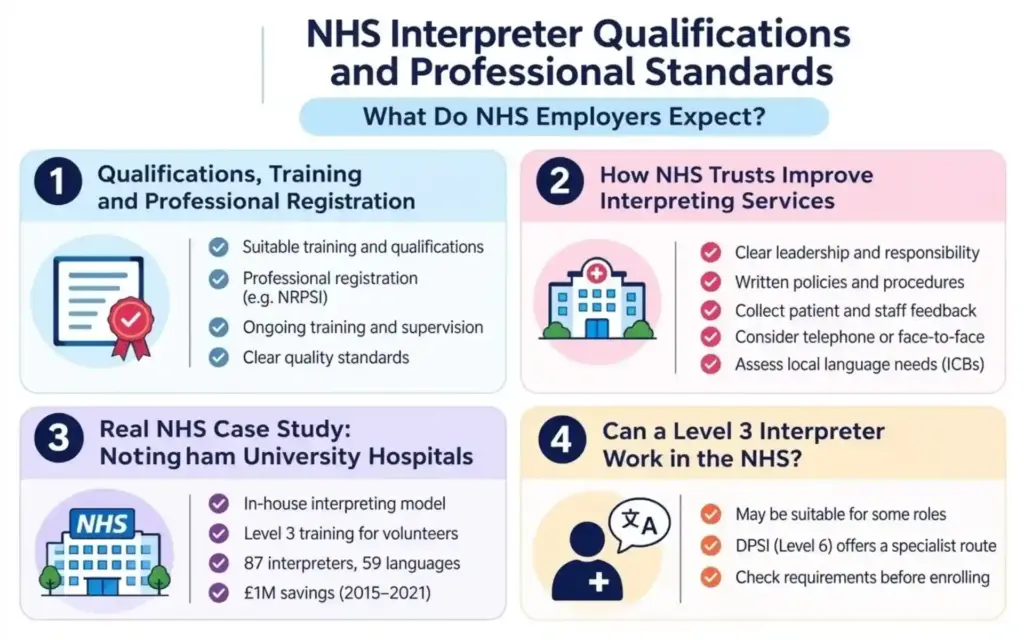
1. Qualifications, Training and Professional Registration
NHS trusts should set clear qualification and training standards when choosing interpreting service providers. They should also consider whether interpreters are registered with professional organisations, such as the National Register of Public Service Interpreters (NRPSI).
Other important considerations include:
- Relevant qualifications:Training should match the type of interpreting work.
- Professional registration: Organisations should check relevant professional registration where appropriate.
- Training and supervision: Interpreters should receive suitable preparation and support.
- Quality monitoring: Providers should have clear performance standards that NHS organisations can review.
This means that completing an interpreting course is only one part of professional development. You should also check the requirements of your intended NHS interpreting role.
2. How NHS Trusts Improve Interpreting Services
NHS trusts should have clear leadership and responsibility for interpreting services. The framework recommends written policies, standard operating procedures and regular reviews of service quality.
Trusts should also collect feedback from patients and healthcare staff, make sure employees know how to request interpreting support and consider whether telephone or face-to-face interpreting is more suitable.
ICBs also have a role in assessing local language needs, working with GP practices and improving access to interpreting services across their areas.
3. Real NHS Case Study: Nottingham University Hospitals
Nottingham University Hospitals NHS Trust provides a useful example of how interpreter training can support healthcare services.
After identifying patient complaints, rising costs and quality concerns in 2014, the trust developed an in-house interpreting model. It began with Polish interpreters in 2015 and later expanded to other languages.
The model combined trained volunteers, professional interpreters and external providers. Volunteers received Level 3 interpreting training and supervision, and some progressed into paid roles.
By March 2024, the service had 87 interpreters and three administrators, supported 59 languages and managed around 25,000 bookings each year. The framework also reports savings of almost £1 million between 2015 and 2021 compared with 2014/15 costs.
This example shows how Level 3 training can support interpreter development. However, it does not mean every Level 3 course qualifies someone for NHS interpreting work.
4. Can a Level 3 Interpreter Work in the NHS?
A Level 3 interpreting course may provide useful foundation knowledge and skills. Some NHS service models may also use Level 3-trained interpreters with supervision. However, requirements depend on the role and provider.
The Level 6 Diploma in Public Service Interpreting (DPSI), including its Health pathway, offers a more specialist professional route. Neither qualification automatically guarantees NHS employment.
Before choosing a course, check the exact qualification, awarding organisation, professional requirements and experience expected by your intended provider.
What Qualifications Do You Need to Become a Court Interpreter in the UK?
Court interpreting requires a high level of language skill, accuracy and professional conduct. Interpreters may work in courts, police interviews and other criminal justice settings. A mistake can affect how someone understands important legal information.
For this reason, court interpreting usually requires more than general language ability or a short introductory course.

The Diploma in Public Service Interpreting (DPSI) is a recognised professional qualification for public service interpreting. It has two main pathways:
- Law: For people who want to work in legal and criminal justice settings.
- Health: For people who want to work in healthcare and related public services.
The Chartered Institute of Linguists (CIOL) explains the DPSI qualification and its pathways on its Diploma in Public Service Interpreting page.
The Ministry of Justice also sets standards for language professionals working through its contracted language services. Its framework explains the expected qualifications, experience and professional standards.
You can read the latest guidance on the Ministry of Justice Language Services page.
Is a Level 3 Qualification Enough for Court Interpreting?
A Level 3 course can help you develop basic interpreting knowledge and practical skills. However, completing a general Level 3 course does not automatically qualify you to work as a court interpreter.
Court work may require a relevant professional qualification, suitable experience and approval under the requirements of the organisation or service provider.
If your goal is court interpreting, research the DPSI Law pathway and the current Ministry of Justice requirements before choosing a course.
You can also read our guide on how to become an interpreter in the UK for a wider overview of the profession.
Level 3 vs Level 6: Which Route Is Right for You?
| Your goal | Route to consider | Why it may suit you |
|---|---|---|
| Learn the basics of interpreting | Introductory or Level 3 learning | Helps build core knowledge and practical skills |
| Explore community interpreting | Relevant community interpreting training | Introduces communication in community settings |
| Work towards NHS interpreting | Relevant health or public service interpreting qualifications | Helps you understand healthcare communication and professional responsibilities |
| Work towards court interpreting | DPSI Law pathway or another accepted professional route | Provides specialist legal interpreting skills |
| Develop professional interpreting skills | Level 6 professional qualification | Offers more advanced training and assessment |
A level 3 interpreting course vs level 6 comparison is useful, but the qualification level alone should not decide your route. You should also check the course content, awarding organisation, assessment method and whether the qualification is accepted for your intended work.
Before enrolling, ask the course provider:
- What qualification or certificate will I receive?
- Is the qualification regulated, accredited or simply a course completion certificate?
- Which awarding organisation issues it?
- Does it prepare me for NHS, court or community interpreting?
- What further qualifications or experience might I need?
For a wider explanation of different routes, read our upcoming pillar guide: Interpreter Qualifications Explained and Compared
Can You Become an Interpreter Without a Degree?
Yes. A university degree is not a universal requirement for every interpreting role.
However, the requirements depend on the type of interpreting work you want to do. Some entry-level or community-based opportunities may focus on language ability, relevant training and experience. Specialist public service work can require a recognised professional qualification.

- Community interpreting may require relevant community interpreting training and experience.
- NHS interpreting providers may set their own qualification and experience standards.
- Court interpreting has specific professional requirements, so you should check the current Ministry of Justice framework and the requirements of the relevant service.
A Level 3 course can be a starting point for learning, but it should not be treated as a replacement for a specialist professional qualification where one is required.
If you are exploring Interpreter Courses UK, compare the entry requirements carefully. A course that teaches interpreting skills is not necessarily a qualification that allows you to work in every professional setting.
Interpreter Course Certificate Explained: What Will You Receive?
The phrase interpreter course certificate explained is important because not all certificates represent the same level of achievement.
Before choosing a course, understand the difference between these common types:
| Certificate or qualification | What it means |
|---|---|
| Course completion certificate | Shows that you completed a course or its required learning activities |
| CPD certificate | Records learning that may contribute to continuing professional development |
| Accredited course certificate | Shows that a course has been assessed or recognised under a named accreditation arrangement; check exactly what the recognition covers |
| Regulated qualification | A qualification regulated within the relevant UK qualifications framework, with an identifiable qualification title and awarding organisation |
A certificate does not automatically prove that you are qualified to work in NHS or court settings. Employers, agencies and public service providers may have additional requirements.
When you see interpreter course certificate explained in a course description, check the awarding body, accreditation details, assessment and exact certificate title. Do not assume that a CPD certificate is the same as an Ofqual-regulated qualification.
You can check regulated qualifications through the Ofqual Register. Search for the exact qualification title and awarding organisation rather than relying only on a course provider’s marketing description.
Interpreter Course Cost UK: What Should You Budget For?
The interpreter course cost UK can vary depending on the course level, subject, awarding organisation and assessment method.
A short online course may cost less than a specialist professional qualification. A professional diploma may also involve separate assessment, registration or examination costs.
When comparing the interpreter course cost UK, look beyond the advertised course fee. Check whether the price includes:
• All learning materials and course modules
• Tutor support
• Written or practical assessments
• Examination or assessment fees
• The final certificate
• Resit or additional assessment charges
A low course price does not always mean the course is the best value. Check whether its content matches your career goal and whether the certificate is suitable for the type of interpreting work you want to pursue.
What Is the Cost of a Level 3 or Level 6 Interpreting Course?
There is no single price for every Level 3 or Level 6 interpreting course.
The total cost depends on the provider and the qualification route. A general online learning course may have a different price structure from a regulated professional diploma with external assessment.
Before paying, compare at least two or three providers. Ask for a clear breakdown of tuition, assessment and certificate fees.
You can explore available learning options through StudyHub’s online courses.
Final Thoughts: Choose an Interpreting Route That Matches Your Goal
Choosing between Level 3 and Level 6 depends on the type of interpreting work you want to pursue.
A Level 3 course can help you develop your knowledge and explore the profession. If you want to work towards specialist NHS or court interpreting, research the relevant professional qualifications, experience requirements and service standards.
Do not choose a course based on its title alone. Check what the certificate represents, who awards it and whether it meets the requirements of your intended role.
If you are at the beginning of your learning journey, explore the StudyHub Interpreter Diploma Level 3 and compare it with the professional routes available in your chosen field.
For a broader understanding of the different options, continue to our pillar guide: Interpreter Qualifications Explained and Compared


Frequently Asked Questions
Level 3 learning generally provides a foundation in interpreting knowledge and skills. Level 6 DPSI is a professional diploma with specialist pathways, including Law and Health. The right choice depends on your career goal and the requirements of the work you want to do.
Possibly, depending on the role and the requirements of the NHS organisation or interpreting provider. A Level 3 course does not guarantee NHS work. Always check the provider’s qualification and experience requirements.
The DPSI Law pathway is an established professional route for court and criminal justice interpreting. However, you should check the current Ministry of Justice framework and the specific requirements of the service or organisation before applying.
No. RQF Level 6 is the same framework level as a bachelor’s degree, but the DPSI is a professional diploma, not a bachelor’s degree.
Not necessarily. A CPD certificate records learning, but it does not automatically meet the qualification requirements for NHS, court or other specialist interpreting work. Check the requirements of your intended employer or service provider.
The cost depends on the course provider, qualification level, assessment and certificate fees. Compare the full cost rather than looking only at the advertised tuition price.
Yes. Many providers offer online interpreting courses. However, online learning does not automatically make a course suitable for professional NHS or court work. Check its content, assessment and recognition before enrolling.
Check the course level, awarding organisation, certificate type, assessment method, course content and any professional requirements linked to your career goal.
- All Courses
- IT & Software389
- Management287
- Teaching and Education250
- Business245
- Health and Fitness227
- Engineering & Technology180
- Health & Safety163
- Health and Social Care144
- Quality Licence Scheme139
- Healthcare137
- Accounting & Finance130
- Psychology112
- Employability112
- Lifestyle105
- Marketing75
- Office Productivity74
- Animal Care63
- Design and Photography55
- Design50
- Beauty & Makeup49
- Accounting & Bookkeeping34
- Web Development27
- Construction26
- Writing20
- Child Care17
- Digital Marketing13
- Environment10
- Bundle8
- Coaching6
- Agriculture5

Awarded By

0 responses on " Level 3 vs Level 6 Interpreting Routes Compared"