



Thinking about changing careers but still want to work in healthcare? Clinical coding could be worth considering, especially if you enjoy working with information, solving problems and paying attention to detail.
A clinical coding career change is possible without previous coding experience. Some NHS trainee roles accept applicants from other industries, provided they meet the employer’s education and skills requirements.
Clinical coders turn information from patient records into standardised codes. These codes help the NHS manage healthcare data, monitor services and support research.
This guide explains how to start a clinical coding career change, which existing skills may help and what training to consider before applying for NHS jobs.
✓QLS Level 3
Clinical Coding Online Course
Check the modules, assessment and current certificate options before you enrol.
Can You Change Careers Into Clinical Coding Without Experience?
Yes. You can begin a clinical coding career change without previous coding experience, although you must meet the requirements of the job you’re applying for.
Some NHS trusts recruit trainee clinical coders and provide workplace training. This creates opportunities for people who want to move into healthcare from another profession.
However, you should check each vacancy carefully. Entry requirements and training arrangements are not identical across NHS employers.
Do You Need a Degree or Healthcare Experience?
A university degree is not always required for a trainee clinical coder position.
According to the NHS clinical coder career guidance, applicants generally need a good basic education, including GCSEs or equivalent qualifications in English, maths and science. Computer skills are also important.
For example, Royal Devon University Healthcare NHS Foundation Trust has advertised trainee opportunities for applicants with computer skills, analytical ability and knowledge of anatomy, physiology and medical terminology.
Previous healthcare experience can be useful, but it is not always essential.
Who Is Clinical Coding Suitable For?
A clinical coding career change may suit people who enjoy structured tasks and working carefully with written information.
Useful personal qualities include:
- Strong attention to detail.
- Confidence using computers.
- Good reading and communication skills.
- Ability to follow instructions.
- Respect for patient confidentiality.
- Willingness to learn medical terminology
You don’t need to know every medical term before starting. However, developing basic knowledge can help you prepare for training and job applications.
Which Skills Can You Transfer From Your Previous Job?

Changing careers doesn’t mean starting without useful experience.
Many everyday workplace skills can support a clinical coding career change, particularly those involving records, accuracy and confidential information.
| Previous Job | Transferable Skills |
|---|---|
| Care assistant | Patient confidentiality, healthcare terminology and record keeping |
| Receptionist | Communication, data entry and organisation |
| Administrator | Document management, IT skills and accuracy |
| Retail worker | Following procedures, checking information and meeting deadlines |
| Data entry worker | Record checking, computer skills and attention to detail |
For example, a receptionist who regularly updates customer records may already understand the importance of entering information accurately.
Similarly, a care assistant may be familiar with medical terms and the importance of protecting sensitive information.
These skills can strengthen an application, although they do not replace clinical coding training.
Practical tip: Before beginning your clinical coding career change, write down three examples from your previous work that demonstrate accuracy, confidentiality or problem-solving.
You can later use these examples in your CV and NHS supporting statement.
Your Five-Step Clinical Coding Career Change Roadmap
A successful clinical coding career change begins with understanding the role and preparing for the training employers expect.
You don’t need to learn everything immediately. Follow these five practical steps to build a clear starting plan.
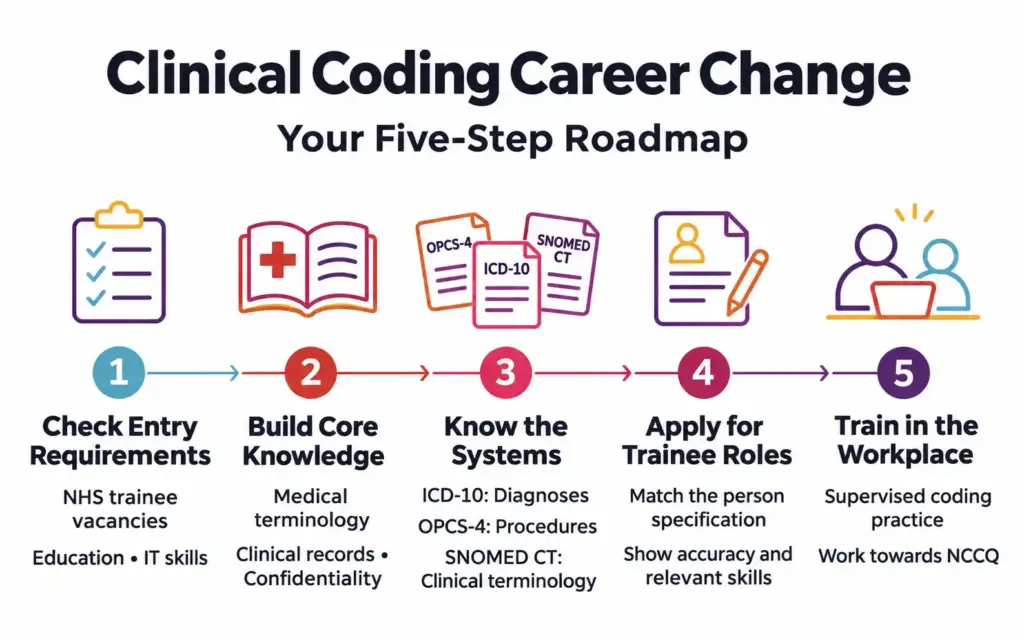
Step 1 — Check NHS Entry Requirements
Start by looking at trainee clinical coder vacancies on NHS Jobs.
Read the job description and person specification carefully. Check the education requirements, computer skills and any knowledge listed as essential or desirable.
Some employers accept applicants without previous coding experience, while others prefer healthcare administration experience.
If you’re planning a clinical coding career change, focus first on vacancies that welcome trainees rather than experienced or accredited coders.
Step 2 — Learn Medical Terminology and Clinical Records
Medical terminology is an important starting point because clinical coders work with healthcare documents.
Begin by learning common medical words, basic anatomy and how clinical records are organised.
You should also understand why patient information must remain confidential.
If you prefer structured introductory learning, StudyHub’s Clinical Coding Online Course at QLS Level 3 introduces medical terminology, clinical records, coding principles and confidentiality.
The course offers flexible online study and is endorsed by the Quality Licence Scheme as non-regulated training.
It can help you build foundational knowledge, but it does not replace NHS professional coding training or award the National Clinical Coding Qualification.
Step 3 — Understand Clinical Coding Systems
Before applying for NHS clinical coding jobs, become familiar with three important systems.
- ICD-10: Used to classify diagnoses and health conditions.
- OPCS-4: Used to classify clinical interventions and procedures.
- SNOMED CT: A structured clinical terminology used to record information in electronic patient records.
These systems have different purposes. Learning their basic roles is a useful part of your clinical coding career change preparation.
You don’t need to memorise every code before applying for a trainee position. Focus on understanding what the systems do and why accuracy matters.
Step 4 — Apply for Trainee Clinical Coder Jobs
Once you understand the basic requirements, begin searching for suitable entry-level vacancies.
Use terms such as trainee clinical coder, clinical coding trainee and NHS clinical coding jobs.
When preparing your application:
- Match your experience to the person specification.
- Give examples of accurate work and confidentiality.
- Mention relevant introductory learning.
- Explain why you’re interested in clinical coding.
Avoid claiming professional coding experience or qualifications you haven’t earned.
Step 5 — Complete Workplace Training and Work Towards NCCQ
After securing a relevant NHS clinical coding role, you’ll normally receive supervised training.
Under NHS England’s clinical coding training guidance, relevant new clinical coders must begin the Clinical Coding Standards Course within six months of starting employment.
With experience and appropriate preparation, coders may work towards the National Clinical Coding Qualification (NCCQ), the recognised national professional qualification.
This is an important longer-term step in a clinical coding career change, particularly for people seeking progression into experienced or specialist positions.
Which Clinical Coding Training Route Should You Choose?
Choosing the right training is an important part of your clinical coding career change. Some courses help beginners understand the subject, while others support professional development after joining an NHS coding team.
Before enrolling, compare what each training option teaches, how it assesses learners and what qualification it provides.
Introductory Online Courses vs NHS Workplace Training
An introductory online course can help you understand medical terminology, patient records and basic coding principles before applying for trainee roles.
NHS workplace training is different. It involves supervised practice, national coding standards and learning to classify real clinical information accurately.
| Training Route | Main Purpose | Best Suited To |
|---|---|---|
| Introductory online course | Build foundational knowledge | Beginners and career changers |
| NHS Clinical Coding Standards Course | Learn national coding standards. | Eligible employed clinical coders |
| National Clinical Coding Qualification (NCCQ) | Demonstrate professional competence | Experienced coders preparing for accreditation |
According to NHS England’s clinical coding training guidance, national coding training follows defined requirements and must use approved learning materials.
For a successful clinical coding career change, choose training that matches your current stage rather than paying for a qualification you are not yet eligible to complete.
QLS Level 3, CPD and NCCQ Explained
These terms appear frequently when comparing clinical coding courses UK learners may consider.
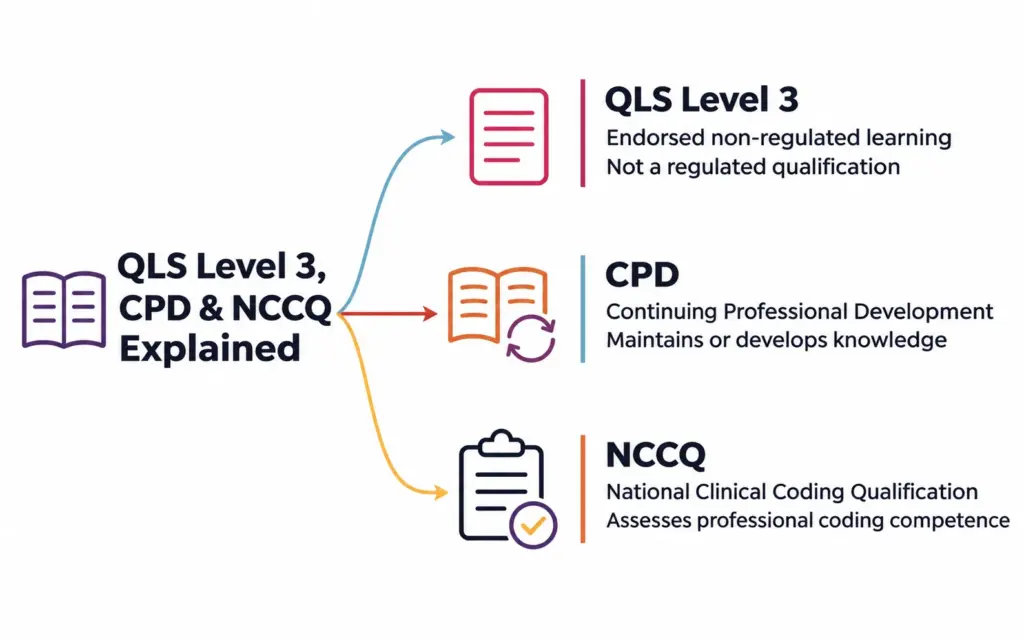
However, they do not mean the same thing.
- QLS Level 3: Endorsement of non-regulated learning. It does not automatically provide a regulated qualification.
- CPD: Continuing Professional Development, which helps people maintain or develop professional knowledge.
- NCCQ: The National Clinical Coding Qualification, which assesses professional coding competence.
NHS England identifies the NCCQ as the recognised national qualification for clinical coders.
If you’re researching clinical coding qualifications in the UK, it is important to distinguish introductory learning from professional accreditation.
How to Apply for Your First NHS Clinical Coding Job
Finding your first NHS trainee role is an important step in a clinical coding career change.
Employers want applicants who can work carefully with information, follow instructions and demonstrate a willingness to learn.
Even without coding experience, you can show relevant strengths from your previous employment.
What to Include in Your Career-Change CV
Your CV should highlight skills that match the vacancy’s person specification.
Focus on:
- Accuracy: Experience checking information or maintaining records.
- IT skills: Confidence using computers, spreadsheets or workplace systems.
- Confidentiality: Understanding the importance of protecting private information.
- Communication: Ability to explain information clearly and ask questions when needed.
- Learning: Relevant training, courses and examples of developing new skills.
For example, an administrator could explain how they maintained accurate records and corrected errors.
A care worker might describe their experience handling confidential information and following procedures.
Use genuine examples rather than claiming coding experience you haven’t gained.
How to Prepare for a Trainee Clinical Coder Interview
Interview preparation should focus on the requirements of the advertised job.
You may be asked how you manage detailed information, maintain accuracy or respond when something is unclear.
Prepare examples of situations where you:
- Found and corrected an error.
- Followed a written procedure.
- Handled sensitive information.
- Learned a new computer system.
- Completed detailed work within a deadline.
You should also understand the basic purpose of ICD-10 and OPCS-4.
A clinical coding career change doesn’t require you to know every clinical code before applying for a trainee job. However, showing genuine interest and preparation can help demonstrate your suitability.
Is Clinical Coding a Good Career Change in 2026?
A clinical coding career change may appeal to people who prefer organised, detail-focused work and want to contribute to healthcare without providing direct patient care.
However, it is important to consider the salary, working conditions and learning requirements before deciding.
Clinical Coder Salary and Career Progression
NHS clinical coding salaries depend on the role, pay band, employer and experience.
The official NHS England 2026–27 pay scales provide the following annual basic salary ranges.
| NHS Pay Band | Annual Salary Range |
|---|---|
| Band 3 | £25,760–£27,476 |
| Band 4 | £28,392–£31,157 |
| Band 5 | £32,073–£39,043 |
These are NHS England pay-band figures, not guaranteed salaries for particular clinical coding positions.
Some trainee posts are advertised at Band 3, while more experienced coding roles may be placed in higher bands.
Progression depends on the employer, professional competence, experience and job responsibilities.
For a fuller explanation of clinical coding roles, salaries and NCCQ progression, StudyHub’s clinical coding career guide covers these topics in more detail.
Will AI Replace Clinical Coders?
AI is already being explored to support clinical coding tasks, including identifying information in patient records and suggesting possible codes.

However, using AI does not remove the need to check accuracy or follow national coding standards.
Clinical information can be complex. Coders must interpret documentation, apply classification rules and identify missing or unclear details.
NHS England’s clinical coding standards and quality guidance continues to emphasise accurate coding, staff training and quality checks.
It is not possible to predict exactly how AI will affect future employment.
For someone considering a clinical coding career change, developing coding knowledge alongside digital skills is a sensible approach.
Remote and hybrid roles may also be available, but working arrangements depend on the employer. Trainees may need to complete supervised onsite training before flexible working becomes an option.
Your 30-Day Clinical Coding Career Change Plan
You don’t need to make every career decision at once. A simple four-week plan can help you prepare for the next step.
This clinical coding career change roadmap is designed for beginners who want to investigate the profession while managing their current commitments.
| Week | Main Focus | Practical Actions |
|---|---|---|
| Week 1 | Research NHS requirements | Read trainee vacancies and identify transferable skills |
| Week 2 | Build basic knowledge | Study medical terminology, clinical records and coding concepts |
| Week 3 | Prepare for applications | Compare training options and update your CV |
| Week 4 | Take the next step | Identify suitable jobs and prepare applications |
What Should You Achieve After 30 Days?
By the end of the month, aim to understand:
What a clinical coder does.
- Which entry requirements you already meet.
- Which skills you still need to develop.
- What introductory training is available.
- How to prepare a relevant trainee job application.
Thirty days is a starting period, not enough time to become a fully trained or accredited clinical coder.
If you need more time, adjust the plan to fit your schedule. Consistent learning matters more than rushing through the process.
✓QLS Level 3
Clinical Coding Online Course
Check the modules, assessment and current certificate options before you enrol.
Is StudyHub's Clinical Coding Course Right for Career Changers?
If you’re beginning a clinical coding career change, introductory online training can help you become familiar with the subject before considering professional opportunities.
StudyHub’s Medical Coding Certification: Clinical Coding Online Course at QLS Level 3 introduces medical terminology, clinical records, ICD-10, OPCS-4, SNOMED CT and confidentiality.
The course offers flexible online learning and includes a written assignment assessment. Optional certificates are available under the provider’s published terms.
No previous qualifications or experience are required to enrol.
However, the Quality Licence Scheme endorsement relates to non-regulated learning. Completing this course does not award the NCCQ or replace NHS-approved clinical coding training.
For learners who want to build introductory knowledge, it may be a useful first step.
Final Thoughts
A clinical coding career change can provide a route into healthcare information work for people from different professional backgrounds.
The best starting point is to understand NHS entry requirements, identify your transferable skills and build basic knowledge of medical terminology and coding systems.
Introductory learning may help you prepare, but professional competence develops through appropriate workplace training and experience.
Take time to compare training options, prepare a relevant CV and apply for suitable trainee vacancies.
With realistic expectations and a clear learning plan, you can make an informed decision about whether clinical coding is the right next step for your career.
Frequently Asked Questions
Yes. Some NHS trusts recruit trainee clinical coders without previous coding experience. However, applicants must meet the relevant education and skills requirements.
A clinical coding career change is possible from administration, care or other industries if you can demonstrate suitable abilities and meet the employer’s criteria.
NHS clinical coding salaries vary by pay band and responsibility.
In England, the 2026–27 Band 3 annual basic salary ranges from £25,760 to £27,476. Band 4 ranges from £28,392 to £31,157.
These figures are official pay-band rates rather than guaranteed salaries for every clinical coding role.
Clinical coding can be challenging at first because it involves medical terminology, detailed patient records and national classification rules.
However, structured learning and supervised practice can help beginners develop their skills.
Accuracy, patience and willingness to learn are particularly important.
AI may automate some coding-related tasks, but its long-term impact on clinical coding jobs remains uncertain.
Clinical coding still requires accurate interpretation, national standards and quality assurance.
People planning a clinical coding career change should develop both classification knowledge and confidence using digital tools.
If you’re completely new to the subject, consider introductory training covering medical terminology, clinical records and UK coding classifications.
Before enrolling, check the course content, assessment and qualification status.
For NHS career progression, remember that introductory courses are separate from the recognised workplace training and NCCQ pathway.
- All Courses
- IT & Software389
- Management287
- Teaching and Education250
- Business245
- Health and Fitness227
- Engineering & Technology180
- Health & Safety163
- Health and Social Care144
- Quality Licence Scheme139
- Healthcare137
- Accounting & Finance130
- Psychology112
- Employability112
- Lifestyle105
- Marketing75
- Office Productivity74
- Animal Care63
- Design and Photography55
- Design50
- Beauty & Makeup49
- Accounting & Bookkeeping34
- Web Development27
- Construction26
- Writing20
- Child Care17
- Digital Marketing13
- Environment10
- Bundle8
- Coaching6
- Agriculture5

Awarded By


0 responses on "Clinical Coding Career Change: Practical Guide"