



Clinical coding course fees vary widely across UK providers. Short online certificates are usually the cheapest option. Certificate and exam fees are often charged separately.
The NCCQ has its own costs. Many NHS employers fund training for trainee coders. Budget for tuition, certificates, exams and study time. Check what every fee includes before you pay.
Two clinical coding courses can look almost identical online and still differ noticeably in price. One may include its certificate. Another may charge for it separately. A third may teach coding systems that NHS hospitals don’t use at all.
That is why clinical coding course fees are rarely as simple as the figure on the page. In the UK, what you actually pay depends on your route into the role, from self-funded online study to training arranged by an NHS employer. This guide sets out what each route usually involves, which costs sit outside the headline fee, and how to judge whether a course is good value for you.
If you are still deciding whether clinical coding is the right path, our guide to clinical coding courses in the UK covers the wider training picture first.
How Much Does a Clinical Coding Course Cost in the UK?
Your route into clinical coding shapes the cost more than any single course price.
There is no single price. Short online certificate courses are usually the lowest-cost option for self-funded learners. Training for NHS trainee coders is commonly arranged by the employer. The National Clinical Coding Qualification (NCCQ) is a separate professional qualification with its own fees.
| Route | Who usually pays | What it leads to | What to budget |
|---|---|---|---|
| Online certificate course | You | Foundation knowledge and a certificate, often non-regulated | Course fee plus any certificate fees |
| Trainee coder post in an NHS organisation | Usually the employer | Training in national coding standards while you work | Usually no tuition cost to you; check the job advert |
| NCCQ | You or your employer | Accredited Clinical Coder status | Exam fees set by the awarding body |
Before comparing prices, check which coding system a course teaches. NHS hospitals in England use ICD-10 and OPCS-4 national clinical classifications for diagnoses and procedures. Many low-cost courses online are built around US systems such as CPT and ICD-10-CM instead, which serve a different healthcare and billing model.
A cheaper course is no bargain if it prepares you for the wrong system. Our guide to the difference between medical and clinical coding explains why this matters for UK roles.
Why Do Clinical Coding Course Fees Vary So Much?
Price reflects depth, certification and support, not quality alone.
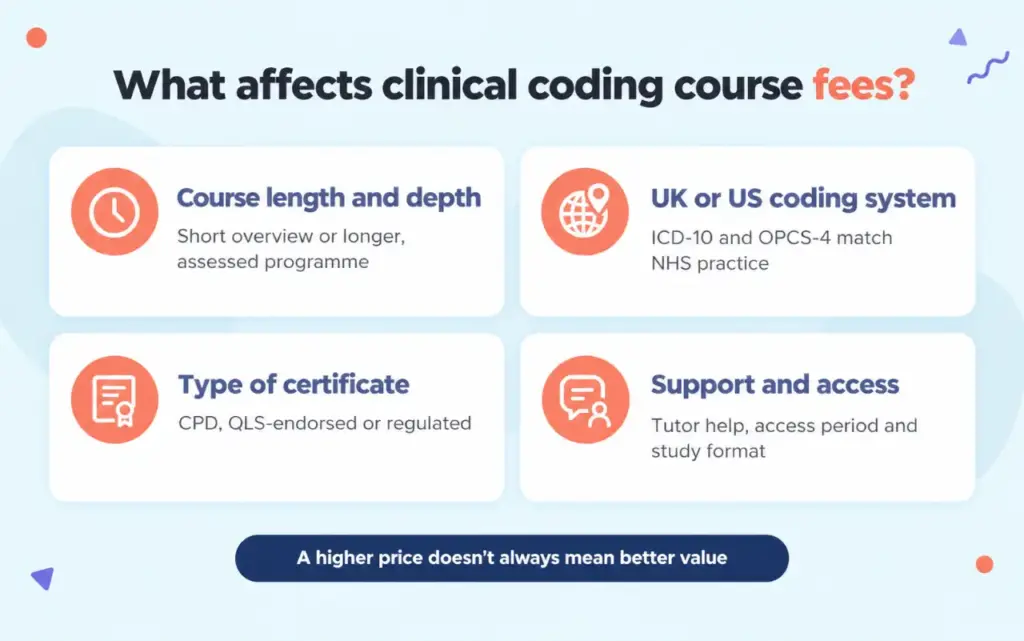
Course length and depth
A short introductory course covering the basics in under 20 hours will cost less than a longer, tutor-assessed programme. Neither is automatically better. The right choice depends on whether you want an overview or more intensive preparation.
UK or US coding systems
Courses teaching ICD-10 5th Edition and OPCS-4 match NHS practice. Courses teaching CPT, HCPCS or the CPC exam are aimed at the US market, even when they are sold to UK learners.
Type of certificate
Certificates sit at different levels of recognition:
CPD certificates confirm you completed structured learning.
QLS endorsement comes from the Quality Licence Scheme, a UK organisation that sets standards for non-regulated training.
Regulated qualifications appear on the Ofqual Register of Regulated Qualifications.
None of these is the same as the NCCQ, which is the professional qualification for NHS coders.
Support, access and format
Tutor support, the length of course access and the study format all affect price. For a closer look at how self-paced study works in practice, review our guide to studying clinical coding online.
Can You Get Clinical Coding Training Funded or Free?

Yes, in some cases. NHS Health Careers describes clinical coders as typically receiving training once they are in post, including training in national coding standards. For many people, the most cost-effective route is applying for a trainee coder role rather than paying for extensive training first.
Existing NHS staff in administrative or medical records roles may also be able to move into coding internally, with training arranged by their organisation. Our guide to NHS-approved clinical coding training explains how these official routes work.
Trainee posts still have entry criteria, and competition can be strong. For details on what employers and providers usually look for, check our guide to clinical coding course requirements.
So where does a self-funded course fit? It doesn’t replace employer training. What it can do is give you working familiarity with ICD-10, OPCS-4 and clinical records before you apply and show a clear interest in the field on your CV and at the interview.
Is a Clinical Coding Course Worth the Money?
A course is worth it when it matches your next career step.
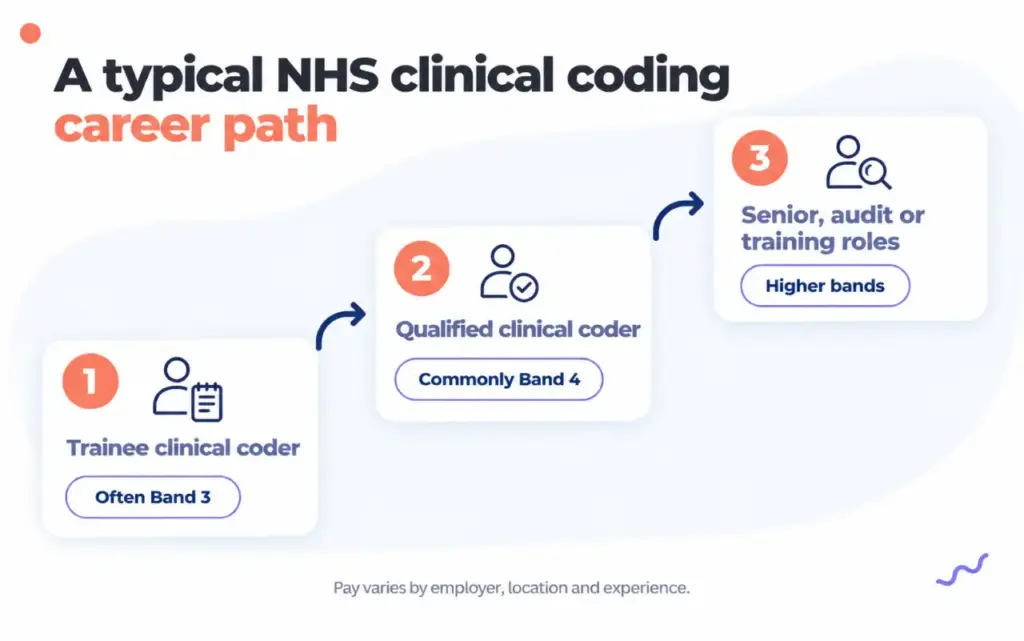
Value depends on what you need the course to do. NHS clinical coding roles are paid on Agenda for Change pay bands. Trainee posts are often advertised at Band 3 and qualified coder roles commonly at Band 4, with senior, audit and training roles higher. Actual pay depends on the employer, location and experience.
It also helps to be clear about what a certificate can and can’t do. A foundation course can show initiative and give you a head start on terminology. It is not a licence to practise, and it doesn’t guarantee a job.
Two illustrative budgeting scenarios
These examples are illustrative, not real case studies.
A career changer. Sam works in retail and wants to move into NHS administration. A low-cost online course helps Sam decide whether coding suits them before applying for trainee posts. Sam opts for the PDF certificate and keeps the remaining budget for interview preparation.
An NHS receptionist. Priya already works in a hospital outpatient department. Her manager supports an internal move into coding, with training provided. For Priya, paying for a long external course would add little. A short introduction to the classifications is enough to prepare for conversations with the coding team.
If you are new to the field, our guide to beginner clinical coding courses can help you match a course to your starting point.
How to Compare Clinical Coding Course Fees Before You Pay
Compare total cost, UK relevance and certificate type side by side.
Use this checklist before you enrol anywhere:
- Confirm the course teaches ICD-10 5th Edition and OPCS-4, not US systems only.
- Check whether certificates cost extra and which one you need.
- Check whether the price includes VAT and whether instalments are available.
- Check how long you will have access to the course materials.
- Find out what tutor support is included and when it is available.
- Read exactly how the certificate is described: CPD, QLS-endorsed or regulated.
- Treat any promise of a guaranteed job with caution.
Budgeting for Clinical Coding Training
Plan for the total cost of your route, not just the course price.
Clinical coding course fees make the most sense when you look at the whole picture. Add certificate, exam and time costs to the advertised price. Check whether an employer-funded trainee post could cover the training you need. Then choose the option that fits your next step.
If you’d like a low-cost introduction to UK coding systems before applying for roles, the Medical Coding Certification: Clinical Coding Online Course at QLS Level 3 covers ICD-10, OPCS-4 and SNOMED CT at your own pace.
Frequently Asked Questions
A coding course typically costs £100–£1,000 or more, depending on the provider, course level, duration and whether certification is included.
Medical coding training can cost £100–£1,000+, while professional certification examinations may involve additional fees depending on the awarding organisation.
Yes, you can learn medical coding fundamentals in three months with consistent study, although professional proficiency and certification preparation may require longer.
Medical coding salaries vary by country, qualifications and experience. Entry-level coders generally earn less than experienced professionals with specialist certifications.
Specialist roles such as coding auditor, compliance manager and clinical documentation improvement specialist can offer higher salaries than entry-level medical coding positions.
The United States is among the highest-paying countries for medical coding, particularly for experienced certified specialists working in hospitals and healthcare organisations.
AI is unlikely to replace medical coders entirely. However, automation may handle routine tasks, making human expertise essential for complex coding and accuracy.
- All Courses
- IT & Software389
- Management287
- Teaching and Education250
- Business245
- Health and Fitness227
- Engineering & Technology180
- Health & Safety163
- Health and Social Care144
- Quality Licence Scheme139
- Healthcare137
- Accounting & Finance130
- Psychology112
- Employability112
- Lifestyle105
- Marketing75
- Office Productivity74
- Animal Care63
- Design and Photography55
- Design50
- Beauty & Makeup49
- Accounting & Bookkeeping34
- Web Development27
- Construction26
- Writing20
- Child Care17
- Digital Marketing13
- Environment10
- Bundle8
- Coaching6
- Agriculture5

Awarded By


0 responses on "Clinical Coding Course Fees: What to Budget"