



Learning British Sign Language (BSL) can open up new ways to communicate with Deaf people and become a valuable skill for personal development, work and everyday life. But if you are completely new to BSL, knowing where to begin can be difficult.
Should you learn the alphabet first? How many signs should you learn? Can you learn BSL online? And how long does it take to become confident?
The easiest way to start is to build your knowledge gradually. Begin with the BSL fingerspelling alphabet, everyday signs, greetings, numbers and simple phrases. As your vocabulary grows, move into BSL grammar, facial expressions, receptive skills and conversation practice.
This guide explains how to start learning British Sign Language, what to learn first, how to practise effectively and what you can do to progress beyond the basics.
What Should I Learn First in British Sign Language?
If you are a complete beginner, start with signs that you can use in everyday communication. Learning useful vocabulary first gives you a foundation for creating simple conversations rather than simply memorising long lists of signs.
A good starting point includes:
- The BSL fingerspelling alphabet
- Greetings and polite expressions
- Numbers
- Names and introductions
- Family and relationships
- Everyday activities
- Common questions
- Basic feelings and descriptions
- Simple conversational phrases
You do not need to learn hundreds of signs before you can start communicating. Begin with a manageable group of useful signs, practise them regularly and gradually add new vocabulary.
Start With Greetings and Basic Expressions
Begin with common expressions such as:
- Hello
- Goodbye
- Please
- Thank you
- Sorry
- Yes
- No
- How are you?
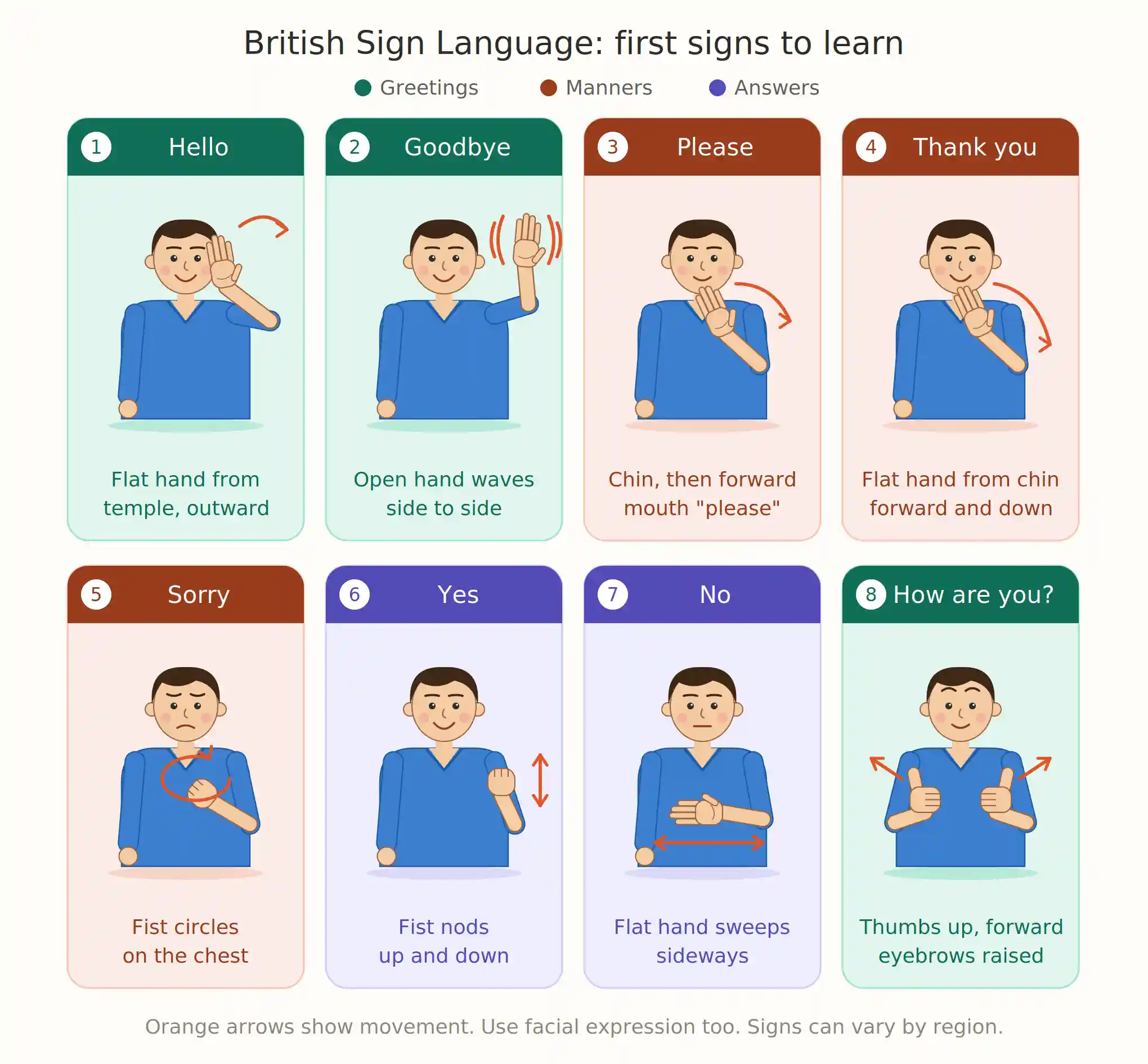
These signs can help you become familiar with BSL communication while giving you vocabulary that is useful from the beginning.
Learn How to Introduce Yourself
Once you know a few basic signs, practise introducing yourself.
You can focus on information such as:
- Your name
- Where you live
- Your age
- Your work or studies
- Your interests
- Your family
Learning signs as part of short introductions can be more useful than memorising isolated vocabulary.
Learn Numbers and Everyday Information
Numbers are another useful area for beginners. You can gradually use them when communicating ages, dates, times and other everyday information.
After learning basic numbers, move on to vocabulary related to:
- Family
- Food and drink
- Work
- Study
- Home
- Travel
- Shopping
- Hobbies
Learn Common Questions
Questions help turn vocabulary into communication.
Start with simple questions about names, locations, interests, feelings and everyday activities. Pay attention to facial expressions and other visual features because meaning in BSL is not communicated through hand movements alone.
Should I Learn the BSL Alphabet First?
Yes, learning the BSL fingerspelling alphabet is a useful early step, but it should not become your entire learning method.
Fingerspelling can help you communicate names, places and words when you do not know a particular sign. It can also help you become more familiar with BSL handshapes.
However, BSL is a complete visual language with its own vocabulary and grammar. It is not simply English represented through hand movements.
A better approach is:
Learn the alphabet → Learn everyday signs → Build short phrases → Develop grammar → Practise conversations
Learning these areas together gives you a more balanced foundation.
Can I Teach Myself BSL at Home?
Yes, you can begin learning British Sign Language at home using structured online resources, demonstrations, dictionaries and regular practice.
Learning at home can be particularly useful if you have limited time or prefer studying at your own pace.
A simple home-learning routine could include:
Learn → Watch → Practise → Review → Repeat
Start by learning a small group of signs. Watch reliable demonstrations carefully, practise the movements and then review the same signs later.
You can also record yourself signing and watch the recording back. This can help you notice movements or hand positions that you may want to improve.
What Are the Benefits of Learning BSL Online?
Online learning can offer several advantages:
- Flexible study times
- Self-paced learning
- Easy access from home
- The ability to revisit lessons
- A structured learning pathway
- Convenient study around work or other commitments
For beginners, a structured course can also provide a clearer route than trying to collect random signs from different sources.
What Are the Limitations of Learning BSL Alone?
Studying alone can make it harder to recognise your own mistakes.
You may become comfortable producing certain signs but still find it difficult to understand another person signing naturally.
For this reason, independent study should ideally be combined with exposure to different BSL users and regular communication practice.
Is It Better to Learn BSL Online or In Person?
Both online and in-person learning can support BSL development, but they offer different experiences.
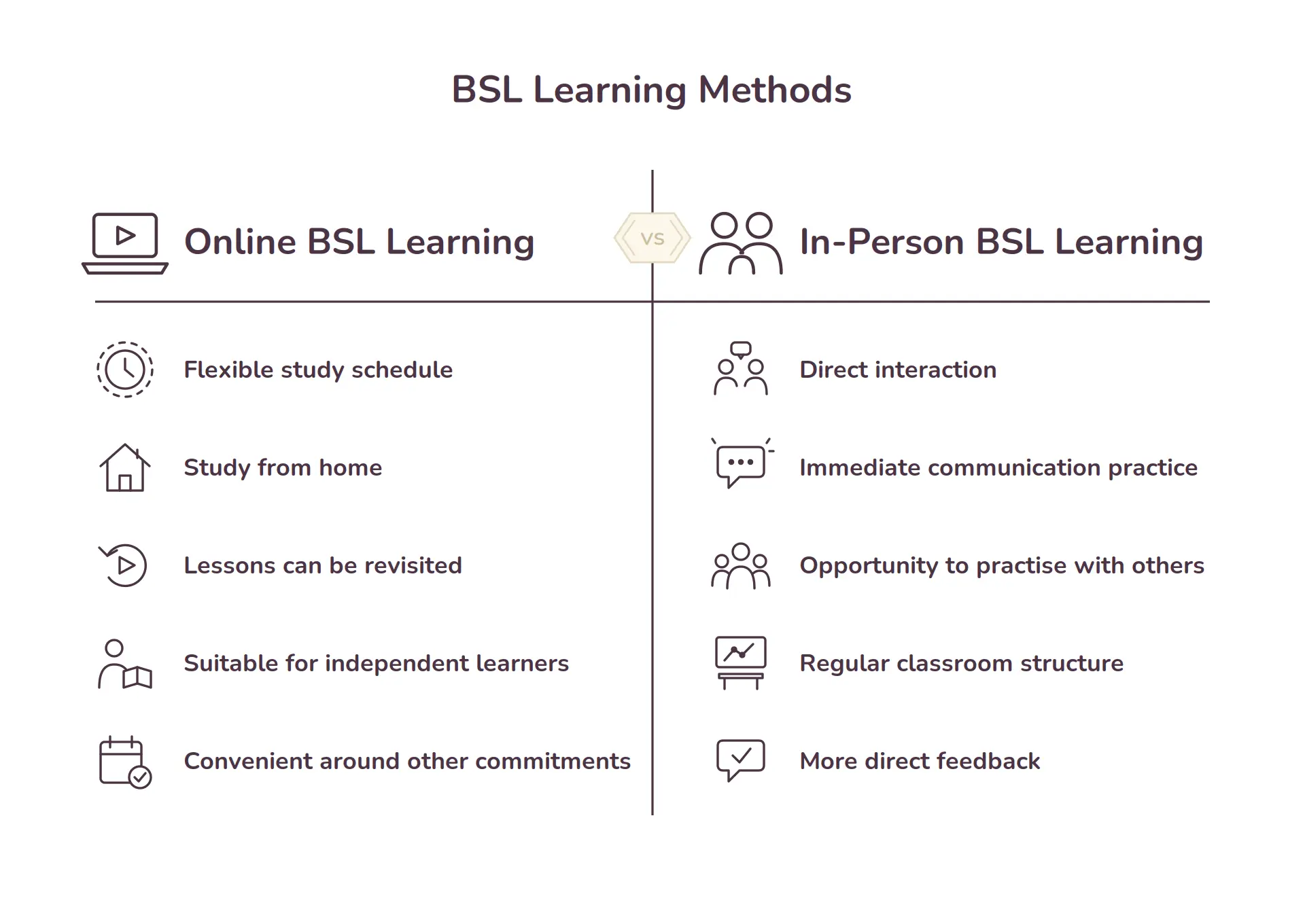
For many learners, combining structured online study with opportunities to communicate with other BSL users can provide a balanced approach.
The most important factor is not simply where you study. It is how consistently you practise and how much exposure you have to natural BSL communication.
What Is the Best Way to Practise BSL as a Beginner?
Regular practice is one of the most important parts of learning BSL.
Instead of trying to study a large amount at once, create a simple routine that you can maintain.
Practise Everyday Vocabulary
Choose a small group of signs connected to things you see or do every day.
For example, you could practise vocabulary related to:
- Food
- Clothes
- Home
- Work
- Family
- Travel
- Technology
- Daily routines
Try using the signs together rather than simply repeating each one separately.
Practise Fingerspelling
Use fingerspelling for familiar names, places and other words.
Start slowly and concentrate on accuracy. As your handshapes become more familiar, you can gradually work on your speed.
Record Yourself
Recording yourself can help you review your signing from another perspective.
Look at:
- Hand position
- Movement
- Facial expression
- Timing
- Clarity
- Overall communication
Regular self-review can help you become more aware of areas that need further practice.
Watch Other People Signing
Learning BSL is not only about producing signs. You also need to become comfortable understanding other people.
Watch different BSL content and try to recognise familiar signs. Begin with shorter sections and gradually increase the length and complexity.
Practise Short Conversations
Once you know enough vocabulary, create simple conversations around familiar subjects.
You could practise:
Greetings → Introduction → Family → Work or study → Hobbies → Daily activities
This helps you move from memorising signs towards using them for communication.
How Many Minutes a Day Should I Practise BSL?
There is no fixed number of minutes that every learner needs.
For a beginner, 15–20 minutes of focused daily practice can be a manageable starting point. You could divide your time between reviewing existing signs, learning new vocabulary, watching BSL and practising short phrases.
For example:
|
Practice |
Time |
|
Review previous signs |
5 minutes |
|
Learn new vocabulary |
5 minutes |
|
Practise phrases |
5 minutes |
|
Watch or review BSL |
5 minutes |
The exact amount is less important than consistency.
A short practice session that you can maintain regularly may be more useful than studying for several hours once a week and then stopping.

Do I Need to Learn BSL Grammar?
Yes. If you want to progress beyond basic vocabulary, understanding BSL grammar is important.
BSL is a language in its own right. It has its own grammatical structures and ways of expressing meaning rather than simply following spoken English word-for-word.
Communication can involve:
- Handshapes
- Movement
- Facial expressions
- Eye gaze
- Body movement
- Use of signing space
- Word and phrase structure
This means that learning individual signs is only one part of learning BSL.
Why Are Facial Expressions Important in BSL?
Facial expressions can contribute to meaning and help communicate aspects of a signed message.
For beginners, it can be tempting to concentrate entirely on the hands. However, effective BSL communication involves paying attention to the whole visual message.
As you progress, make facial expressions and other visual features part of your learning rather than treating them as an optional extra.
How Can I Get Better at Understanding Other People Signing?
Producing BSL and understanding someone else’s signing are related but different abilities.
You may know a sign yourself but struggle to recognise it when another person uses it quickly or differently.
To improve your receptive skills, try the following:
Watch Different BSL Users
Avoid relying on only one person or one learning resource.
Seeing different signing styles can help you become more comfortable with variations in movement, speed and expression.
Start With Short Clips
Begin with short pieces of signed communication.
Watch once to understand the general meaning, then watch again and focus on individual signs or phrases.
Replay Difficult Sections
If you miss something, replay the section rather than immediately giving up.
Try to identify:
- The signs you recognise
- The facial expressions
- The context
- The overall meaning
Then watch again.
Practise Fingerspelling Recognition
Fingerspelling can become difficult when it is produced quickly.
Start with familiar names and short words before gradually working towards longer or less familiar words.
Focus on Meaning, Not Every Individual Sign
You do not always need to recognise every sign immediately.
Context can help you understand the overall message even when you miss part of a sentence.
Why Can I Sign a Word but Struggle to Recognise It?
This is common when learning a visual language.
Producing a sign means you know how to make it yourself. Recognising another person’s sign requires you to process their handshape, movement, location, facial expression and the surrounding context.
Someone may also sign faster than you are used to.
A useful practice cycle is:
Watch → Recognise → Review → Watch Again → Sign
Over time, repeated exposure can make familiar signs easier to recognise.
Why Should I Learn About Deaf Culture While Learning BSL?
Learning BSL is about more than memorising vocabulary.
BSL is closely connected with Deaf communities and culture, so developing an understanding of Deaf culture can help learners approach communication respectfully.
It is also important to remember that Deaf people do not all communicate in exactly the same way. Some people may use BSL, while others may prefer speech, lip-reading, writing or a combination of communication methods.
Why Is Deaf Awareness Important?
Deaf awareness can help you communicate more thoughtfully.
For example, when communicating with someone who uses BSL, make sure they can see you clearly and avoid assuming which communication method they prefer.
Rather than making assumptions, ask about the person’s preferred way of communicating.
Why Learn From Deaf BSL Users?
Exposure to fluent BSL users can help you understand how the language is used naturally.
It can also give you greater exposure to:
- Natural signing speed
- Facial expressions
- Different signing styles
- BSL grammar
- Everyday communication
Learning the language alongside an understanding of Deaf culture can create a more respectful and informed approach to communication.
How Can I Practise BSL Respectfully With Other People?
If you have opportunities to communicate with Deaf people or fluent BSL users, approach those interactions respectfully.
Remember that someone who uses BSL is not automatically available to teach you.
When practising:
- Respect the person's time
- Pay attention to their preferred communication method
- Ask politely if you do not understand
- Accept corrections positively
- Do not expect someone to teach you for free
- Keep practising independently as well
Making mistakes is normal when learning a new language. The important thing is to remain respectful and willing to improve.
How Long Does It Take to Learn British Sign Language?
There is no single timeframe for learning British Sign Language.
The time required depends on factors such as:
- How often you practise
- How much BSL you watch
- Your previous language-learning experience
- How much vocabulary you learn
- How often you communicate with other signers
- Your personal learning goals
Someone who wants to communicate using basic everyday signs will have a different learning goal from someone who wants advanced BSL communication skills.
Basic BSL vs More Advanced Communication
At the beginning, you can focus on:
- Fingerspelling
- Greetings
- Numbers
- Family
- Everyday vocabulary
- Simple questions
- Basic phrases
As you progress, you can develop:
- Broader vocabulary
- BSL grammar
- Receptive skills
- Facial expression
- Spatial awareness
- Longer conversations
- Greater communication confidence
The important thing is to focus on steady progress rather than expecting fluency immediately.
Is BSL Difficult to Learn?
BSL may feel unfamiliar when you first start because it is a visual language with its own vocabulary, grammar and communication features.
The learning process can involve developing several abilities at once:
Hand movement + Visual recognition + Grammar + Facial expression + Receptive skills
This can take time.
However, beginners do not need to master everything at once. Start with everyday communication, practise regularly and gradually increase the complexity of what you learn.
The more consistently you use BSL, the more familiar the language can become.
Should I Take a BSL Course?
A structured BSL course can be useful if you want a clear learning pathway instead of relying entirely on separate online resources.
A course can help you organise your learning around specific topics and progress from basic knowledge towards more developed communication.
Before choosing a course, consider:
- Your current BSL knowledge
- Your reason for learning
- The level you want to reach
- How much time you can study
- Whether you want a structured learning pathway
- Whether the course matches your career or personal goals
Is BSL Level 1 Suitable for Beginners?
BSL Level 1 is generally associated with introductory learning and is a common starting point for people with little or no previous knowledge.
Learners can then progress to higher levels as their knowledge and communication ability develops.
If you are learning BSL for a specific job or professional purpose, check the qualification or level expected by the relevant employer, organisation or professional body.
Start Learning British Sign Language With StudyHub
If you want to develop your understanding of British Sign Language through structured online learning, StudyHub’s British Sign Language Level 1 & 2 course can provide a convenient learning pathway for learners who want to build their BSL knowledge.
You can study at your own pace and develop your understanding progressively rather than trying to learn everything at once.
Ready to start your BSL learning journey? Explore the StudyHub British Sign Language Level 1 & 2 course and take the next step towards developing your communication knowledge.

What Common Mistakes Should I Avoid When Learning BSL?
Beginners can make progress more easily when they recognise some common learning mistakes early.
1. Translating English Word-for-Word
BSL is not simply English expressed through hand movements.
Focus on understanding BSL as its own language rather than translating every English sentence directly.
2. Learning Too Many Signs at Once
Trying to memorise a large amount of vocabulary can make it difficult to remember what you have learned.
Start with a smaller group of useful signs and review them regularly.
3. Ignoring BSL Grammar
Vocabulary alone will not give you a full understanding of the language.
Gradually learn how BSL structures meaning and sentences.
4. Forgetting Facial Expressions
Do not focus exclusively on hand movements.
Facial expressions and other visual features can contribute to communication.
5. Only Practising Signs You Produce Yourself
Understanding other people is just as important as producing signs.
Include receptive practice in your learning routine.
6. Fingerspelling Too Quickly
Focus on clear handshapes before trying to increase speed.
Accuracy should come before speed.
7. Relying on Only One Resource
Different resources can expose you to different vocabulary, signing styles and explanations.
Use reliable learning materials alongside structured study.
8. Being Afraid of Mistakes
Mistakes are part of learning a language.
Use them to identify what needs more practice and keep progressing.
A Simple BSL Learning Roadmap for Beginners
You can use the following roadmap as a starting point:
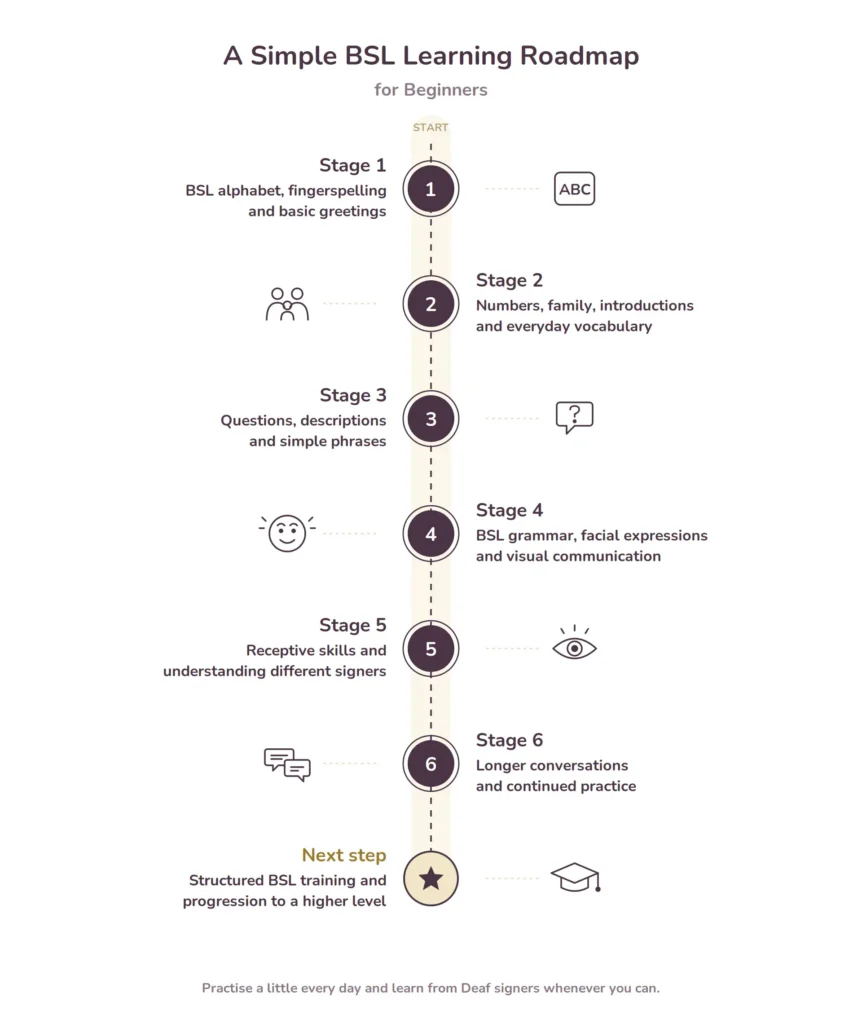
You can use the following roadmap as a starting point:
Quick Tips for Learning British Sign Language
If you are just starting, remember these simple points:
Start small: Learn useful everyday signs first.
Practise regularly: Short, consistent sessions can help you retain what you learn.
Watch BSL: Developing receptive skills is just as important as signing yourself.
Learn grammar: BSL has its own language structure.
Use facial expressions: Pay attention to the full visual message.
Learn about Deaf culture: Language and culture are closely connected.
Practise communication: Move beyond individual signs and use short phrases and conversations.
Be patient: Developing confidence in a new language takes time.


Frequently Asked Questions
Start with the BSL fingerspelling alphabet, greetings, numbers and common everyday signs. Once you have a basic vocabulary, begin learning simple phrases, BSL grammar and receptive skills.
Begin with useful everyday vocabulary such as greetings, introductions, numbers, family, common questions and daily activities. Learning fingerspelling alongside these signs can also help you communicate unfamiliar names and words.
Yes. Online BSL learning can provide flexible access to structured lessons and learning resources. Regular practice and exposure to other BSL users can complement online study.
You can learn BSL basics independently using suitable learning resources. However, communicating with other BSL users and receiving appropriate feedback can help you develop stronger communication and receptive skills.
There is no fixed timeframe. Your progress depends on your practice routine, learning method, exposure to BSL and the level of communication you want to achieve.
- All Courses
- IT & Software388
- Management287
- Teaching and Education250
- Business245
- Health and Fitness227
- Engineering & Technology180
- Health & Safety163
- Health and Social Care143
- Quality Licence Scheme139
- Healthcare137
- Accounting & Finance130
- Psychology112
- Employability112
- Lifestyle105
- Marketing75
- Office Productivity74
- Animal Care63
- Design and Photography55
- Design50
- Beauty & Makeup49
- Accounting & Bookkeeping34
- Web Development27
- Construction26
- Writing20
- Child Care13
- Digital Marketing13
- Environment10
- Bundle8
- Coaching6
- Agriculture5
Awarded By

0 responses on "How Do I Start Learning British Sign Language? A Beginner’s Guide"