


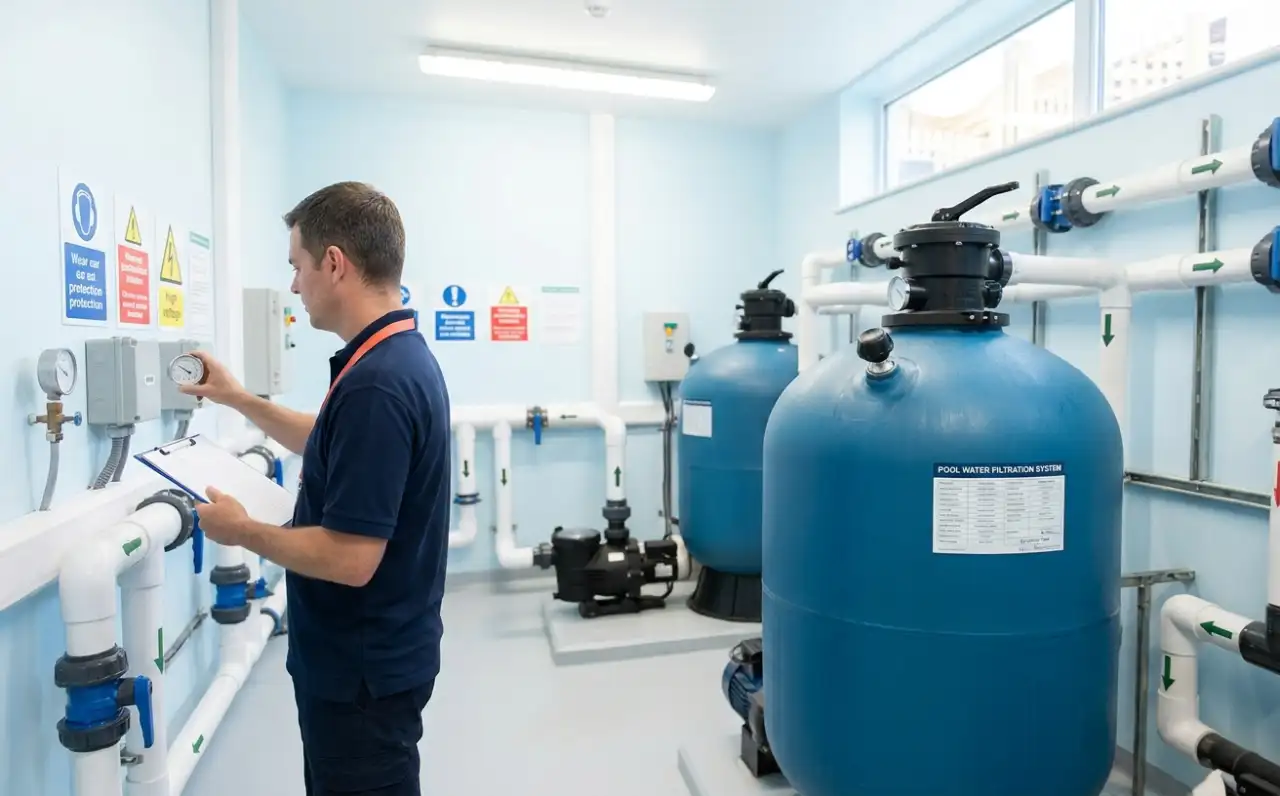
Swimming pool caretaker training covers water, plant and safety. Caretakers running a plant room should hold approved training. The usual route is a PWTAG-approved pool plant operator course. Certificates last up to three years. Staff who only test water can take shorter courses. Online CPD courses offer useful starting knowledge.
Picture a school caretaker on the first day of the summer term. The head teacher hands over the plant room keys and says the pool is now part of the job. Swimming pool caretaker training exists for exactly this moment. It turns a new responsibility into clear, safe daily habits.
This guide is for school caretakers, hotel maintenance staff and facility engineers who now look after a pool.
Start Your Pool Maintenance Training
Learn pool care, cleaning and essential maintenance at your own pace.
What Does a Swimming Pool Caretaker Do?
A swimming pool caretaker keeps a pool clean, safe and ready to use. In most schools and hotels, this sits alongside normal building duties such as heating, security and small repairs.
A pool technician looks after equipment and water quality. A pool plant operator runs the plant room, where pumps and filters treat the water. Many caretakers do both.
| How often | Typical pool tasks |
|---|---|
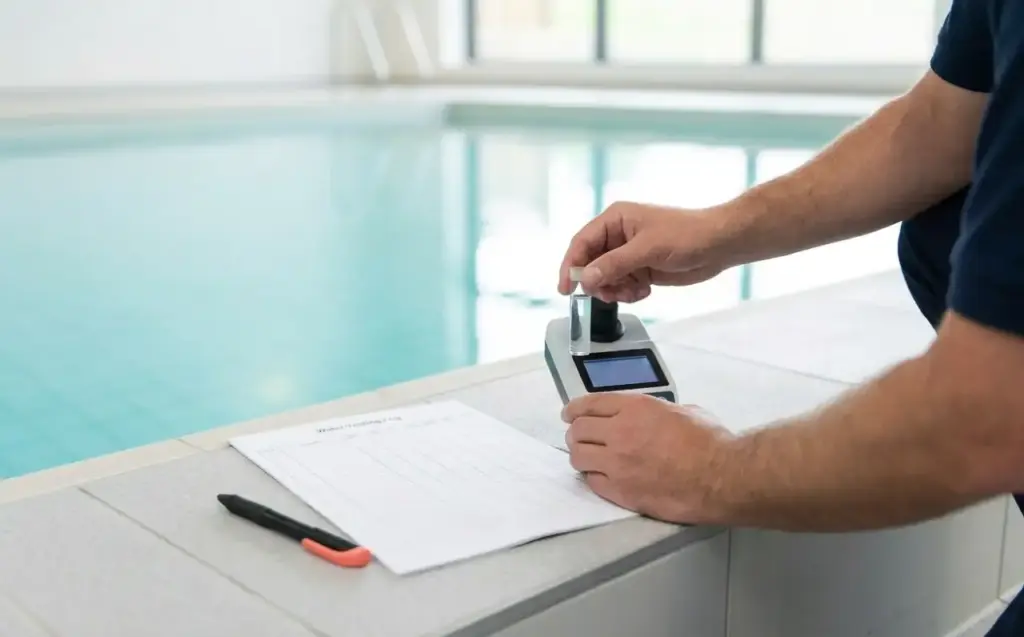
| Daily | Test and record the water, skim the surface, clean poolside areas and look over pumps and filters for faults |
| Weekly | Deeper cleaning, filter backwashing where the system needs it, equipment inspections |
| Periodically | Arrange servicing, supervise contractors and review records and risk assessments |
Your exact duties are set out in your site’s Pool Safety Operating Procedures (PSOP) which includes both the Normal Operating Plan (NOP) and the Emergency Action Plan (EAP)—alongside your plant room risk assessment.
Want the full picture of every pool course on offer in the UK? Our Swimming Pool Maintenance Training: UK Course Guide maps each option clearly.
Which Pool Technician Skills Do Caretakers Need?
Caretakers mainly need water testing, plant care, cleaning and chemical safety skills. Most swimming pool caretaker training splits these into two groups.
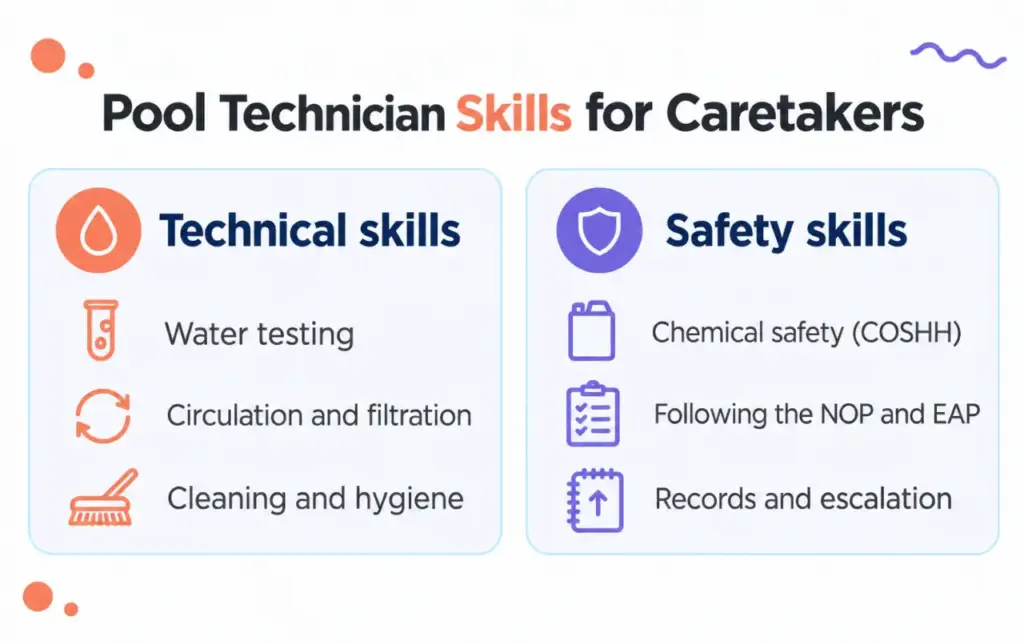
Technical skills
• Water testing: measuring pH and chlorine levels at set times each day, and writing the results down.
• Circulation and filtration: how pumps and filters move and clean the water, and what to do when pressure readings change.
• Cleaning and hygiene: keeping the pool, poolside and changing areas clean.
Safety skills
• Chemical safety: pool chemicals are hazardous. Storing and handling them safely falls under the Control of Substances Hazardous to Health (COSHH) rules. A short COSHH Basics for a Safe Working Environment course can help with this part of the job.
• Following procedures: working to the NOP and the Emergency Action Plan (EAP).
• Records and escalation: keeping clear logs and calling a qualified operator or contractor when results fall outside safe limits.
Good pool safety training covers all three of these areas, not just the chemistry.
Water testing is the skill caretakers use most each day. Pool Water Testing Courses: Skills and Training Options explains which course fits your testing duties.
What Training Do Caretakers Need to Run a Pool?
Employers must make sure pool staff are properly trained. Caretakers who operate pool plant need suitable training, arranged by their employer. For running a plant room, the industry standard is a PWTAG-approved pool plant operator qualification.
HSE guidance HSG179, Health and safety in swimming pools, states that “the pool operator must provide suitable information, instruction and training for employees operating pool water treatment plant and equipment”. It is guidance rather than law, explaining how employers meet their wider health and safety duties. It covers public-type pools, such as school, hotel and leisure pools, not private home pools.
HSE covers England, Scotland and Wales. In Northern Ireland, HSENI also directs pool operators to HSG179.
What is a pool plant operator qualification (PPO)?
A pool plant operator qualification (PPO) shows you can run a plant room and restore pool water to safe conditions. In the UK, awarding bodies such as RLSS UK and STA offer them. Courses usually combine theory, a water testing assessment and an exam.
What is a swimming pool technical operator (SPTO)?
A swimming pool technical operator (SPTO) meets the standard set by the Pool Water Treatment Advisory Group (PWTAG). Under the Pool Water Treatment Advisory Group (PWTAG) Code of Practice, all public and commercial pools including school and hotel facilities should have access to a Swimming Pool Technical Operator (SPTO) on site or on call. Smaller facilities can manage daily operations using an on-site designated supervisor backed up by a visiting SPTO.
Qualified operators can join the PWTAG SPTO register.
Not sure which rules apply to your pool? Pool Maintenance Course Requirements Explained sets out the standards, roles and responsibilities in plain English.
Which Swimming Pool Caretaker Training Suits Your Role?
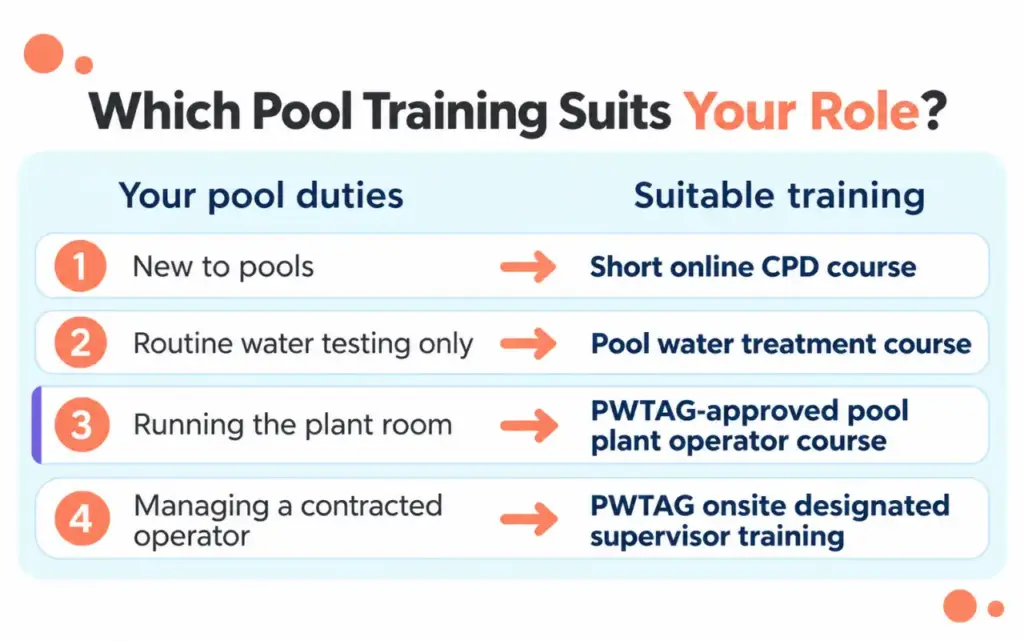
Match the course to your real pool duties. Choose by duties: a short online CPD course for the basics, a pool water treatment course for routine testing, and a PWTAG-approved pool plant operator course for running the plant room.
| Your pool duties | Typical roles | Suitable training | What it covers |
|---|---|---|---|
| New to pools, or occasional pool tasks | New caretakers, hotel maintenance assistants | Short online CPD course | Basic equipment, cleaning, water balance and safety. Not a plant operator qualification. |
| Routine water testing only | Leisure staff, caretakers covering tests | Pool water treatment course | Testing and recording water. Not restoring water or running the plant. |
| Running the plant room day to day | School caretakers, pool technicians, facility engineers | PWTAG-approved pool plant operator course | Full plant operation and restoring water to safe levels. Renewed within three years. |
| Managing a site with a contracted operator | Facilities and site managers | PWTAG onsite designated supervisor training | Overseeing contractors, records and daily routines. |
Budget is often the deciding factor for schools and hotels. Pool Maintenance Training Costs: UK Price Guide breaks down what each course level typically costs.
Start Your Pool Maintenance Training
Learn pool care, cleaning and essential maintenance at your own pace.
How Do Pool Skills Help Your Facilities Career?
Pool skills widen your role and future options. Pool skills also make you more useful to any site with a pool, and they can open routes into technical and supervisory work. They do not guarantee a pay rise.
According to National Careers Service guidelines for UK school and building caretakers, starting salaries typically range between £20,000 and £23,000, rising to £28,000-£32,000+ for experienced caretakers taking on technical facilities duties. Caretakers can progress into supervisor roles, facility services or property maintenance.
Swimming pool caretaker training also adds clear, specific evidence to your CV.
School caretakers
School pools used for lessons need steady plant cover, including during the holidays. School caretaker pool training keeps the pool running without waiting for outside help.
Hotel and leisure maintenance staff
Guests expect clean, clear water every day. Staff with solid pool technician skills, such as accurate testing and good records, are valuable to any hotel. Spa pools carry extra infection risks, covered in HSE guidance on spa-pool systems.
Facility engineers
Engineers who look after several sites often oversee pool contractors. Pool plant knowledge helps you ask the right questions and review service reports with confidence.
On your CV, list the qualification name, awarding body and expiry date, plus real tasks such as “tested and recorded pool water three times daily”. A CV writing and job searching course can help you present this clearly.
How to Start Swimming Pool Caretaker Training
Five steps take you from a new starter to a confident operator. Start with your site’s pool documents, then choose training that matches your duties.
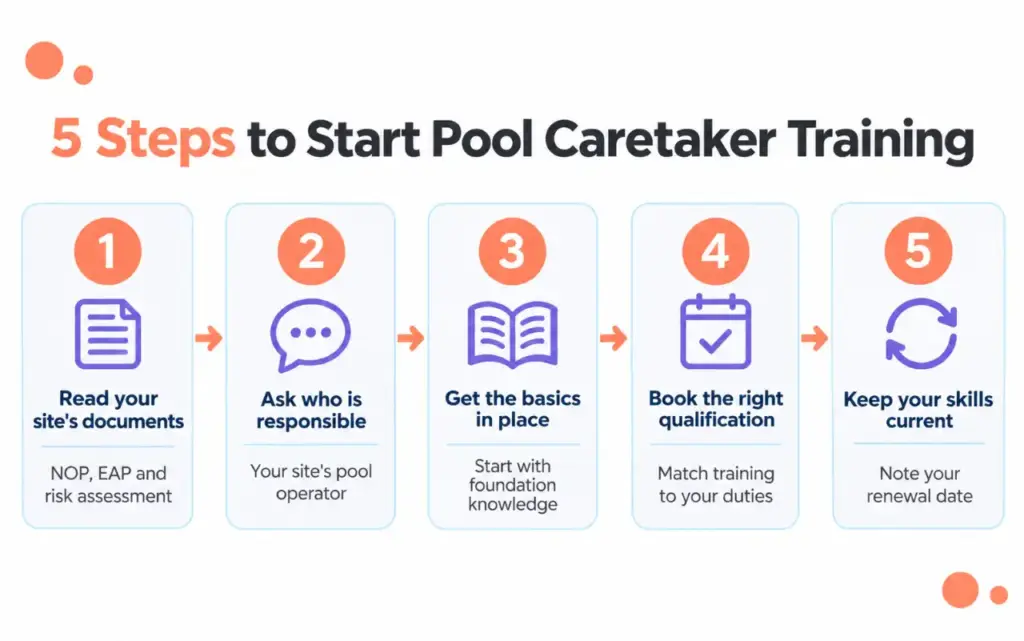
1.Read your site’s documents. Start with the NOP, the EAP and the plant room risk assessment.
2.Ask who is responsible. Find out who your site’s pool operator is and which standard it follows.
3.Get the basics in place. If pools are new to you, a short online pool maintenance course offers a gentle starting point.
4.Book the right qualification. Choose the course that matches your duties, using the table above.
5.Keep your skills current. Note your renewal date and keep a log of your water testing experience.
Final Thoughts on Pool Training for Caretakers
Start with your duties, then pick the right course. Swimming pool caretaker training is about running a safe pool with confidence, not collecting certificates. If you run the plant room, aim for a PWTAG-approved pool plant operator course. If pools are new to you, start with the basics and step up as your role grows. StudyHub’s Pool Maintenance Training is a simple first step.
Frequently Asked Questions
How long does a pool plant operator qualification last?
A PWTAG-approved pool plant operator qualification remains valid for three years. Operators must complete a revalidation course or full requalification before expiry, while employers are advised to conduct annual workplace competence reviews.
How long does swimming pool caretaker training take?
It varies. A short online CPD course may take under two hours, while a pool plant operator course often runs across three days.
Is it hard to become a pool technician?
Not usually. The theory is straightforward with good training. Confidence in the plant room comes from supervised practice, so many people start with daily tasks.
Is a pool attendant the same as a lifeguard?
Not always. Some sites call lifeguards pool attendants. Lifeguards supervise swimmers and need a pool lifeguard qualification. Plant operators look after the water instead.
What are the 3 C's of pool care?
Circulation, cleaning and chemistry. Water keeps moving, surfaces stay clean and chemicals stay balanced. It is a handy rule, not a substitute for training.
Is there an online pool plant operator course?
Yes. Several awarding bodies offer blended or virtual classroom delivery for PWTAG-approved courses. These include live online lectures combined with practical workplace assessments and invigilated exams, making them ideal for staff already working in a plant room environment.
- All Courses
- IT & Software389
- Management287
- Teaching and Education250
- Business245
- Health and Fitness227
- Engineering & Technology180
- Health & Safety163
- Health and Social Care144
- Quality Licence Scheme139
- Healthcare137
- Accounting & Finance130
- Psychology112
- Employability112
- Lifestyle105
- Marketing75
- Office Productivity74
- Animal Care63
- Design and Photography55
- Design50
- Beauty & Makeup49
- Accounting & Bookkeeping34
- Web Development27
- Construction26
- Writing20
- Child Care17
- Digital Marketing13
- Environment10
- Bundle8
- Coaching6
- Agriculture5

Awarded By


0 responses on "Swimming Pool Caretaker Training: Skills and Courses"