


A customer walks into a pharmacy and needs help collecting medicine. The pharmacist smiles and wants to assist, but the customer is Deaf and communicates using British Sign Language. Neither person understands the other. After a few written notes and confused gestures, the conversation ends with frustration instead of confidence. Situations like this happen across the UK every day. However, they do not happen because people do not care. Instead, they happen because communication becomes a barrier. Fortunately, awareness is growing. Since the British Sign Language Act became law and schools began preparing for a British Sign Language GCSE, more people have started asking an important question: What is British Sign Language, and should I learn it? This complete guide explains everything in simple words, so you can understand British Sign Language step by step and start learning with confidence.
Table of Contents
What Is British Sign Language?
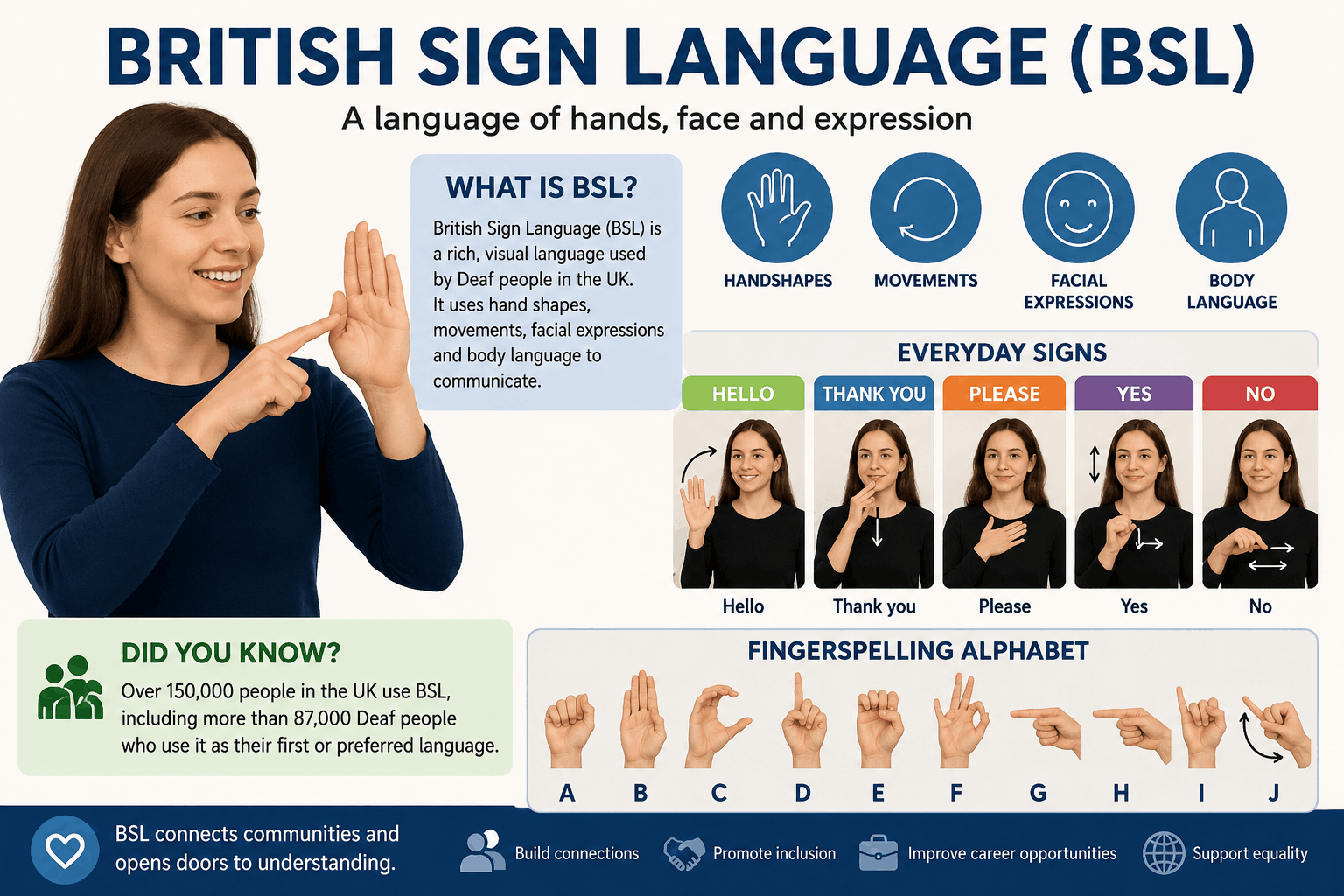
Imagine speaking without making a sound. Instead of using your voice, you use your hands, facial expressions, eye contact, and body movements. That is how British Sign Language works.
British Sign Language (BSL) is a complete visual language used by many Deaf people throughout the United Kingdom. It is not simply English shown with hand signs. Instead, it has its own grammar, sentence structure, vocabulary, and regional differences. Therefore, British Sign Language is recognised as a language in its own right.
Many beginners are surprised to learn that sign language is not universal. Just as countries have different spoken languages, they also have different sign languages. For example, American Sign Language (ASL) is very different from British Sign Language, even though both countries speak English. Because of this, anyone living, studying, or working in the UK should learn British Sign Language rather than another country’s sign language.
Did You Know?
Over 150,000 people in the UK use British Sign Language, including more than 87,000 Deaf people who use it as their first or preferred language. That is one reason why BSL is becoming increasingly important in schools, workplaces, healthcare, and public services.
Now that you know what British Sign Language is, another question naturally follows. Why are so many people learning it today? Before answering that, it helps to understand how BSL actually works.
How Does British Sign Language Work?
Think about how you normally communicate. You choose words, change your voice, smile, and sometimes use hand gestures. British Sign Language also communicates ideas and emotions, but it does so visually instead of through speech.
Every conversation combines several important parts.
Hand shapes
Hand movements
Hand position
Facial expressions
Eye contact
Body posture
Each part is important. If one part changes, the meaning can also change.
For example, imagine someone signing “Are you happy?” without raising their eyebrows. The sentence may look more like a statement than a question. Therefore, facial expressions are part of the grammar, not simply emotions.
How BSL Communication Works
Thought
↓
Hand Signs
+
Facial Expressions
+
Body Language
↓
Clear Communication
Unlike spoken English, British Sign Language does not always follow English word order. Instead, it follows its own language rules. Consequently, learners should avoid translating every English word into a sign. It is much better to learn BSL naturally, just as you would learn any other language.
This is exactly why structured learning makes such a difference. Many beginners watch random videos online and quickly become confused. On the other hand, a step-by-step course introduces signs, grammar, and conversations in the correct order. That is why many new learners begin with the Studyhub British Sign Language (BSL) Course, where every lesson builds naturally on the previous one.
Why Is British Sign Language Becoming More Important in the UK?
A few years ago, many people had never heard of the British Sign Language Act. Today, the picture looks very different.
Schools are preparing to teach a British Sign Language GCSE. Businesses are improving accessibility. Hospitals are working to communicate more effectively with Deaf patients. Employers are also recognising the value of inclusive communication.
As a result, British Sign Language is no longer seen as a skill for only a small group of people. Instead, it is becoming a valuable life skill that helps people communicate more confidently in modern Britain.
Several important changes have encouraged this growth.
Why More People Are Learning BSL
Change | Why It Matters |
British Sign Language Act | Increased national awareness |
British Sign Language GCSE | More learning opportunities in schools |
Inclusive workplaces | Better communication with customers and colleagues |
Healthcare accessibility | Improved support for Deaf patients |
Public awareness | More people recognise the importance of BSL |
These developments mean there has never been a better time to learn British Sign Language.
Why Learn British Sign Language?
Learning British Sign Language is about much more than remembering hand signs. It is about making communication possible when spoken words are not enough. Moreover, it allows you to connect with people in a respectful and meaningful way.
Instead of simply listing the benefits, imagine how BSL can change everyday situations.
Build Real Connections
Imagine meeting a Deaf neighbour who has lived next door for years. Until now, you have smiled politely but never spoken. Then one day, you greet them using British Sign Language. Suddenly, a simple greeting becomes the start of a real conversation.
Learning BSL helps build friendships that might never have happened otherwise.
As a result, many learners say their confidence grows alongside their communication skills.
Support a More Inclusive Society
Every person deserves to communicate without barriers.
Unfortunately, many Deaf people still experience difficulties in shops, hospitals, schools, and public services. However, when more hearing people learn British Sign Language, those barriers begin to disappear.
Even basic signs such as “Hello,” “Thank you,” or “Can I help you?” can completely change someone’s experience.
Therefore, learning BSL is not only about personal development. It is also about creating a society where everyone feels included.
Improve Your Career Opportunities
Employers increasingly value communication skills.
Whether you work in healthcare, education, childcare, customer service, hospitality, or community services, understanding British Sign Language can make you stand out.
For example:
A receptionist can welcome Deaf visitors more confidently.
A teaching assistant can support Deaf pupils more effectively.
A nurse can reduce communication barriers.
A customer service adviser can offer a better experience.
Although BSL may not always be required, it demonstrates empathy, communication, and a willingness to learn.
For learners who want recognised skills, the Studyhub British Sign Language (BSL) Level 1 & 2 with Bonus Module provides a structured pathway from beginner knowledge to more confident everyday communication.
Exercise Your Brain
Learning a language challenges your brain in healthy ways.
However, British Sign Language is different because it develops visual thinking as well as memory. Instead of listening for words, you learn to notice movement, space, and facial expressions.
Many learners find this both enjoyable and rewarding.
Is British Sign Language the Same as Makaton or Sign Supported English?
This is one of the biggest questions beginners ask. In fact, many people think they are all the same because they involve hand signs. However, they are completely different communication systems with different purposes.
Understanding this difference will help you choose the right learning path from the very beginning.
Imagine someone wants to communicate naturally with a Deaf colleague who uses British Sign Language every day. If they only know Makaton or Sign Supported English (SSE), communication may still be difficult because the grammar and signing styles are different.
That is why learning the correct communication system matters.
British Sign Language vs SSE vs Makaton
Feature | British Sign Language (BSL) | Sign Supported English (SSE) | Makaton |
Complete language | ✔ Yes | ✘ No | ✘ No |
Own grammar | ✔ Yes | ✘ Uses English grammar | ✘ Uses spoken English |
Main users | Deaf community | Hearing and Deaf people together | People with communication or learning difficulties |
Facial expressions | Essential | Helpful | Helpful |
Best for | Natural conversations with Deaf people | Supporting spoken English | Communication support |
Which One Should You Learn?
The answer depends on your goal.
If you want to communicate with many Deaf people across the UK, British Sign Language is the best choice.
If you support spoken English in classrooms or workplaces, SSE may sometimes be used.
If you work with people who have additional communication needs, Makaton can also be valuable.
However, because this guide focuses on British Sign Language, we will continue exploring how beginners can start learning BSL confidently.
Common Myths About British Sign Language
Many people delay learning because they believe information that simply is not true. Consequently, they miss the opportunity to learn one of the UK’s most valuable communication skills.
Let’s clear up the biggest myths.
Myth 1: Every country uses the same sign language.
Truth: Every country has its own sign language.
For example, American Sign Language (ASL), Australian Sign Language (Auslan), and British Sign Language are all different languages. Therefore, learning BSL is the correct choice if you live or work in the UK.
Myth 2: BSL is English with hand signs.
This is probably the biggest misunderstanding.
Although some signs may look familiar, British Sign Language has its own grammar and sentence structure. It is a complete language, not a signed version of English.
Myth 3: Only Deaf people should learn BSL.
Absolutely not.
Parents, teachers, nurses, receptionists, support workers, carers, students, police officers, customer service advisers, and thousands of other hearing people learn British Sign Language every year.
Some want to improve their careers, while others simply want to communicate better with family members, neighbours, or customers.
Myth 4: Learning BSL is too difficult.
Every language requires practice. However, BSL is often easier than people expect because learners begin with simple conversations.
Instead of memorising hundreds of signs immediately, you first learn greetings, numbers, colours, and everyday expressions. As your confidence grows, your vocabulary grows naturally too.
Your Step-by-Step British Sign Language Learning Journey
One reason many beginners give up is because they do not know what to learn first.
Some watch random YouTube videos.
Others memorise individual signs without understanding grammar.
Eventually, they become confused.
A structured learning plan solves this problem.
Beginner Roadmap
Never Learned BSL
│
▼
Understand What BSL Is
│
▼
Learn the Alphabet
│
▼
Greetings & Manners
│
▼
Numbers, Colours & Family
│
▼
Everyday Conversations
│
▼
Grammar & Facial Expressions
│
▼
Confident Communication
Notice something important.
Every step builds on the previous one.
That is exactly why following a structured course is much easier than jumping between random videos online.
Many beginners start with the Studyhub British Sign Language (BSL) Course, which introduces each topic in a logical order. Instead of wondering what to learn next, you simply follow the lessons one by one.

Basic British Sign Language Skills Every Beginner Should Learn
Once you understand how British Sign Language works, you can begin learning practical communication.
However, do not try to learn hundreds of signs during your first week.
Instead, focus on everyday situations.
Week 1
Learn:
Hello
Goodbye
Thank you
Please
Yes
No
These simple signs immediately help you communicate politely.
Week 2
Next, learn signs for:
Family
Friend
Home
School
Work
Food
Now you can begin introducing yourself and talking about everyday life.
Week 3
After that, learn:
Numbers
Days
Time
Colours
Questions
At this stage, short conversations become much easier.
Week 4
Finally, begin learning:
BSL grammar
Facial expressions
Conversation practice
Fingerspelling
Everyday situations
By following this order, learners usually feel much more confident than those who study random vocabulary.
The Studyhub British Sign Language (BSL) Level 1 & 2 with Bonus Module follows a similar step-by-step structure. Consequently, learners build strong foundations before moving to more advanced communication.
Access the course library of 3000+ courses for just £149 for a lifetime!
Final Thoughts
Learning British Sign Language is about much more than mastering hand signs. It is about opening doors that spoken language sometimes cannot. Every sign you learn helps remove communication barriers, create stronger relationships, and build a more inclusive society. Throughout this guide, you have discovered what British Sign Language is, how it works, why it is becoming more important across the UK, and how you can begin learning step by step. More importantly, you now know that BSL is not only for the Deaf community. It is a valuable skill for parents, teachers, healthcare professionals, students, customer service staff, employers, and anyone who wants to communicate with confidence and respect.
So, start learning British Sign Language today and take the first step towards more confident, inclusive communication.
FAQs
No. British Sign Language is suitable for beginners of all ages. Like any language, it requires regular practice. However, many learners can communicate using simple everyday signs within a few months.
Yes. The British Sign Language Act 2022 legally recognises BSL in England, Scotland, and Wales, helping improve accessibility and awareness across public services.
Absolutely. Many hearing people learn British Sign Language to improve communication at work, support family members, volunteer, or simply develop a valuable life skill.
There is no fixed timeframe. However, many beginners in the UK can learn basic British Sign Language within a few months through regular practice, while achieving higher-level skills and recognised qualifications usually takes longer.
Yes. Many people choose online learning because it offers flexibility. However, following a structured course is usually much more effective than relying only on random videos.
- All Courses
- IT & Software388
- Management287
- Teaching and Education250
- Business245
- Health and Fitness227
- Engineering & Technology180
- Health & Safety163
- Health and Social Care143
- Quality Licence Scheme139
- Healthcare137
- Accounting & Finance130
- Psychology112
- Employability112
- Lifestyle105
- Marketing75
- Office Productivity74
- Animal Care63
- Design and Photography55
- Design50
- Beauty & Makeup49
- Accounting & Bookkeeping34
- Web Development27
- Construction26
- Writing20
- Child Care13
- Digital Marketing13
- Environment10
- Bundle8
- Coaching6
- Agriculture5
Awarded By

0 responses on "What Is British Sign Language? Why Learn It and How to Get Started"