



Imagine trying to discuss housing support, speak to a local service or understand an important appointment when you and the person helping you do not share a language. Even a simple conversation can quickly become difficult.
Community interpreting is the process of helping people who use different languages communicate when accessing community and public-facing services. The interpreter listens to one person and conveys the meaning accurately in another language, helping both sides understand each other without taking over the conversation.
Community interpreters may work across local services, education, social support and other community settings. Their work requires much more than simply speaking two languages. Accuracy, listening, cultural awareness, impartiality and professional boundaries all matter.
The ISO 13611:2024 community interpreting standard sets out requirements and recommendations for community interpreting services involving spoken and signed languages.
This guide explains what community interpreting means in a UK context, what the role involves, where interpreters may work and the skills and training worth considering.
Interested in Building Your Interpreting Skills?
If you are exploring community interpreting and want to build your knowledge before taking the next step, Studyhub's Interpreter Diploma Level 3 offers structured online study covering interpreting techniques, language skills, cultural competence, ethics, confidentiality and specialised interpreting fields.
Explore the Interpreter Diploma Level 3 →What Is Community Interpreting?
Community interpreting helps people communicate with organisations and services when they do not share the same language. The interpreter facilitates communication between the parties by conveying spoken or signed messages accurately while preserving their meaning and context.
The aim is not to make decisions for the people involved. Nor is it to speak on someone’s behalf. Instead, the interpreter makes communication possible so that the people involved can speak to and understand each other.
That distinction matters. A bilingual person may understand two languages, but professional interpreting involves additional skills such as listening, retaining information, conveying meaning accurately, handling terminology and working within professional boundaries.
Community interpreting is also shaped by its setting. A conversation about housing support, for example, may involve different terminology and sensitivities from a meeting in an education or community-support setting.
Is community interpreting the same as public service interpreting?
The terms community interpreting and public service interpreting can overlap, but their use is not identical everywhere.
ISO 13611:2024 establishes principles for community interpreting and recognises that terminology and scope can differ between countries. In the UK, it is particularly important not to assume that general community interpreting preparation automatically meets the requirements for specialist public-service assignments.
Legal interpreting is a good example. Courts, police work and other justice settings can require specialist knowledge, interpreting techniques, qualifications and experience beyond those associated with foundation-level community interpreting. The same principle applies when an employer or commissioning organisation sets specific requirements for another specialist environment.
So, when considering interpreting work, always look at the particular setting and its requirements, rather than relying on the job title alone.
What Does a Community Interpreter Do?
A community interpreter’s central responsibility is to enable accurate communication between people who use different languages.
In practice, that can involve listening carefully to what one person says, understanding the meaning and context, and conveying that message in another language. The interpreter then performs the same function when the other person responds.
Depending on the assignment, an interpreter may need to:
- prepare relevant terminology before a session;
- listen carefully without losing important details;
- retain information long enough to interpret it accurately;
- communicate clearly in both working languages;
- manage the flow of interpreted communication;
- recognise when clarification is genuinely necessary;
- remain professional when conversations involve sensitive subjects.
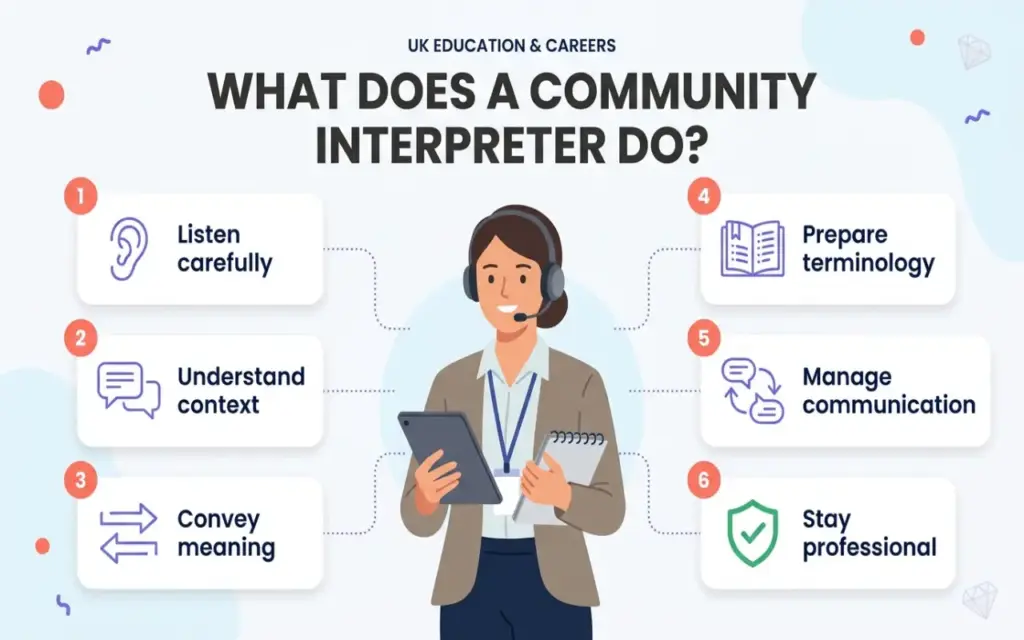
Preparation can be particularly important. If an interpreter knows the general subject of an appointment beforehand, they can familiarise themselves with relevant terminology rather than meeting every specialist term for the first time during the conversation.
What should a community interpreter not do?
Interpreting is not the same as giving advice.
A community interpreter should not casually change, omit or add meaning because they think a different answer would be more helpful. They should not give their personal opinion as though it came from one of the speakers or automatically take one person’s side because they share the same language or cultural background.
Confidentiality and impartiality are also important professional principles. The Chartered Institute of Linguists’ Code of Professional Conduct sets expectations around matters including confidentiality, impartiality and professional competence.
Put simply, an interpreter is not automatically an adviser, advocate or decision-maker. The role is to support communication accurately and professionally.
Ethical practice can become more complex when interpreters face conflicts of interest, sensitive information or difficult professional boundaries. These issues deserve more detailed treatment in interpreting ethics training.
Where Do Community Interpreters Work?
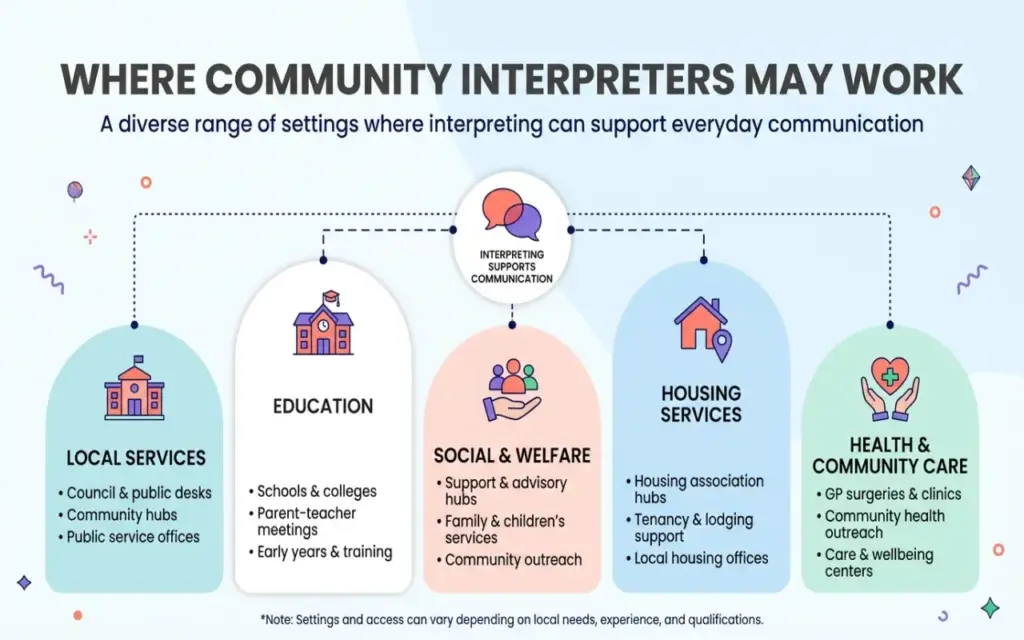
Community interpreting can take place wherever language differences make it harder for someone to communicate with a community-facing service.
Depending on the role and organisation, settings may include:
- local authorities;
- community organisations;
- education services;
- social and welfare services;
- housing-related services;
- some health and community-care environments.
The exact scope of a community interpreter’s work varies. An interpreter should therefore consider not only whether they know the required languages but also whether they have the competence and subject knowledge appropriate to the assignment.
The UK’s National Careers Service interpreter profile describes public-service interpreters as potentially working with legal, health and local-government services. It also identifies workplaces ranging from offices and hospitals to police stations and courts, although specialist settings can carry additional requirements.
Face-to-face, telephone and remote interpreting
Interpreting does not always happen with everyone sitting in the same room.
The National Careers Service notes that interpreters can work in person, over the phone and online.
Telephone interpreting removes visual information such as facial expressions and gestures, so interpreters need to rely heavily on careful listening, tone and verbal turn-taking. Video interpreting provides visual information but introduces other considerations, including technology and connection quality.
These formats require their own practical techniques. Readers interested specifically in remote work can explore telephone interpreting skills training.
Community Interpreting vs Other Types of Language Work
Community interpreting sits within a much wider language profession. Understanding the differences can prevent confusion about what a particular course, qualification or job is designed for.
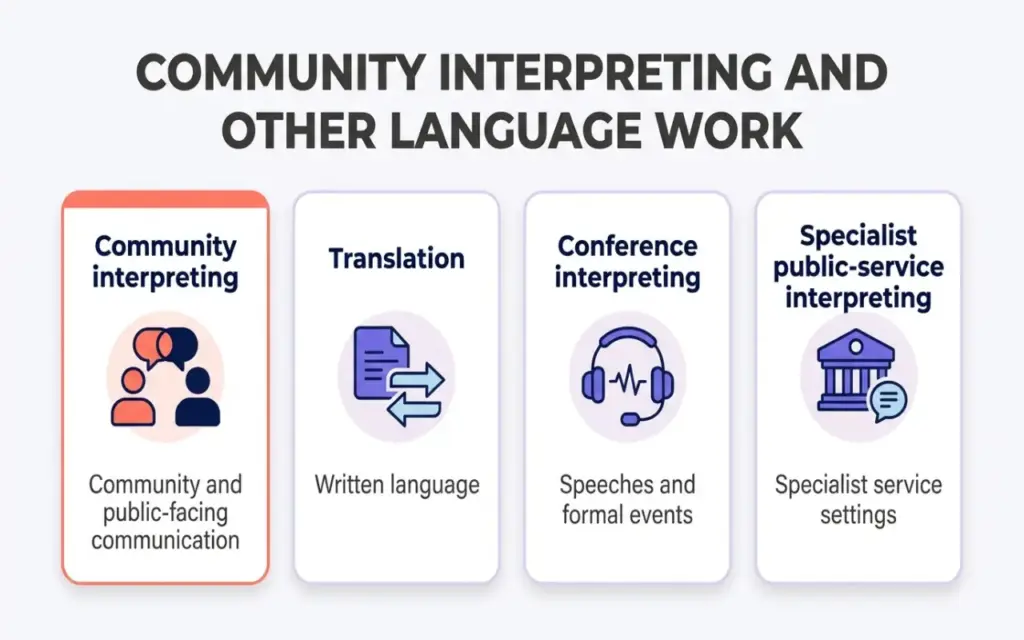
| Activity | Main focus |
|---|---|
| Community interpreting | Communication in community and public-facing service settings |
| Translation | Converting written material from one language into another |
| Conference interpreting | Interpreting speeches, presentations, meetings and conferences |
| Specialist public-service interpreting | Interpreting in settings that may require specialist terminology, competence or qualifications |
Community interpreting vs translation
Interpreting and translation both involve working across languages, but they are not interchangeable skills.
Interpreters primarily work with spoken or signed communication, often in real time. Translators primarily work with written material. The GOV.UK technical review of spoken-language interpreting specifically notes that translation requires a different skill set and that translation programmes do not necessarily teach interpreting skills.
Someone who is an excellent translator is therefore not automatically prepared to interpret professionally, just as interpreting experience does not automatically make someone a professional translator.
What about legal and medical interpreting?
Legal and medical environments can involve specialist terminology, procedures and responsibilities. They should not simply be treated as interchangeable with general community assignments.
In legal settings in particular, the UK’s professional requirements can be substantially higher than foundation-level community interpreting. Readers considering that direction should investigate legal interpreting training in the UK rather than assuming general training is sufficient.
Healthcare interpreting also brings its own communication demands and terminology. Anyone interested specifically in that area can explore medical interpreting courses in the UK.
What Skills Does a Community Interpreter Need?
Speaking two languages is an important foundation, but bilingual ability by itself does not cover everything an interpreter needs.
Language and listening skills
Community interpreters need strong command of their working languages and the ability to move accurately between them.
Active listening is particularly important. The interpreter needs to follow what is being said, understand its meaning and retain enough information to convey it accurately. A small change in wording can sometimes change the meaning of an entire statement.
The National Careers Service identifies active listening, verbal communication, attention to detail and a good memory among the skills associated with interpreting. It also notes the importance of understanding informal speech, slang and regional differences.
Terminology preparation matters too. Interpreters may encounter words and expressions that are uncommon in everyday conversation, so researching an assignment beforehand can make communication more accurate and efficient.
Cultural awareness and communication
Language does not exist separately from culture.
Expressions, forms of address and ways of communicating can vary between communities. Cultural awareness can help an interpreter recognise these differences and understand the context behind what someone is saying.
However, cultural knowledge should not become guesswork. An interpreter’s task is still to convey what the speaker communicates, rather than replacing their words with assumptions about what someone from a particular background probably means.
Confidentiality, impartiality and professional boundaries
Community interpreting can involve private or sensitive conversations. Professional conduct is therefore central to the role.
Important principles include:
- protecting confidential information;
- remaining impartial;
- conveying meaning accurately;
- recognising potential conflicts of interest;
- maintaining appropriate professional boundaries;
- working within one's competence.
These principles sound straightforward on paper, but real assignments can present difficult situations. Interpreting ethics training can explore those scenarios in greater depth without reducing ethics to a simple checklist.
Do You Need Qualifications to Become a Community Interpreter in the UK?
There is no single qualification route that applies to every interpreting job in the UK. Requirements vary according to the employer, client, sector and complexity of the assignment.
Can you become an interpreter without a degree?
A university degree is not the only route into interpreting.
The National Careers Service lists several routes, including university study, college courses, volunteering and specialist courses offered through professional bodies. It also states that community interpreting college courses are available for people who are fluent in English and another language used within the community.
This does not mean that anyone who speaks two languages automatically meets the requirements for paid interpreting work. Employers can set their own expectations around qualifications, competence, experience and checks.
Where does Level 3 community interpreting fit?
Level 3 appears within UK community-interpreting training, but the exact title and status of a course matter.
A 2025 GOV.UK technical review of spoken-language interpreting qualifications describes the Level 3 Certificate in Community Interpreting as a commonly accepted minimum standard for community-based interpreting. It also distinguishes that qualification from professional interpreting standards for specialist legal work.
This distinction is important when researching courses. A training programme with “Level 3” in its title should not automatically be assumed to award the regulated Level 3 Certificate in Community Interpreting. Check the exact qualification, awarding organisation and course outcome before relying on it for a particular role.
Why can specialist requirements be different?
The demands of interpreting change with the setting.
Legal interpreting, for example, can require knowledge of legal procedures and terminology alongside advanced interpreting skills. The GOV.UK technical review notes that professional public-service interpreting qualifications such as the DPSI assess skills and techniques required for specialist contexts, and it discusses higher qualification and experience expectations for professional registration.
This is why there is no reliable shortcut such as “complete any Level 3 course and you can work everywhere”.
How Do You Become a Community Interpreter?
If community interpreting interests you, start by thinking about the type of work you eventually want to do. Your intended setting will influence the skills, training and experience you may need.
A practical starting route looks like this:
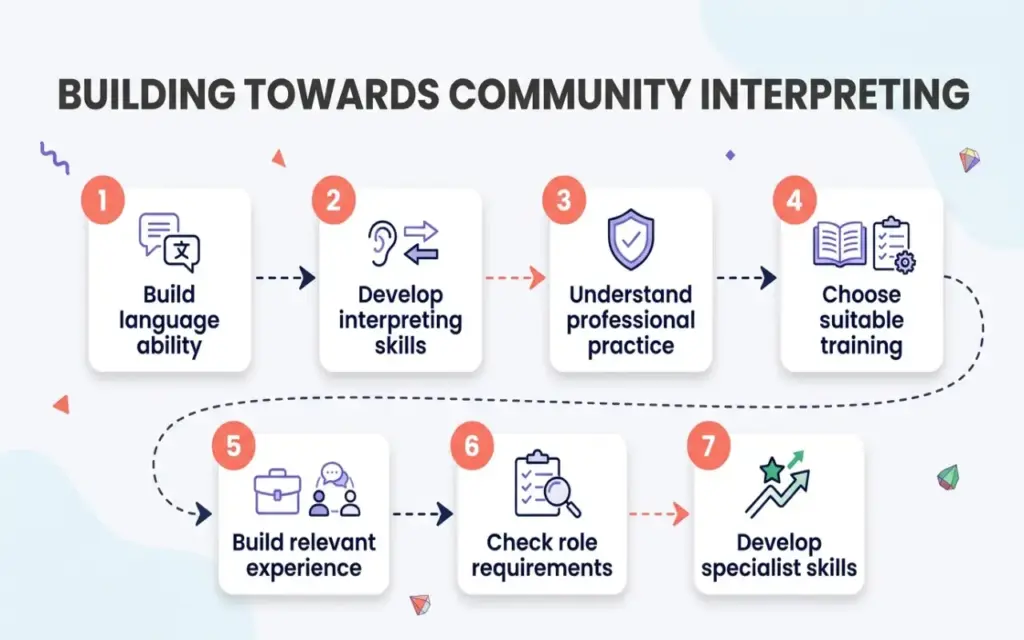
1. Develop strong ability in English and another language.
You need to communicate accurately and understand more than everyday vocabulary.
2.Develop interpreting skills, not only bilingual ability.
Practise listening, retaining information and conveying meaning without unnecessary additions or omissions.
3. Understand professional practice.
Study confidentiality, impartiality, boundaries, preparation and ethical decision-making.
4.Choose training that matches your goal.
Check exactly what a course teaches and what its certificate represents.
5. Build relevant experience where appropriate.
The National Careers Service identifies volunteering opportunities through organisations such as local councils, health and social services, welfare-rights organisations and community organisations.
6. Check employer requirements.
Do this before assuming a particular course qualifies you for a particular job.
7. Develop specialist knowledge if you want to move into a specialist setting.
For readers who want structured introductory study, Studyhub’s Interpreter Diploma Level 3 covers areas including language skills, interpreting techniques, specialised interpreting fields, cultural competence, technology, ethics and confidentiality. The course uses a written assignment, with optional certificates available after successful completion.
It should be considered a learning option rather than automatically treated as the regulated Level 3 Certificate in Community Interpreting or as a guarantee of eligibility for a particular interpreting role. If employment is your goal, check the requirements of the organisation or sector you hope to work with before choosing training.
Is Community Interpreting Right for You?
Community interpreting may suit someone who enjoys languages but also values careful, disciplined communication.
Ask yourself whether you can listen without rushing to respond, communicate confidently in both languages and stay focused when a conversation becomes complicated. You should also be comfortable maintaining professional boundaries and handling sensitive information appropriately.
Preparation is another part of the work. Even highly fluent speakers may need to research terminology before an unfamiliar assignment.
Most importantly, consider whether you are willing to develop interpreting competence beyond bilingualism. Knowing two languages gives you a valuable foundation. Professional interpreting adds technique, judgement, accuracy, ethics and responsibility to that foundation.
Your answer does not need to be “yes” immediately. Introductory study and appropriate experience can help you understand the field before deciding whether you want to pursue it further.
Understanding Your Next Step in Community Interpreting
Community interpreting is ultimately about enabling accurate communication where language might otherwise prevent people from accessing or engaging effectively with services.
Doing it well requires more than speaking two languages. Language ability needs to be combined with listening, interpreting technique, preparation, cultural awareness and professional conduct.
If you are considering this field, identify the type of interpreting you are interested in first. Then check the training, experience and qualification expectations for that particular setting. That approach will help you choose learning that supports your actual goal rather than relying on a course title alone.
Frequently Asked Questions
A community interpreter enables communication between people who use different languages in community or public-facing settings. The interpreter listens to what is communicated and conveys its meaning accurately in the other language while maintaining appropriate professional boundaries.
A degree is not the only route into interpreting in the UK. The National Careers Service lists college courses, volunteering and specialist professional-body courses alongside university study. However, individual employers and specialist settings may set specific qualification and experience requirements.
Not by itself. Strong ability in two languages is a foundation, but interpreting also requires active listening, memory, accurate communication, interpreting techniques, professional conduct and the ability to work within appropriate boundaries.
The terms can overlap, and their precise use varies by context and country. In the UK, it is particularly important to distinguish general community interpreting from specialist public-service work where additional qualifications, experience or subject knowledge may be expected.
Yes. Interpreting can take place face to face, by telephone or online. The National Careers Service specifically describes interpreters as working in person, over the phone and online. Different formats can require different communication and technology skills.

- All Courses
- IT & Software389
- Management287
- Teaching and Education250
- Business245
- Health and Fitness227
- Engineering & Technology180
- Health & Safety163
- Health and Social Care144
- Quality Licence Scheme139
- Healthcare137
- Accounting & Finance130
- Psychology112
- Employability112
- Lifestyle105
- Marketing75
- Office Productivity74
- Animal Care63
- Design and Photography55
- Design50
- Beauty & Makeup49
- Accounting & Bookkeeping34
- Web Development27
- Construction26
- Writing20
- Child Care17
- Digital Marketing13
- Environment10
- Bundle8
- Coaching6
- Agriculture5

Awarded By

0 responses on "What Is Community Interpreting? UK Guide to the Role and Skills"