



Choosing the right interpreter qualification can feel confusing, especially when course providers use terms such as Level 3, Level 6, diploma, CPD-accredited and regulated qualification. Although these terms may appear similar, they do not necessarily mean the same thing.
If you want to become an interpreter in the UK, the right training depends on your career goals, language skills and the type of interpreting you want to do. A course that helps you build foundational knowledge may not meet the entry requirements for a court, healthcare service or specialist interpreting assignment.
This guide explains interpreter qualifications in the UK, compares common training routes, explores the difference between course certificates and regulated qualifications, and shows you how to check whether a course suits your plans.
Whether you are starting from scratch, developing your professional skills or comparing a Level 3 interpreting course with a Level 6 qualification, this guide will help you make a more informed decision.
What Qualifications Do You Need to Become an Interpreter in the UK?
There is no single qualification required for every interpreter role in the UK. Requirements depend on the interpreting specialism, employer, commissioning organisation and assignment.
According to the National Careers Service guide to becoming an interpreter, possible routes include university study, college courses, volunteering and specialist training offered through professional bodies.
Common options include:
Introductory interpreting courses: Help learners understand interpreting principles, terminology and professional responsibilities.
Level 3 interpreting courses: Can provide foundational or intermediate learning, depending on the course specification and assessment.
Professional interpreting qualifications: Qualifications such as the Diploma in Public Service Interpreting (DPSI) may be relevant to specific public service settings.
University qualifications: Degrees and postgraduate courses in interpreting, translation and interpreting, or related language subjects can support particular career paths.
Professional development: Additional training can help experienced interpreters maintain and develop their knowledge.
The important point is that a qualification should match the work you intend to do. Before enrolling, check the actual course specification and the requirements of your preferred employer or professional body.
What Is the Difference Between an Interpreter and a Translator?
Interpreters generally work with spoken or signed communication, while translators generally work with written material.
An interpreter listens to, understands and conveys a message in another language, aiming to preserve the speaker’s meaning and intent. A translator works with written content, such as reports, documents, letters and publications.
Although both professions require strong language skills, they involve different techniques and working practices. Someone who is fluent in two languages may still need specialist training to interpret accurately in professional situations.
Interpreters may work in areas such as:
- Community and public services
- Healthcare and social care
- Legal and justice settings
- Business meetings and conferences
- Telephone and video interpreting
- British Sign Language (BSL) and other signed-language services
Each area can involve different knowledge, assessment and professional requirements. For example, interpreting in a legal setting may require specialist legal terminology, knowledge of relevant procedures and compliance with the commissioning organisation’s standards.
Types of Interpreter Qualifications in the UK
Understanding the main qualification routes can help you decide where to begin and what to study next.
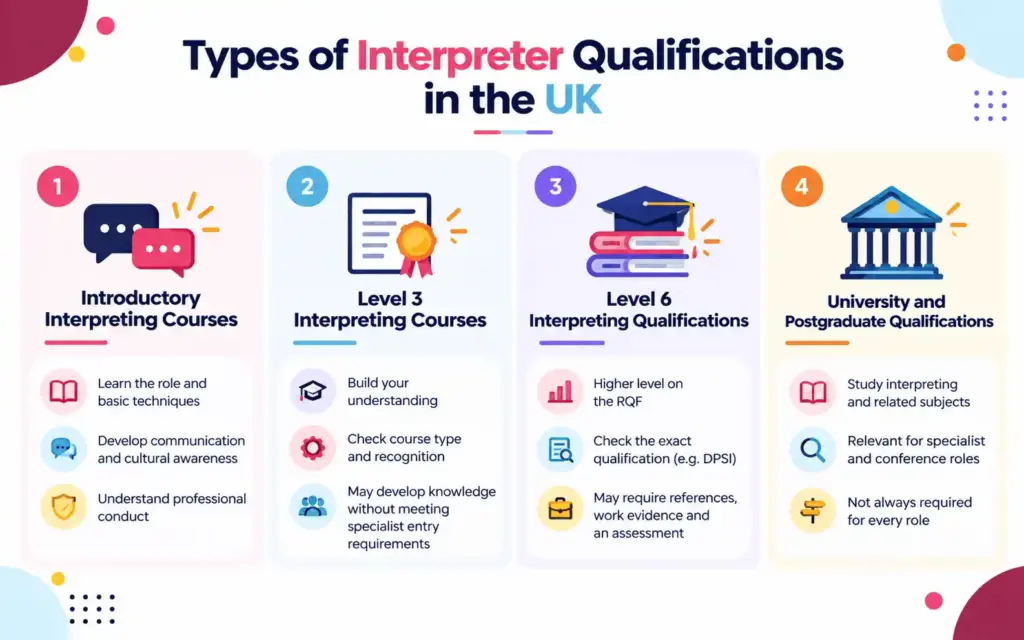
Introductory Interpreting Courses
An introductory course can help learners understand the role of an interpreter, basic interpreting techniques and the importance of clear communication.
Depending on the syllabus, it may cover:
- The difference between interpreting and translation
- Listening and communication techniques
- Language and cultural awareness
- Professional conduct and confidentiality
- Common interpreting situations
- Challenges that can arise during assignments
These courses can be useful if you want to explore the subject before committing to a longer qualification. However, completing an introductory course does not automatically establish that you are ready for professional assignments.
Level 3 Interpreting Courses
A Level 3 interpreting course may help learners develop their understanding of interpreting and its professional responsibilities. The content and depth of learning depend on the specific course.
Before enrolling, check whether the course is an introductory learning programme, a regulated qualification or another type of training.
Do not assume that every course using the words “Level 3 Diploma” is a regulated qualification. The title alone does not establish its regulatory status, awarding organisation or acceptance by employers.
A course may be appropriate for developing knowledge without meeting the entry requirements for specialist interpreting work.
Level 6 Interpreting Qualifications
Level 6 qualifications sit at a higher level on the Regulated Qualifications Framework (RQF) than Level 3 qualifications. However, the level alone does not tell you everything about a qualification’s content, purpose or suitability for a particular job.
The Institute of Translation and Interpreting (ITI), for example, lists the Diploma in Public Service Interpreting (DPSI) Law and DPSI Health among the Level 6 examples used in its qualified interpreter membership criteria. Its criteria also consider professional references, evidence of interpreting work and an assessment.
This illustrates why you should compare the exact qualification rather than relying only on its level.
University and Postgraduate Qualifications
University study is another route into interpreting. Relevant subjects can include interpreting studies, languages and interpreting, translation and interpreting, and modern languages.
Postgraduate qualifications may be particularly relevant to conference interpreting and other specialist career paths. The training required depends on the type of interpreting you want to pursue.
You do not necessarily need a university degree for every interpreting role. However, some employers, professional bodies and specialist assignments may have specific qualification or experience requirements.
For more detail on career routes, read our guide to how to become an interpreter in the UK.
Level 3 vs Level 6 Interpreting Course: What Is the Difference?
The main distinction is the qualification level, but the practical difference depends on the individual courses being compared.
| Comparison point | Level 3 interpreting course | Level 6 interpreting qualification |
|---|---|---|
| General level | Lower level than Level 6 on the RQF | Higher level than Level 3 on the RQF |
| Potential purpose | May introduce or develop foundational knowledge | May support more advanced professional learning |
| Entry requirements | Depend on the provider and course | Depend on the qualification and awarding organisation |
| Assessment | May involve quizzes, assignments or other methods | Depends on the qualification specification |
| Professional recognition | Must be checked for the specific course | Must also be checked for the specific qualification |
| Suitability for specialist work | Cannot be assumed | Cannot be assumed from level alone |
Important: This table compares general qualification levels, not every Level 3 or Level 6 course. The word “Level” does not, by itself, prove that a course is regulated or accepted for a particular job.
For example, a course marketed as an Interpreter Diploma Level 3 may offer structured learning about interpreting techniques, cultural competence and confidentiality. That learning can be useful, but it should not be presented as equivalent to a specific regulated professional qualification unless the evidence supports that claim.
If you are considering a Level 6 qualification, verify the exact title, awarding organisation, qualification specification and relevant professional requirements.
Course Certificate vs CPD Recognition vs Regulated Qualification
These terms are often confused, but they describe different things. Understanding the distinction is essential when comparing interpreter training options.
| Type | What it generally means | What you should check |
|---|---|---|
| Course completion certificate | Evidence that you completed a course or met the provider's stated requirements | Course content, assessment method and what completion confirms |
| CPD recognition | Recognition associated with continuing professional development | Which organisation recognises the learning and what the recognition covers |
| Regulated qualification | A qualification regulated within the relevant national framework | Exact qualification title, awarding organisation and official register entry |
| Professional membership | Membership of a professional organisation under its eligibility rules | Entry criteria, assessment requirements and ongoing obligations |
| Specialist professional qualification | A qualification designed for a particular professional field or purpose | Whether it meets the requirements of the intended employer or assignment |
A certificate can demonstrate that you have completed learning, but it does not automatically prove that you hold a regulated qualification.
Similarly, CPD recognition does not, by itself, mean that a course is an Ofqual-regulated qualification or that it qualifies you for a regulated or specialist role.
In England and Northern Ireland, you can use the official Find a regulated qualification service to check relevant entries. For Wales, consult Qualifications Wales. For Scotland, refer to SQA Accreditation.
Always verify the precise qualification and awarding organisation rather than relying solely on a course description or badge.
Do You Need a Degree to Become an Interpreter?
No, not every interpreting career requires a degree. The route depends on the work you want to do and the requirements of the organisation engaging you.
The National Careers Service identifies college courses, university study, volunteering and specialist qualifications as possible routes into interpreting.
For some roles, relevant vocational training and practical experience may be appropriate. Other positions, particularly specialist or conference interpreting roles, may require more advanced training or specific professional qualifications.
If you do not have a degree, consider the following steps:
- Assess your English and other working-language skills.
- Decide which type of interpreting interests you.
- Research the entry requirements for that area.
- Compare relevant courses and professional qualifications.
- Look for suitable opportunities to practise and gain experience.
- Check whether employers require registration, references, background checks or additional training.
Do not choose a course simply because it appears to offer a quick route into the profession. Choose one that fits your starting point and long-term goals.
How to Check Whether an Interpreter Qualification Is Recognised
Before paying for an interpreter course, carry out a few checks. These can help you understand what the qualification provides and whether it is relevant to your plans.

Check the Exact Qualification Title
Look for the full qualification title rather than relying on general phrases such as “professional interpreter diploma”.
If the provider describes the course as regulated, confirm its status through the relevant official qualification register.
Verify the Awarding Organisation
Find out who awards the qualification or issues the certificate. If the course claims to lead to a regulated qualification, check whether the awarding organisation and exact qualification appear on the relevant register.
A training provider and an awarding organisation may be different entities, so establish which organisation is responsible for the award.
Understand the Certificate
Ask what you receive when you finish the course.
For example, is it a course completion certificate, a CPD-related certificate or a certificate for a regulated qualification? What assessments must you pass? Are there additional requirements?
These details matter because different certificates can demonstrate different achievements.
Review the Course Assessment
Check whether the course includes written assignments, practical interpreting exercises, examinations or other assessments.
The presence of an assessment does not automatically establish that a qualification is regulated. However, understanding the assessment method helps you judge how the course measures learning.
Check Employer and Professional Requirements
If you want to work in courts, healthcare, immigration or another specialist area, review the requirements published by the relevant employer, commissioning body or professional organisation.
For example, the Ministry of Justice’s Language Services guidance includes information about interpreter qualifications and standards for justice assignments in England and Wales. These requirements should not be assumed to apply identically to every interpreter role across the UK.
Confirm Any Additional Requirements
Depending on the assignment, you may also need relevant experience, language-specific competence, professional references, security clearance or background checks.
A course certificate alone may not meet all these requirements.
Which Qualifications Do Interpreters Need for Legal and Healthcare Work?
Legal and healthcare interpreting can involve sensitive information, specialist terminology and significant consequences if communication is inaccurate. Requirements therefore need to be checked carefully.

Legal and Court Interpreting
Interpreters working in courts and other justice settings may need to meet the standards set by the relevant commissioning organisation.
The Ministry of Justice’s updated Code of Conduct and Ethics for Interpreters, published on 5 October 2026, applies to the relevant MoJ language service arrangements in England and Wales.
It covers professional conduct, confidentiality, impartiality, competence and other responsibilities. The guidance also states that interpreters must hold the valid qualifications, certificates and security levels required for their assignments.
This means that a general interpreting course should not be assumed to qualify someone for court work. Check the current requirements for the specific role and service provider.
Healthcare and Community Interpreting
Healthcare and community interpreters may support communication between professionals and people who do not share a language. Depending on the role, they may work in hospitals, GP practices, local authorities, social services or community organisations.
Relevant knowledge can include healthcare terminology, confidentiality, impartiality and the ability to communicate accurately in sensitive situations.
The required qualification and experience can vary between employers and services. Check the relevant organisation’s requirements before applying.
British Sign Language Interpreting
British Sign Language interpreting is a specialist area that involves signed communication rather than simply transferring spoken words between two languages.
Training and professional requirements differ from those for spoken-language interpreting. If your goal is to work with BSL, research the qualifications and experience expected for the specific role.
You can also read our guide to starting to learn British Sign Language.
What Skills Should an Interpreter Course Help You Develop?
Qualifications are only one part of preparing for interpreting work. Interpreters also need practical language and communication skills.
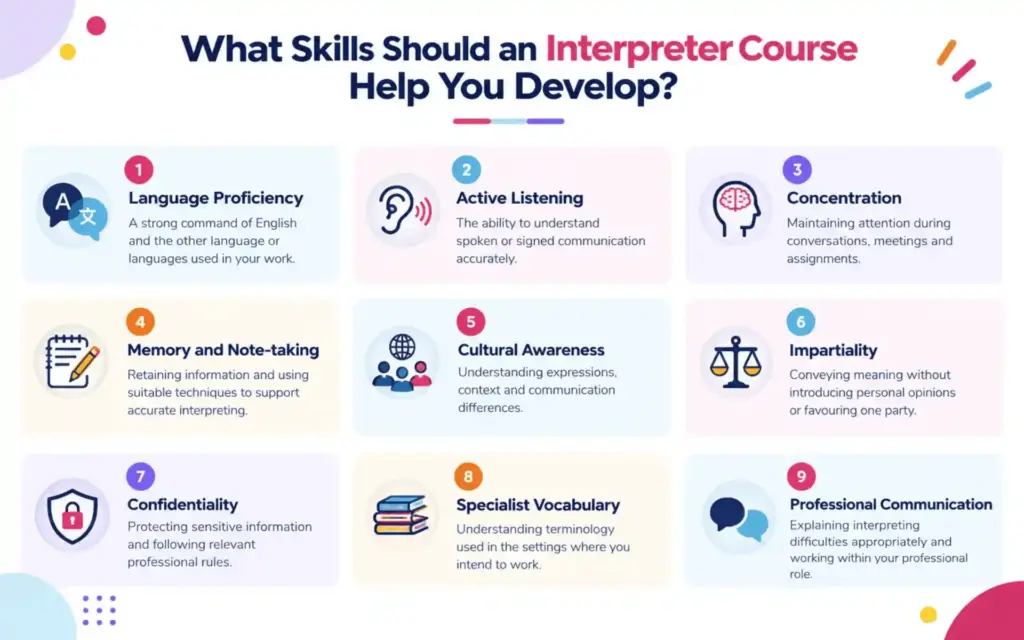
Important skills include:
Language proficiency: A strong command of English and the other language or languages used in your work.
Active listening: The ability to understand spoken or signed communication accurately.
Concentration: Maintaining attention during conversations, meetings and assignments.
Memory and note-taking: Retaining information and using suitable techniques to support accurate interpreting.
Cultural awareness: Understanding expressions, context and communication differences.
Impartiality: Conveying meaning without introducing personal opinions or favouring one party.
Confidentiality: Protecting sensitive information and following relevant professional rules.
Specialist vocabulary: Understanding terminology used in the settings where you intend to work.
Professional communication: Explaining interpreting difficulties appropriately and working within your professional role.
A course’s syllabus should make it reasonably clear which of these areas it covers. If practical interpreting ability is important to your goal, check whether the course includes opportunities to practise and receive feedback.
How to Choose the Right Interpreter Course
Use this checklist when comparing interpreter qualifications in the UK.
Define your goal: Decide whether you want introductory knowledge, further professional development or a qualification for a specific role.
Check the course level: Understand what the stated level means and whether it relates to a regulated qualification.
Read the syllabus: Look for relevant content on interpreting techniques, ethics, confidentiality and specialist terminology.
Review assessments: Find out how learning is assessed and what you must complete to receive the certificate.
Verify recognition: Check claims about regulation, CPD recognition and awarding organisations.
Check entry requirements: Make sure you meet the course’s language, education or experience requirements.
Research professional requirements: Confirm whether your intended employer or sector expects particular qualifications, registration or experience.
Compare the total cost: Check tuition fees and any additional charges for certificates, assessments or other services.
Review study arrangements: Consider course access, tutor support, flexibility and the time available for study.
Keep your expectations realistic: A course can support learning without guaranteeing employment, professional membership or eligibility for specialist assignments.
Taking these steps can help you avoid choosing a course based on its title or marketing claims alone.
Is the Studyhub Interpreter Diploma Level 3 Worth Considering?
If you want to develop your understanding of interpreting before deciding on a longer-term career route, you can explore the Studyhub Interpreter Diploma Level 3.
The course page describes learning in areas including interpreting techniques, language skills, specialised interpreting fields, cultural competence, technology, ethics and confidentiality. It also outlines the course assessment and certificate arrangements.
Before enrolling, review the current syllabus, assessment details, certificate information and any additional charges. Check whether the course matches your learning goals and whether you need a different qualification for your intended professional setting.
The course may be worth considering as a learning option if its content suits your needs. However, do not assume that completing it automatically makes you eligible for court, healthcare or other specialist interpreting assignments. Confirm the requirements of the relevant employer, commissioning organisation or professional body.
Explore the course: Studyhub Interpreter Diploma Level 3.
Common Mistakes to Avoid When Comparing Interpreter Qualifications
When researching interpreter courses, watch out for these common mistakes.
Assuming every diploma is regulated. A diploma title does not automatically prove that a qualification is regulated. Check the official register where applicable.
Confusing CPD recognition with professional eligibility. CPD recognition may be relevant to professional development, but it does not automatically meet an employer’s entry requirements.
Choosing a course by level alone. Compare the exact qualification, learning outcomes, assessment and recognition rather than relying only on a Level 3 or Level 6 label.
Assuming one qualification covers every specialism. Legal, healthcare, conference and BSL interpreting can have different requirements.
Ignoring practical experience. Language proficiency and course completion do not necessarily demonstrate that you can manage every professional interpreting situation.
Relying on outdated guidance. Employer requirements and service arrangements can change. Check current official information before making a career decision.
Avoiding these mistakes will help you compare courses more accurately and choose training that supports your intended direction.
Final Thoughts: Choosing the Right Interpreter Qualification
Choosing between interpreter qualifications becomes easier when you understand what each course offers and what your intended role requires.
An introductory course may help you explore the profession, while a specialist or higher-level qualification may be more appropriate for particular professional pathways. However, course level, certificate wording and CPD recognition should never be treated as automatic proof of professional eligibility.
Before enrolling, review the syllabus, confirm the qualification’s status, check the awarding organisation and research the requirements of your preferred interpreting sector.
If you are beginning your learning journey, the Studyhub Interpreter Diploma Level 3 is one option to review. Compare its current course details with your goals before deciding whether it is right for you.
The best interpreter qualification is not simply the one with the highest level or most impressive title. It is the one that matches your learning needs and is appropriate for the work you want to do.
Frequently Asked Questions
There is no single qualification for every interpreting role. Options include college courses, university study and specialist professional qualifications. The appropriate route depends on your intended specialism and the requirements of the employer or commissioning organisation.
Not necessarily. A Level 3 course may help you develop interpreting knowledge, but completing one does not automatically qualify you for professional assignments. Check the course’s status and the requirements of your intended role.
Not automatically. CPD recognition and qualification regulation are different things. Check the exact qualification and awarding organisation on the appropriate official register if the provider claims that the qualification is regulated.
The Diploma in Public Service Interpreting is a professional qualification associated with public service interpreting. The relevant specialism and current entry requirements should be checked with the awarding or professional organisation.
The Diploma in Public Service Interpreting is a professional qualification associated with public service interpreting. The relevant specialism and current entry requirements should be checked with the awarding or professional organisation.
Check the full course title, provider, awarding organisation, syllabus, assessment method, certificate type, total cost and any claims about recognition. If you need the qualification for a particular job, confirm acceptance with the relevant employer or professional body first.
- All Courses
- IT & Software389
- Management287
- Teaching and Education250
- Business245
- Health and Fitness227
- Engineering & Technology180
- Health & Safety163
- Health and Social Care144
- Quality Licence Scheme139
- Healthcare137
- Accounting & Finance130
- Psychology112
- Employability112
- Lifestyle105
- Marketing75
- Office Productivity74
- Animal Care63
- Design and Photography55
- Design50
- Beauty & Makeup49
- Accounting & Bookkeeping34
- Web Development27
- Construction26
- Writing20
- Child Care17
- Digital Marketing13
- Environment10
- Bundle8
- Coaching6
- Agriculture5
Awarded By

0 responses on "Interpreter Qualifications UK: Levels, Courses and Recognition"