



Two community interpreting courses can both say “Level 3” and still offer different training, assessment and outcomes. That is why choosing by the course title alone can be misleading.
For community interpreting, Level 3 is an important UK benchmark, but the right course depends on where you want to work, what the course actually awards, how your interpreting skills are developed and assessed, and your existing language ability.
If you need a broader overview first, see interpreter qualifications explained and compared.
Looking for Online Interpreter Training?
If you want to build your interpreting knowledge through flexible online study, StudyHub's Interpreter Diploma Level 3 offers a structured way to explore key interpreting skills and practices.
Review the course content, assessment and certificate details alongside the comparison points in this guide to see whether it fits your learning goals.
Explore the Interpreter Diploma Level 3 →What Should You Compare in a Community Interpreting Course?
Start with what you want the training to help you do. Then look beyond the headline level and compare the details.
| Check | What to ask |
|---|---|
| Level and status | What level is stated, and what exactly is awarded? |
| Skills | Are practical interpreting skills taught and assessed? |
| Work setting | Which interpreting environments does the training cover? |
| Assessment | Is there a portfolio, practical assessment, exam or another form of assessment? |
| Delivery | Is it online, live, blended or self-paced? |
| Support | Is tutor feedback or practical support available? |
| Total cost | Are assessment, certification or resit fees separate? |
| Recognition | What does the resulting certificate or qualification actually represent? |
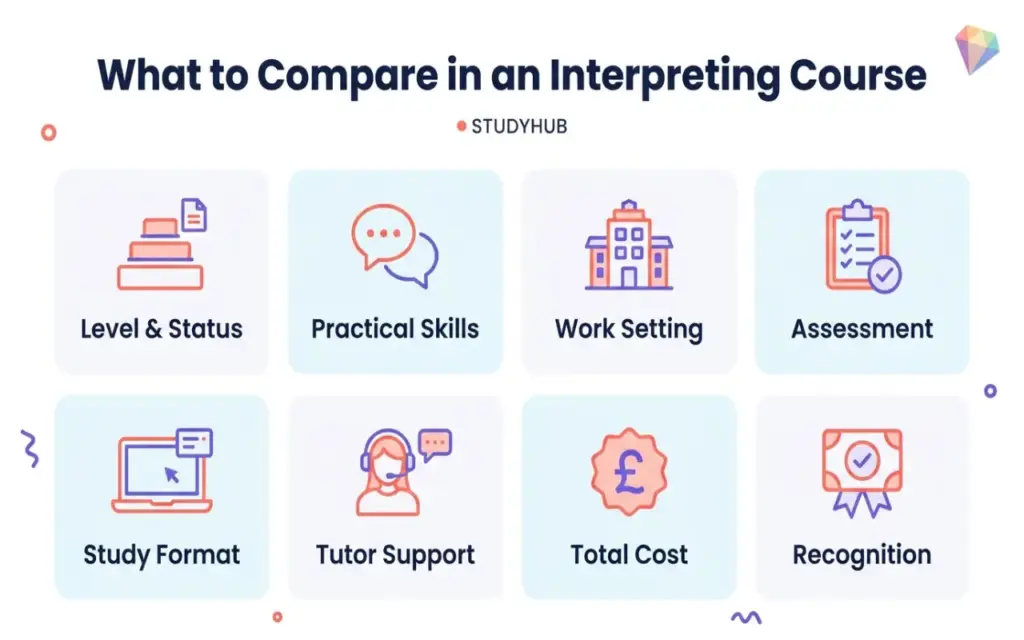
The distinction between course level and qualification status deserves particular attention. Do not assume that two courses using “Level 3” in their titles lead to the same qualification. In England, you can check whether a qualification is officially regulated through the GOV.UK service, which also provides qualification and awarding-organisation details.
Price matters too, but the advertised fee may not tell you everything you need to know. Check what is included before enrolling. For a more detailed breakdown, see interpreter course fees and hidden costs.
Which Course Level Fits Community Interpreting Work?
Course levels can indicate different stages of training, but the highest level is not automatically the best choice for every learner.
Introductory courses
An introductory course can suit someone exploring community interpreting or building foundational knowledge. It may introduce the interpreter’s role, communication principles and community settings.
That does not necessarily mean the learner is ready for paid interpreting assignments. Always check what the particular course prepares you for and what employers or agencies require.
Why Level 3 matters for community interpreting
A UK government technical review of spoken-language interpreting requirements describes the Level 3 Certificate in Community Interpreting as the commonly accepted minimum standard for community-based interpreting. It associates this level with community settings and notes that these qualifications do not generally cover legal interpreting.
This makes Level 3 particularly relevant when comparing community interpreting routes. However, the distinction is important: a course labelled “Level 3” is not automatically the regulated Level 3 Certificate in Community Interpreting.
If you need the qualification itself explained in greater depth, read about Level 3 interpreter qualifications.
When Level 6 may become relevant
More specialised public-service interpreting can demand a different standard. The same government review identifies RQF Level 6 as the professional standard for more demanding Ministry of Justice interpreting assignments.
If court, NHS or other specialist interpreting is your longer-term goal, see Level 3 and Level 6 interpreter routes rather than assuming one community course covers every setting.
Match the Course to Where You Want to Interpret
A useful question to ask before comparing course prices is: where do I actually want to use these skills?
Community interpreters may support communication in areas such as education, health and social services, welfare, housing and other community or public services. Specialist legal or police interpreting can have different expectations.
Requirements also vary between organisations. For example, Leeds City Council’s interpreter requirements currently provide several routes for freelance interpreters, including professional experience, Community Interpreting Level 3 or an equivalent/higher interpreting qualification, or specified qualifications combined with a language assessment.
So check the requirements of organisations or agencies you may eventually want to work with rather than assuming there is one rule for every UK community interpreting role.
Check What the Course Actually Awards
“Course”, “certificate”, “qualification” and “professional registration” are not interchangeable terms.
Before enrolling, check:
- What will you receive when you complete the course?
- Who issues or awards it?
- Is it a regulated qualification, if your goal requires one?
- Does it meet the requirements of the employers, agencies or professional routes you are considering?
Ofqual regulates awarding organisations and their regulated qualifications. This is different from a training provider simply offering a course, so check exactly what qualification or certificate a course leads to before enrolling.
For a fuller explanation of the distinction, see what an interpreter course certificate means.
Does the Course Develop Practical Interpreting Skills?
A course title tells you very little about how much practical interpreting you will actually do.
Look at whether the curriculum develops relevant skills such as active listening, consecutive interpreting, note-taking, terminology and glossary building, confidentiality, impartiality, cultural awareness and professional boundaries.
Assessment matters as well. Reading about interpreting is different from demonstrating interpreting competence, so check which skills are actually assessed.
Language proficiency is another consideration. Training can develop interpreting techniques, but it does not replace a strong command of the languages you intend to work between.

Online, Live or Self-Study: Which Format Suits You?
There is no single delivery format that suits everyone.
A self-paced online course can offer flexibility if you need to study around work or other commitments. Live tutor-led training may provide more immediate interaction and feedback, while blended learning can combine scheduled teaching with independent study.
Whichever format you consider, look beyond convenience. Ask how you will develop practical skills, what feedback is available and how assessment works.
Learners specifically looking for flexible online study can review StudyHub’s Interpreter Diploma Level 3 and check its curriculum, assessment and certificate details against the comparison criteria in this guide.
Level 3 Course or DPSI: Are They Alternatives?
Not necessarily. A community-focused Level 3 route and a Level 6 Diploma in Public Service Interpreting (DPSI) can serve different stages and professional goals.
If you are considering specialist public-service interpreting, particularly legal work, do not choose between them on the level number alone. Look at the work setting and professional requirements you are targeting.
For that specific decision, see online interpreter diploma vs DPSI.
Quick Checklist Before Choosing a Community Interpreting Course
Before enrolling, ask:
- What exactly will I receive after completing it?
- Is the qualification or certificate status clear?
- Are practical interpreting skills developed and assessed?
- Does the training fit my intended work setting?
- What assessment will I complete?
- What is the total cost, including any separate fees?
- Does it meet the requirements of organisations I may want to work with?
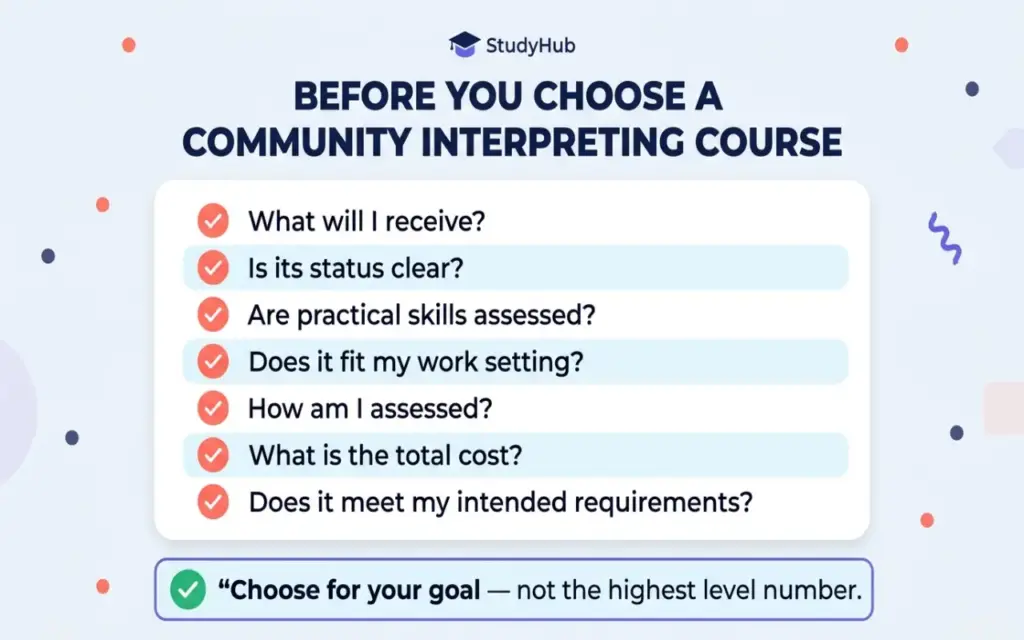
The highest-level or most expensive course is not automatically the most suitable. The better choice is the one that matches your current ability and intended route.
Choose for the Work You Want to Do
A useful community interpreting courses comparison should lead back to one question: what kind of interpreting work are you preparing for?
Match your choice to your current ability, intended setting, course or qualification status, practical assessment, support, cost and future progression. Level 3 can be an important benchmark for community work, while specialist public-service ambitions may require a different route.
If flexible online training fits your current goals, review StudyHub’s Interpreter Diploma Level 3 and compare its details with the checklist above before deciding.
Frequently Asked Questions
Community interpreting helps people who do not share the same language communicate in community and public-service settings. Depending on the role, this may involve services connected with healthcare, education, welfare, housing or local government.
Not necessarily. The National Careers Service interpreter career profile lists several routes into interpreting, including university, college courses, volunteering and specialist professional-body courses. It also notes that community interpreting courses are available at different levels.
Level 3 is an important UK benchmark for community-based interpreting, but whether a particular qualification is sufficient depends on the assignment and the requirements of the employer or agency. Specialist settings may require higher qualifications, additional experience or other criteria.
Check the course’s status, intended work setting, practical skills, assessment method, delivery and support, total cost, and recognition. Most importantly, confirm exactly what the course awards and whether it suits the interpreting work you intend to pursue.
Learn Community Interpreting Online
Interpreter Diploma Level 3
- All Courses
- IT & Software389
- Management287
- Teaching and Education250
- Business245
- Health and Fitness227
- Engineering & Technology180
- Health & Safety163
- Health and Social Care144
- Quality Licence Scheme139
- Healthcare137
- Accounting & Finance130
- Psychology112
- Employability112
- Lifestyle105
- Marketing75
- Office Productivity74
- Animal Care63
- Design and Photography55
- Design50
- Beauty & Makeup49
- Accounting & Bookkeeping34
- Web Development27
- Construction26
- Writing20
- Child Care17
- Digital Marketing13
- Environment10
- Bundle8
- Coaching6
- Agriculture5
Awarded By

0 responses on "Community Interpreting Courses Compared: UK Guide"