



An online interpreter diploma and the DPSI may sound like similar training options, but they should not automatically be treated as equivalent qualifications. The CIOL Qualifications Level 6 Diploma in Public Service Interpreting (DPSI) is an Ofqual-regulated qualification for public service interpreting. An online interpreter course may instead be designed to build knowledge and skills, with its status depending on the specific programme and awarding arrangements.
So, if you are comparing the two, look beyond the word “diploma”. Consider the qualification status, assessment, skills covered, professional recognition and, most importantly, the type of interpreting work you hope to pursue.
For a broader look at interpreter qualifications in the UK, see our dedicated qualifications guide.
Online Interpreter Diploma vs DPSI: Quick Comparison
The simplest way to understand the difference is to separate learning a subject from gaining a particular professional qualification.
| Comparison | Online Interpreter Diploma/Course | DPSI |
|---|---|---|
| Main purpose | Depends on the course; may focus on developing interpreting knowledge and skills | Professional public service interpreting qualification |
| Qualification status | Depends on the specific programme | Ofqual-regulated qualification |
| Level | Depends on the individual course and its status | RQF Level 6 |
| Assessment | Varies between courses | Five assessed units |
| Main focus | Depends on the syllabus | Public service interpreting and related translation skills |
| Professional recognition | Must be checked for the individual course | Established professional qualification |
| NRPSI relevance | Eligibility should not be assumed | Can support an application, subject to NRPSI's full criteria |
| Suitable for | Depends on the learner's goals and starting point | People prepared to demonstrate professional-level public service interpreting skills |
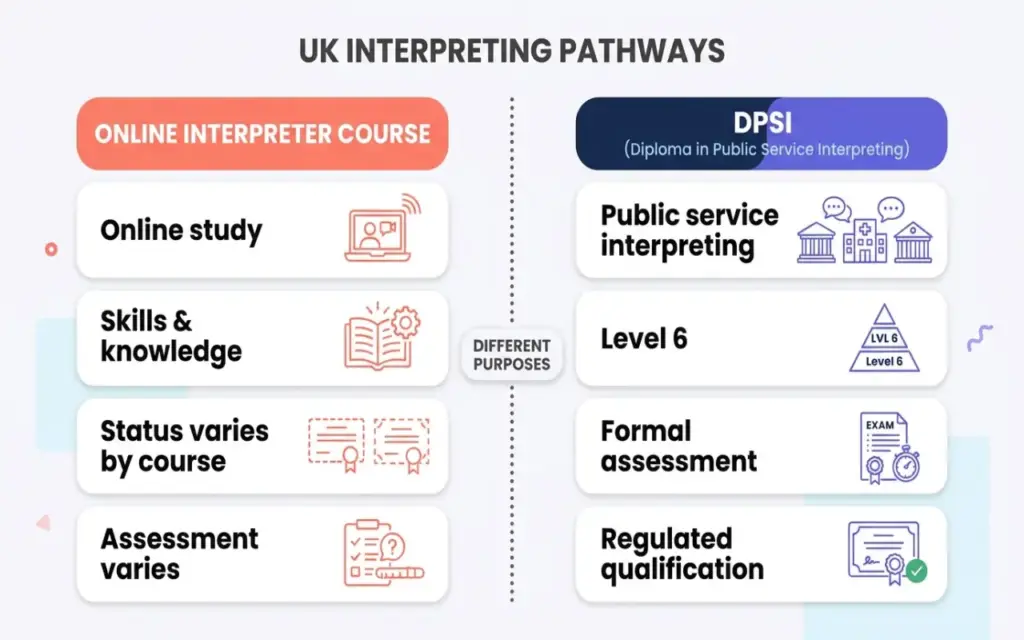
The official GOV.UK guidance on qualification levels places regulated Level 6 diplomas at Level 6 of the framework. However, a course having “Level 3” or “Diploma” in its title does not by itself establish that it is a regulated qualification.
StudyHub’s Interpreter Diploma Level 3 is an online course covering areas including language skills, interpreting techniques, specialised fields, cultural competence, technology, ethics and confidentiality. Its current course page describes a written assignment at the end and the opportunity to claim a course certificate after successfully passing the test. It should not be presented as equivalent to the DPSI.
What Is an Online Interpreter Diploma?
“Online” tells you how you study, not what type of credential you will receive.
An online interpreter diploma or course might introduce interpreting techniques, communication, ethics, cultural awareness and specialist contexts. But course titles vary considerably, so the word “diploma” alone does not tell you whether a programme is an Ofqual-regulated qualification.
Before enrolling, check who awards the credential, how you will be assessed, what skills are covered and whether the programme has the recognition you need for your intended work. If a provider presents a course at a particular level, check exactly what that description means and whether a regulated qualification number or awarding organisation is specified where relevant.
This distinction becomes particularly important when comparing Level 3 interpreter qualifications. We cover those options separately rather than treating every course using “Level 3” in its title as the same type of credential.
It is equally useful to know what an interpreter course certificate means. A certificate showing that you completed or passed a training course is not automatically the same thing as an Ofqual-regulated qualification.
What Is the DPSI?
The Diploma in Public Service Interpreting (DPSI) from CIOL Qualifications is an Ofqual-regulated Level 6 qualification. CIOL describes it as a professional qualification for public service interpreting and says it is now available fully online.
The official DPSI information from CIOL shows that the qualification consists of five units:
- consecutive and simultaneous interpreting;
- sight translation into English;
- sight translation from English;
- written translation into English; and
- written translation from English.
This breadth matters. Candidates are being assessed on specific interpreting and translation competencies rather than simply completing online learning materials.
There is also an important distinction between a DPSI preparation course and the DPSI qualification itself. CIOL Qualifications is the awarding organisation and states that candidates may prepare through a course or enter independently. A preparation course can help someone get ready for the assessment, but completing such a course does not itself mean the learner has achieved the DPSI.
CIOL also describes the DPSI as a professional qualification set at degree level and expects candidates to be competent in their source and target languages and able to interpret and write at a professional standard.
Is an Online Interpreter Diploma Equivalent to the DPSI?
Two programmes can both contain the word “diploma” while having very different purposes, assessments and recognition. Similarly, “online” simply describes a method of delivery. It does not tell you whether a programme is regulated.
When comparing an interpreter course with the DPSI, check:
- whether the credential is regulated;
- its recognised qualification level, if applicable;
- the awarding organisation;
- what the assessment actually tests;
- which interpreting and translation skills are assessed;
- whether relevant employers or professional registers recognise it; and
- what type of interpreting the programme is intended to support.
The distinction between levels is also meaningful for regulated qualifications. GOV.UK’s guidance on the Regulated Qualifications Framework levels lists Level 3 and Level 6 as separate qualification levels.
But that does not mean every course marketed with “Level 3” in its title is automatically an RQF Level 3 qualification.
A better question than “Is this online?” is therefore:
What exactly will I achieve when I finish, and does that match what I need next?
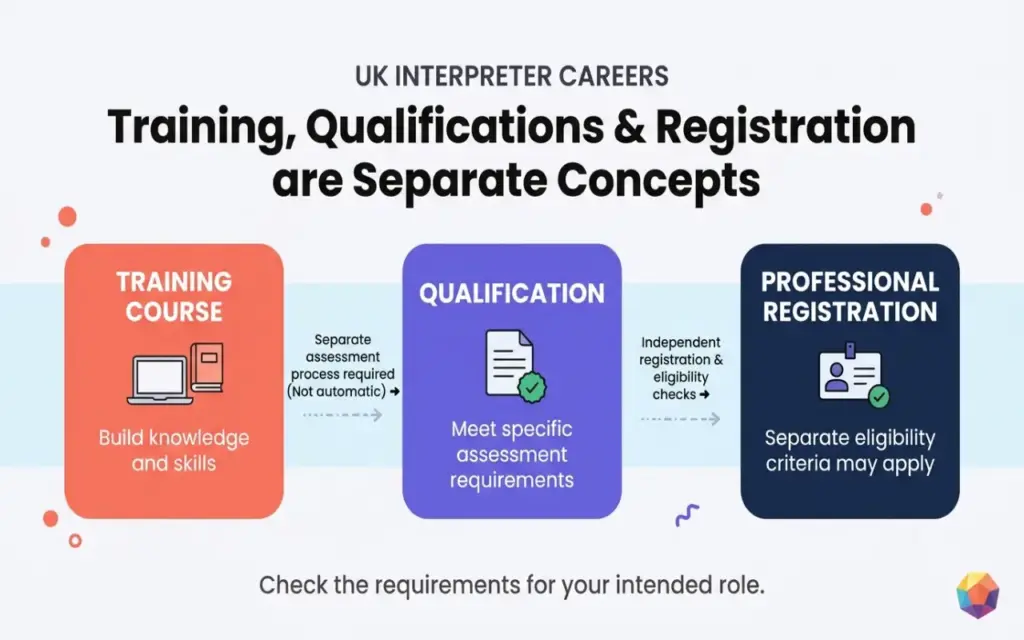
Which Option Fits Your Interpreting Goals?
Neither option should be chosen simply because its title sounds more advanced. Start with where you are now and where you want the training to take you.

When an Online Interpreter Course May Suit You
An online course may make sense if you are exploring interpreting, want flexible study or need to build your understanding of the field before deciding whether to pursue a particular professional qualification.
For learners at this stage, StudyHub’s Interpreter Diploma Level 3 provides online study across eight core areas, including interpreting techniques, language skills development, cultural competence, specialised fields, technology, ethics and confidentiality.
The course page says no previous qualifications or experience are required to enrol. That makes it relevant to learners building their knowledge, but completion should not be described as automatically making someone professionally qualified for a particular interpreting role.
When the DPSI May Be More Relevant
The DPSI may be more relevant if you are already working towards professional public service interpreting and need a recognised Level 6 qualification aligned with that goal.
CIOL states that DPSI holders can apply for registration with the National Register of Public Service Interpreters. Registration itself is a separate process, however, and candidates need to meet the register’s current qualification and experience criteria.
This is why the intended workplace matters. Courts, healthcare organisations, government services, agencies and other public service settings may have their own requirements for particular assignments.
If those areas interest you, our guide to Level 3 and Level 6 routes for NHS and court interpreting examines those routes separately rather than assuming one credential fits every setting.
Before planning around professional registration, check the current NRPSI registration requirements directly.
What Should You Check Before Choosing an Interpreter Course?
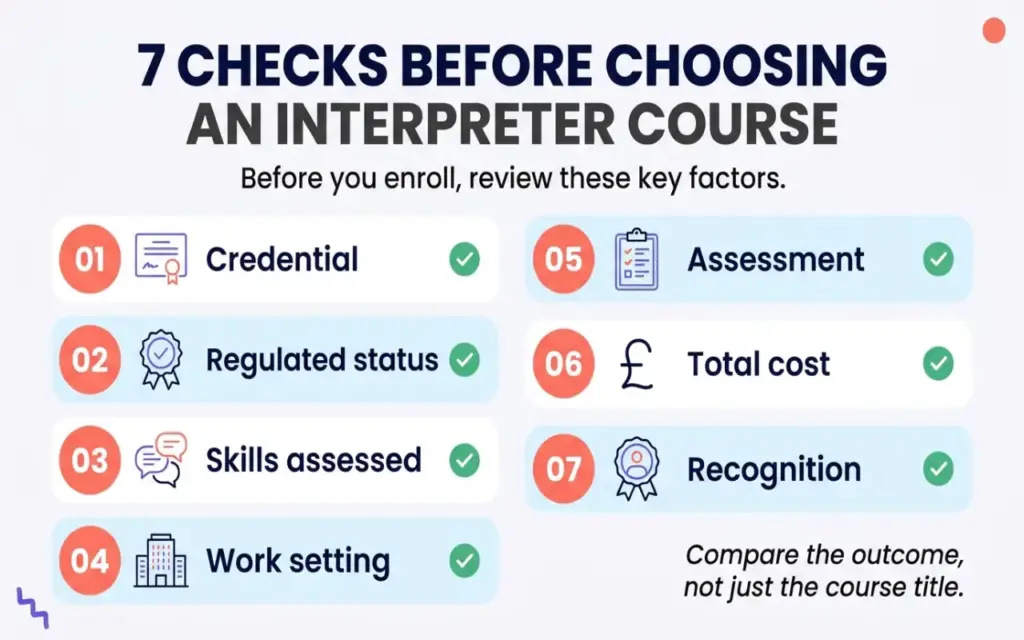
A course title is only the starting point. Before paying for training, work through these seven questions:
1. What will I receive at the end?
Check whether it is a course certificate, regulated qualification or another form of credential.
2.Is the qualification regulated?
If this matters for your goal, identify the regulator, awarding organisation and qualification details rather than relying on the course title.
3. What skills will actually be assessed?
Reading about interpreting is different from being assessed on interpreting performance.
4. Does it match my intended setting?
Community, healthcare, legal and other public service settings can have different expectations.
5. How am I assessed?
Look at practical assessments, written work, examinations and other requirements.
6. What will the complete route cost?
Course fees may not be the only expense. Assessment, examination, resits or certification can sometimes be separate. Our guide to interpreter course fees and hidden costs covers this topic in more detail.
7. Will the credential meet the requirements that matter to me?
Check the current criteria of the employer, agency, professional register or sector you intend to approach.
Online Interpreter Diploma vs DPSI: Which Should You Choose?
Choose according to the credential you need and the work you want to pursue.
An online interpreter course can be useful for building knowledge, exploring interpreting and developing your understanding at your own pace. The DPSI serves a different purpose: it is a specific Ofqual-regulated Level 6 professional qualification in public service interpreting.
If you are still comparing the wider options, our guide to interpreter qualifications in the UK can help you place different routes in context.
If you already have a particular employer, agency, interpreting setting or professional register in mind, check its current requirements first. That will tell you far more about the right next step than the word “diploma” on its own.
Frequently Asked Questions
The CIOL Qualifications DPSI is an Ofqual-regulated Level 6 qualification. CIOL describes it as a professional qualification set at degree level for public service interpreting. The qualification assesses consecutive and simultaneous interpreting, sight translation and written translation.
It can be valuable if your goal is professional public service interpreting and the DPSI aligns with the requirements of the settings or organisations you want to work with. It is not a guarantee of employment, so check the requirements for your intended sector, employer or professional register before deciding.
CIOL does not state on its current DPSI information page that candidates must first complete a Level 3 course. Instead, it says candidates are responsible for ensuring they are sufficiently prepared, competent in both working languages and able to interpret and write at a professional level. Check the current DPSI candidate information before applying.
There is no single answer for every interpreting role. The appropriate training or qualification depends on the type of interpreting, the organisation commissioning the work and any professional registration requirements that apply.
- All Courses
- IT & Software389
- Management287
- Teaching and Education250
- Business245
- Health and Fitness227
- Engineering & Technology180
- Health & Safety163
- Health and Social Care144
- Quality Licence Scheme139
- Healthcare137
- Accounting & Finance130
- Psychology112
- Employability112
- Lifestyle105
- Marketing75
- Office Productivity74
- Animal Care63
- Design and Photography55
- Design50
- Beauty & Makeup49
- Accounting & Bookkeeping34
- Web Development27
- Construction26
- Writing20
- Child Care17
- Digital Marketing13
- Environment10
- Bundle8
- Coaching6
- Agriculture5
Awarded By

0 responses on "Online Interpreter Diploma vs DPSI: What’s the Difference?"