



A clinical coding certificate comes from a short online course. It covers the basics of turning health records into codes. The NCCQ is the UK’s professional exam for clinical coders. Most people sit it after working as a coder. Passing it leads to accredited clinical coder status. That is why a course usually comes first.
Online certificates and the NCCQ both come up in clinical coding job searches, but they do very different jobs. Choosing between a clinical coding certificate vs NCCQ is really a question of timing, because each one fits a different point in a coder’s career.
A course is where many people begin. The professional exam comes later, once you have already worked as a coder.
What Is the NCCQ in Clinical Coding?
The NCCQ is the UK’s professional qualification for working clinical coders.
The NCCQ, short for the National Clinical Coding Qualification, is the main professional qualification for clinical coders in the UK. IHRIM, the Institute of Health Records and Information Management, awards it.
Clinical coding means turning notes about a patient’s hospital stay into standard codes. The NHS uses this data to plan services and support research. Coders use two main classifications:
ICD-10 (5th Edition) for diagnoses, such as illnesses and injuries
OPCS-4 for operations and procedures
The qualification checks that a coder can use both correctly and follow national coding standards. People who pass become accredited clinical coders, often shortened to ACC.
Who Can Sit the NCCQ Exam?
The NCCQ exam has a theory paper and a practical coding paper. IHRIM sets the NCCQ requirements and expects hands-on coding experience, so most candidates are working coders.
Want the full picture of NHS-backed training routes before the exam? Read NHS Approved Clinical Coding Training: Practical Guide for the details.
What Is a Clinical Coding Certificate?
A certificate shows you finished introductory training, not that you are a qualified coder. You receive this after finishing a short course, usually online. Many courses accept complete beginners and cover:
- medical words and abbreviations found in patient records
- how ICD-10 and OPCS-4 are organised
- SNOMED CT, a system of medical terms used in health records
- confidentiality and the legal side of handling patient data
What the course labels mean:
Non-regulated: the course is training, not a qualification regulated by Ofqual in England, Qualifications Wales, CCEA Regulation in Northern Ireland or SQA Accreditation in Scotland.
CPD-accredited: an independent body has checked it meets continuing professional development standards.
Endorsed: an organisation such as the Quality Licence Scheme has reviewed the course’s quality.
One example is the Medical Coding Certification: Clinical Coding Online Course at QLS Level 3. It is non-regulated training endorsed by the Quality Licence Scheme, featuring approximately 14 hours of structured study material and no formal entry requirements. Passing the final assignment lets you claim a CPD-accredited certificate.
Where Do CPC and CCS Fit In?
CPC and CCS are American certifications. UK hospitals use NHS classifications instead, so neither is the usual route into UK coding jobs.
Confused by the two job titles? Our article Medical Coding vs Clinical Coding UK: Key Differences explains how the US and UK roles differ.
Clinical Coding Certificate vs NCCQ: Side-by-Side Table
A certificate is an entry point. The NCCQ is a professional benchmark for experienced coders.
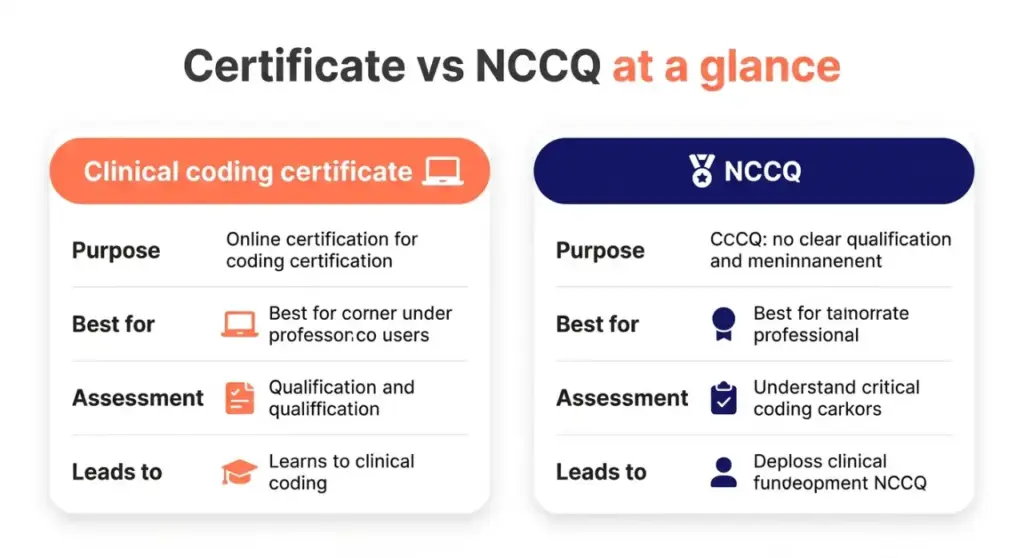
| Feature | Clinical coding certificate | NCCQ |
|---|---|---|
| Main purpose | Introduces coding basics | Confirms professional coding skill |
| Best for | Beginners and career changers | Working coders |
| Entry requirements | Often none | Set by IHRIM; coding experience expected |
| Awarded by | The training provider, sometimes with an endorsing body | IHRIM |
| How you prepare | Online study at your own pace | Real coding work plus exam revision |
| Time needed | Hours or weeks (about 14 hours for the course above) | Taken after a period of coding work |
| Cost | Usually low | Exam fees set by IHRIM |
| Assessment | Course quiz or assignment | Theory and practical papers |
| What it leads to | A certificate of completion | Accredited Clinical Coder (ACC) status |
Put simply, a certificate shows you have started. Accredited status shows you can code accurately to the national standard.
Planning your spending? Clinical Coding Course Fees: What to Budget breaks down typical costs for clinical coding training in the UK.
Where Each Option Fits in a UK Clinical Coding Career
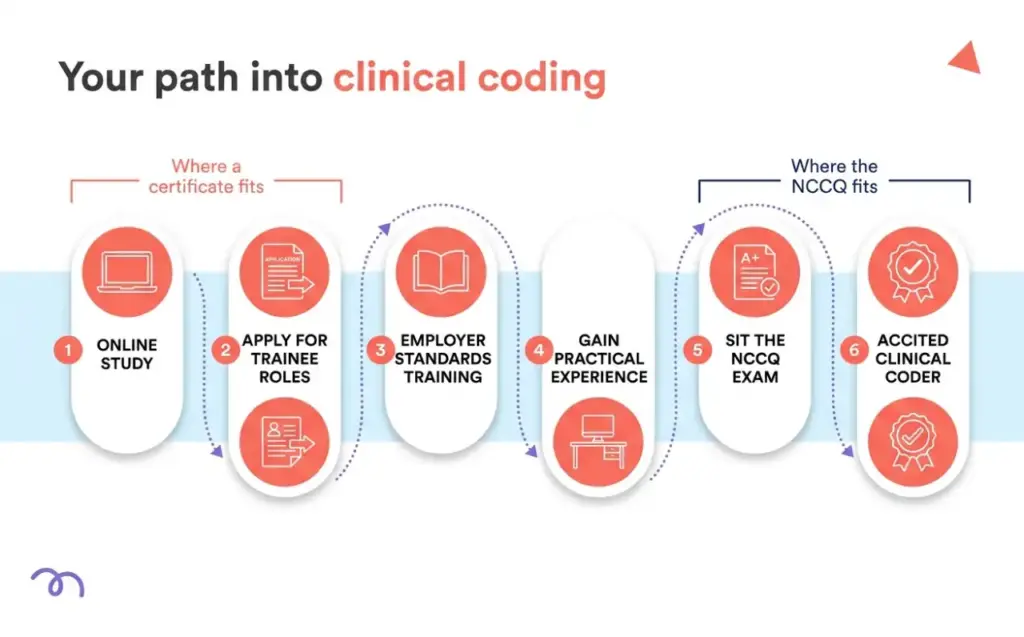
Most coders gain basic knowledge first, work as trainees and then sit the NCCQ. The clinical coding certificate vs NCCQ question becomes much clearer on a career timeline. In the NHS, a typical path looks like this:
Gain basic knowledge. An online course introduces codes and medical terms.
Apply for a trainee clinical coder job. NHS Health Careers describes the clinical coder role and common ways in.
Complete standards training. New NHS coders receive training on the national clinical coding standards, arranged by their employer.
Code real patient records. You gain supervised experience.
Sit the exam. Once you meet IHRIM’s requirements, you take the NCCQ.
Become an accredited clinical coder. ACC status can lead on to senior, audit or training roles.
Each UK nation runs its own NHS. Employers are trusts in England, health boards in Scotland and Wales, and health and social care trusts in Northern Ireland. Training arrangements can differ, so check locally.
Not sure if you meet the entry rules for a course? Read Clinical Coding Course Requirements before you apply for any training.
Clinical Coding Certificate vs NCCQ: Which Suits Your Stage?

These example scenarios are illustrations, not real cases.
If You Are New to Clinical Coding
Sam works in retail and wants an NHS office job. The NCCQ expects coding experience, so it isn’t Sam’s first step. A beginner course lets Sam try the work before applying.
Weighing up starter options? Beginner Clinical Coding Courses lists what to look for when you choose your very first clinical coding course.
If You Work in NHS Administration
Priya is a ward clerk who already handles patient records. A short course helps her talk confidently about codes when a trainee post opens.
If You Are a Trainee Coder
Tom started as a trainee last year and has finished his standards training. A basic online certificate adds little for him now. The NCCQ is his next real milestone.
If You Are an Experienced Coder
Ann has coded for years but never sat the exam. Passing would turn her experience into a formal qualification for senior posts.
Does the NCCQ Affect Pay and Career Prospects?
ACC status often links to a higher NHS pay band, but pay depends on the role.
Yes, it can. NHS jobs that ask for ACC status usually sit in a higher pay band than trainee jobs. NHS clinical coders are paid under the Agenda for Change system, where each job sits in a numbered pay band.
You can check current figures for each band in the Agenda for Change pay scales. Private sector pay varies, so always check the job advert.
Want a wider view of every route? Clinical Coding Courses in the UK: Training Guide covers the path from first course to professional status.
What an Online Certificate Can and Cannot Do
An online certificate adds knowledge and shows commitment. It does not replace the NCCQ or employer training.
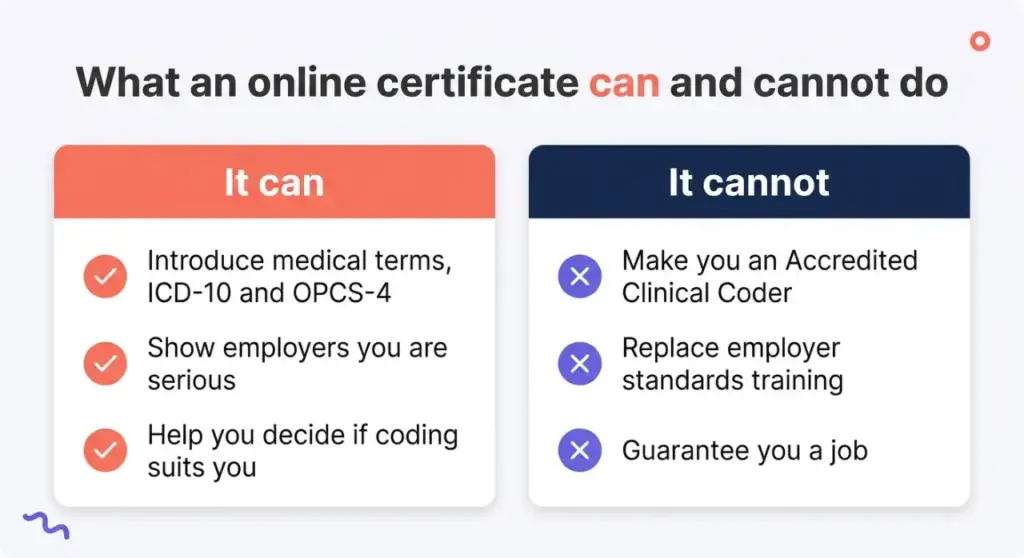
What it can do:
- Introduce medical terms, ICD-10 and OPCS-4
- Show employers you are serious about coding
- Help you decide whether coding suits you
- Provide talking points for a job interview
What it cannot do:
- Make you an accredited clinical coder
- Replace the standard training employers arrange
- Guarantee you a coding job
Tip: On your CV, list the course by its exact name and call it introductory training. Honest wording earns more trust.
Studying around work or family? Clinical Coding Course Online UK: Practical Guide covers how online study works from day to day.
So, Which Should You Start With?
Pick the option that matches your career stage today.
The clinical coding certificate vs NCCQ choice comes down to where you are now. If you are new, a certificate course is a sensible, low-cost first step. If you already code for a living, the NCCQ is the milestone worth working towards.
Ready for step one? The Medical Coding Certification: Clinical Coding Online Course at QLS Level 3 covers the basics at your own pace, with tutor support on weekdays.
Frequently Asked Questions
The NCCQ is the main professional qualification for UK clinical coders. Online certificates suit beginners who want basic knowledge before applying for trainee roles.
It is the status a coder gains after passing the NCCQ. It shows they can code accurately to the UK’s national clinical coding standards.
No. You can start as a trainee without it. Employers often encourage coders to work towards it, and senior roles may ask for ACC status.
No, it is designed for working coders. IHRIM expects hands-on coding experience and sets the current requirements, so check them before applying.
An online course may take hours or weeks. The NCCQ comes after a period of real coding work, plus time preparing for the exam.
The basics are manageable for most people. The hard part is applying detailed coding rules accurately, which takes practice, supervision and time on the job.
It can be if you are new to coding. It shows interest and basic knowledge, but it does not replace the NCCQ or employer training.
- All Courses
- IT & Software389
- Management287
- Teaching and Education250
- Business245
- Health and Fitness227
- Engineering & Technology180
- Health & Safety163
- Health and Social Care144
- Quality Licence Scheme139
- Healthcare137
- Accounting & Finance130
- Psychology112
- Employability112
- Lifestyle105
- Marketing75
- Office Productivity74
- Animal Care63
- Design and Photography55
- Design50
- Beauty & Makeup49
- Accounting & Bookkeeping34
- Web Development27
- Construction26
- Writing20
- Child Care17
- Digital Marketing13
- Environment10
- Bundle8
- Coaching6
- Agriculture5

Awarded By


0 responses on "Clinical Coding Certificate vs NCCQ: Which Do You Need?"