


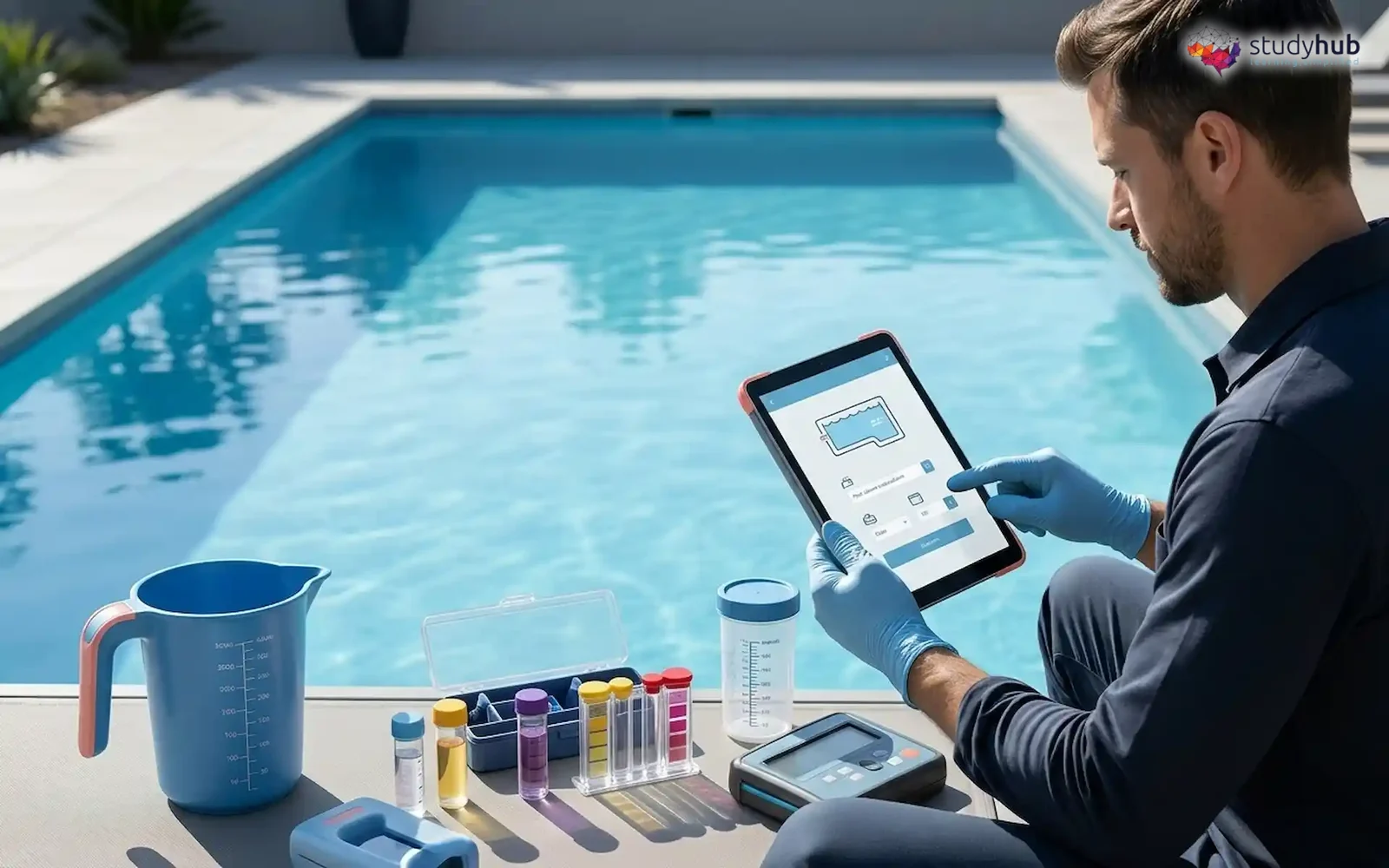
Pool water can look clean but still have the wrong chemical balance. The pH may be too high, the alkalinity may be unstable, or the water may not contain enough sanitiser to control harmful germs.
If you want to know how to balance pool water, the first step is to test it. You should then review the readings and make careful adjustments based on the pool type, treatment system and product instructions.
A common balancing routine checks total alkalinity first, followed by pH, calcium hardness and sanitiser. However, these checks are connected. For public and commercial pools, the pool’s approved operating procedures and PWTAG guidance must take priority. Required disinfection levels must be maintained throughout the process.
This guide explains how to balance pool water in clear steps, what each reading means and what to check before adding chemicals. You can also build wider knowledge through Studyhub’s Pool Maintenance course, which includes a module on the chemical balance of water.
Need your pool’s volume? Jump to the pool volume and dose calculator.
What Does It Mean to Balance Pool Water?
Balanced pool water has chemical levels that are kept within suitable limits for the type of pool and its treatment system. These levels help protect swimmers, pool surfaces and equipment.
Water balance is not the same as disinfection. Water balance relates to the chemical condition of the water, while disinfection helps control harmful microorganisms. Both are important for good pool water quality.
For example, pH affects how well chlorine works. Total alkalinity helps prevent sudden changes in pH, while calcium hardness is important when checking the risk of scale or corrosion.
When people ask how to balance pool water, they often focus only on chlorine. However, chlorine is just one part of the process. You also need to check the other measurements that affect the water.
Why Is Pool Water Balance Important?
Poor water balance can cause several problems:
- Unstable pH: The water may become harder to control.
- Scale deposits: Minerals can build up on tiles, heaters, pipework and other equipment.
- Corrosion: Water with unsuitable chemical conditions may damage some pool surfaces and fittings.
- Poor disinfection: A pH level outside the correct range can reduce how well chlorine works.
- Bather discomfort: Poor water quality may irritate the skin and eyes.
The right approach to how to balance pool water is to test the water, understand the readings and correct the cause instead of adding chemicals without a plan.
Which Pool Water Levels Should You Check?
Before you decide how to balance pool water, you need to understand the main chemical readings. Each one gives different information about the condition of the water.
| Water parameter | What it measures | Why it matters |
|---|---|---|
| Total alkalinity | The water's ability to resist changes in pH | Helps keep pH more stable |
| pH | How acidic or alkaline the water is | Affects swimmer comfort and chlorine performance |
| Calcium hardness | The amount of dissolved calcium | Helps assess the risk of scale and corrosion |
| Free chlorine | Chlorine available for disinfection | Helps show whether the pool has enough disinfectant |
| Combined chlorine | Chlorine that has reacted with substances in the water | Helps identify chloramine build-up |
| Cyanuric acid | A stabiliser used with certain chlorine products | Helps protect chlorine from sunlight in outdoor pools |
| Total dissolved solids (TDS) | The total amount of dissolved material | Helps assess changes in water quality and water balance |
You do not need to adjust every measurement every time. The correct tests and frequency depend on the pool, the disinfectant used and the site’s operating procedures.
What Are the Recommended Pool Water Levels in the UK?
For public swimming pools, the PWTAG Code of Practice gives useful guidance for pool operators. Its published values include:
| Parameter | PWTAG guidance for public pools |
|---|---|
| pH with chlorine-based disinfectants | 7.0–7.4 |
| Preferred pH range | 7.0–7.2 |
| Total alkalinity | 80–200 mg/L as calcium carbonate |
| Calcium hardness | Ideally 80–200 mg/L as calcium carbonate |
PWTAG also explains that calcium hardness above 300 mg/L may lead to scale deposits when the water temperature or pH changes suddenly.
Important: These figures are not universal targets for every pool. The PWTAG Code is written for public-use swimming pools and does not directly cover domestic pools, spas or every specialist pool type. Always check the guidance for your pool and follow its written operating procedure.
You can read the PWTAG Code of Practice and its full Code of Practice document for more detail.
How to Balance Pool Water: A Step-by-Step Guide
A clear routine makes it easier to understand how to balance pool water without making unnecessary chemical changes.
Use this general learning sequence:
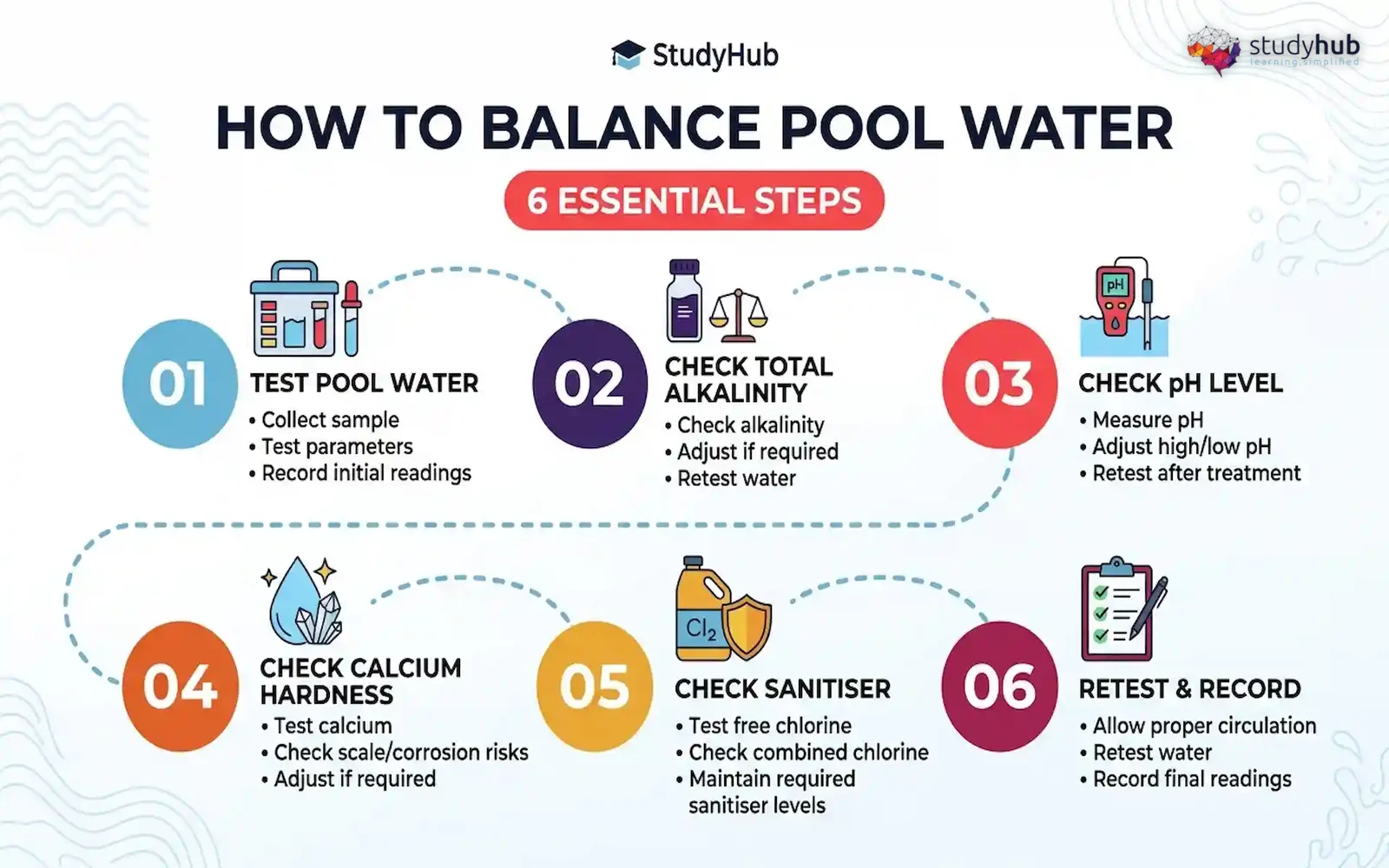
- Test the water.
- Check and adjust total alkalinity.
- Check and adjust pH.
- Assess calcium hardness.
- Check and maintain the sanitiser level.
- Retest and record the results.
This sequence is a guide to understanding common balancing tasks. It must not replace the pool’s operating procedures. PWTAG explains that pH and free chlorine are key considerations for public pool water and take priority over other water-balance factors. Therefore, never allow an essential sanitiser level to remain outside its required operating range while working through the other checks.
Step 1: Test Your Pool Water First
Testing is the starting point for anyone learning how to balance pool water. It helps you understand what needs attention before you choose a chemical or calculate a dose.
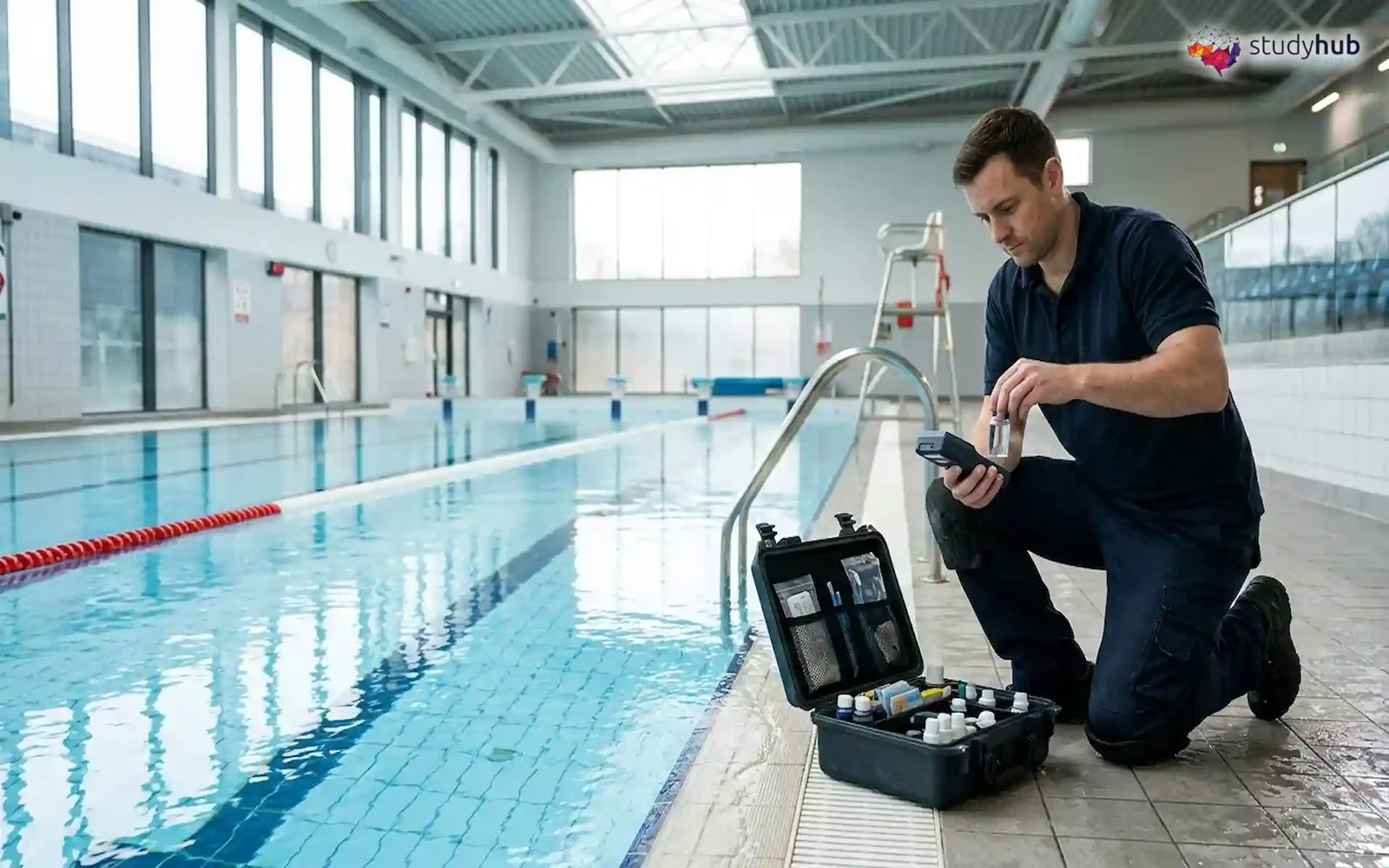
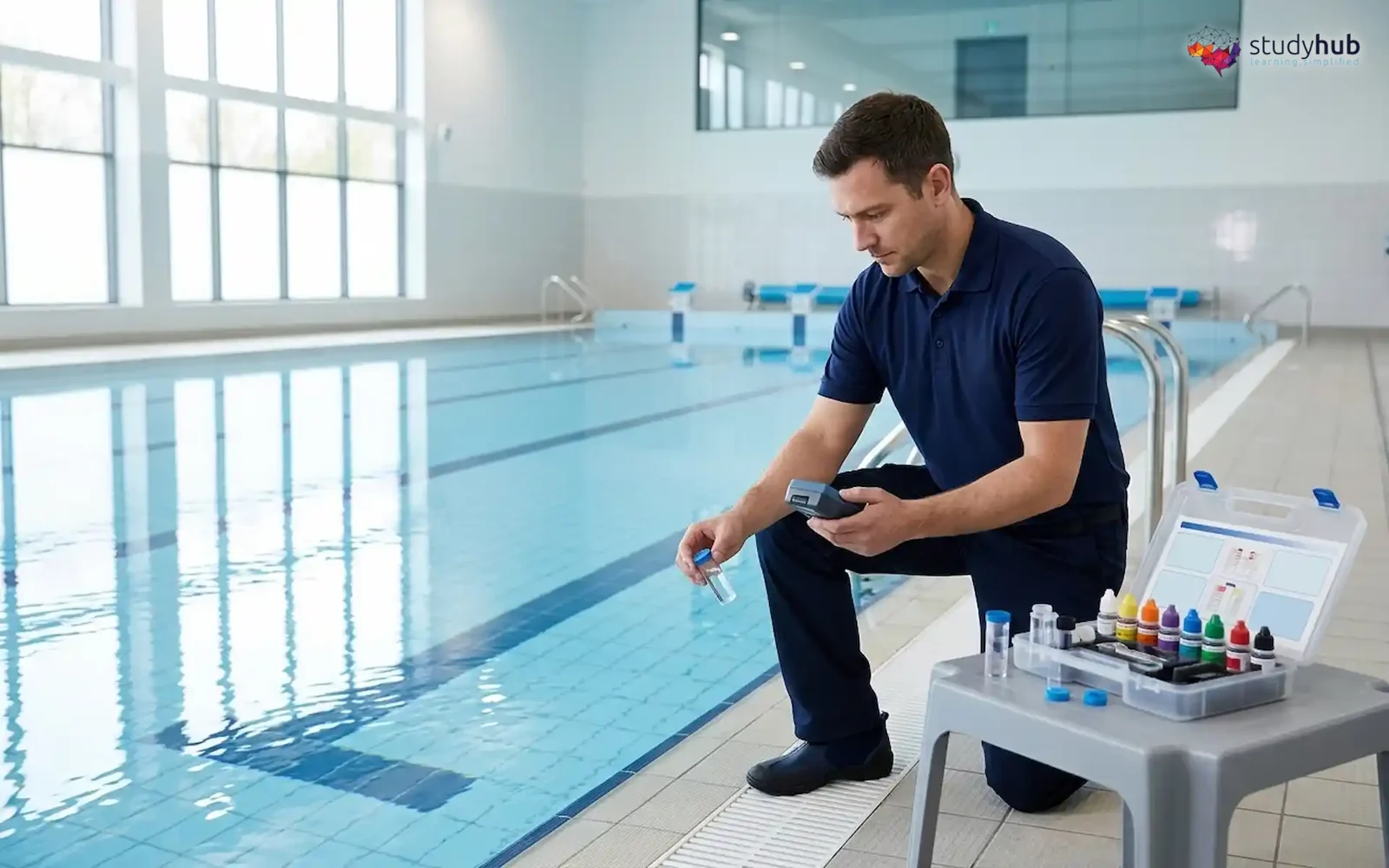
Start by checking the pool’s testing procedure and gathering the correct equipment. Depending on the pool and its monitoring system, this may include:
- A suitable pool water testing kit.
- Test strips or liquid reagents.
- A comparator or photometer.
- Clean sample vials.
- A pool water testing logbook.
- The pool’s chemical target ranges and product instructions.
How to take a useful water sample
- Follow the pool’s sampling procedure.
- Take a fresh, representative sample from the correct sampling point.
- Avoid taking a sample directly beside a water inlet or chemical dosing point unless the procedure tells you otherwise.
- Use a clean vial or container suitable for the test.
- Test the sample promptly and follow the equipment instructions.
- Record the results before making any changes.
For a commercial pool, the sampling point should follow the site’s procedure. PWTAG operator training includes sampling from the pool’s weakest point, around 100–300 mm below the water surface. Hanna Instruments also explains why samples taken too close to inlets or dosing points may give misleading results.
Read the Hanna Instruments guide to pool water testing for more information about testing equipment and sample collection.
Record the first readings
Write down the results before adding anything. Include the date, time, test location and any relevant notes about the pool.
This gives you a starting point. It also helps you check whether an adjustment has improved the water or created another problem.
The first stage of how to balance pool water is not adding chemicals. It is understanding the test results.
Step 2: Check and Adjust Total Alkalinity First
Total alkalinity is the water’s ability to resist sudden changes in pH. It acts as a buffer, helping the pH remain more stable.
If total alkalinity is too low, the pH may change quickly and become harder to control. If it is too high, adjusting the pH may become more difficult.
How to correct total alkalinity
First, compare the test result with the target range set for your pool. Do not rely on a general target taken from a different pool type.
- If alkalinity is low: An approved alkalinity increaser may be used according to the product label and pool procedure.
- If alkalinity is high: The operator may need a controlled correction method, such as suitable acid treatment or water replacement, depending on the pool and its system.
Some products used to lower alkalinity can also lower pH. This is why you should not make a large adjustment without checking how it may affect the other readings.
After making an adjustment
- Follow the chemical manufacturer’s instructions.
- Allow the water to mix and circulate as directed.
- Retest total alkalinity.
- Check pH again before moving to the next correction.
- Record the chemical used and the final reading.
When you understand how to balance pool water, it becomes easier to see why alkalinity matters before making routine pH adjustments. A stable alkalinity level can make pH control more manageable.
PWTAG recommends regular alkalinity monitoring and gives guidance on suitable measurement methods in its Code of Practice.
Step 3: Check and Adjust Pool Water pH
pH measures how acidic or alkaline the water is. It is one of the most important readings because it affects chlorine disinfection and the overall condition of the pool water.
For public pools using chlorine-based disinfectants, PWTAG gives a pH range of 7.0–7.4, with 7.0–7.2 preferred for a better disinfectant effect. The correct target for a particular pool must still follow its operating procedure and treatment system.
What happens when pH is too high?
- Chlorine may become less effective.
- Scale may form more easily in some conditions.
- Water quality may become harder to manage.
What happens when pH is too low?
- The water may become more corrosive.
- Some metal fittings and pool equipment may be affected.
- Swimmers may experience discomfort.
How to adjust pool water pH
If the pH reading is outside the pool’s target range, check which correction product is approved for the treatment system.
- To lower a high pH reading, the pool procedure may specify a suitable pH reducer.
- To raise a low pH reading, it may specify a suitable pH increaser.
Always check the chemical label, pool volume and current reading before calculating the amount. Add only the recommended dose and follow the required circulation and retesting instructions.
Do not mix pH correction products with chlorine or other pool chemicals. The HSE warns that accidentally mixing an acid with a chlorine-based disinfectant can release dangerous chlorine gas.
A key part of how to balance pool water is checking pH again after the adjustment. Do not assume the reading has reached its target just because you have added the product.
Once the pH is within the required range, record the result and prepare to assess calcium hardness in the next stage.
Step 4: Check and Adjust Calcium Hardness
Calcium hardness measures how much dissolved calcium is present in pool water. It is important because calcium levels can affect pool surfaces, pipes and treatment equipment.
When learning how to balance pool water, do not ignore calcium hardness. Even when pH and alkalinity are within range, unsuitable calcium levels may still contribute to water problems.
What happens when calcium hardness is too low?
Low calcium hardness may increase the risk of corrosion or damage to certain cement-based pool surfaces, depending on the overall water balance.
What happens when calcium hardness is too high?
High calcium hardness can increase the risk of scale deposits. You may notice white marks on tiles, rough surfaces or mineral build-up around fittings.
How to manage calcium hardness
- Test calcium hardness using a suitable testing method.
- Compare the result with the target for your pool type and surface.
- Check pH and total alkalinity as part of the wider water-balance assessment.
- If calcium is too low, use an approved calcium increaser where suitable.
- If calcium is too high, a controlled water replacement plan may be needed.
- Retest the water after any adjustment.
Do not add a calcium product just because the reading looks different from a general guide. The right action depends on the pool surface, source water and overall chemical balance.
For more technical guidance, read PWTAG’s advice on common swimming pool problems.
Step 5: Check and Adjust the Sanitiser Level
Sanitisers help control harmful germs in pool water. Chlorine is widely used, although some pools use bromine or another approved treatment system.
Checking the sanitiser is an important part of how to balance pool water because correct water chemistry alone does not make a pool safe for swimming.
Understand free and combined chlorine
- Free chlorine: The chlorine available to disinfect the water.
- Combined chlorine: Chlorine that has reacted with substances brought into the pool, such as sweat and other pollutants.
- Total chlorine: The combined amount of free and combined chlorine.
A high combined chlorine reading may suggest that the pool needs further investigation and corrective action.
How to check and manage sanitiser
- Test the disinfectant level using a suitable test kit or approved monitoring system.
- Check the result against the pool’s required operating range.
- Review the pH reading because it affects chlorine performance.
- Follow the pool’s approved procedure if the sanitiser level is too low or too high.
- Retest to confirm that the reading has returned to the correct range.
Never use a standard chlorine target for every pool. The correct range depends on the disinfectant, pH, stabiliser use, pool type and operating requirements.
An important safety point: Do not leave a public pool without its required disinfectant level while correcting other chemical readings. Follow the site’s procedure and take prompt action if the level is outside its safe operating range.
For more information about pool water treatment, visit the PWTAG Code of Practice.
Step 6: Retest, Circulate and Record the Results
After making the required adjustments, check the water again. This helps you confirm whether the treatment has worked.
A key part of how to balance pool water is checking the final readings instead of assuming that the chemicals have corrected the problem.
Follow these steps:
- Allow enough time for the chemicals to mix, following the product instructions.
- Keep the circulation system running as directed by the pool procedure.
- Retest the affected parameters.
- Check that the readings are within the required range.
- Record the final results.
- Report any unusual or repeated readings to the responsible pool operator.
Your pool water testing log should include the date, time, test results, chemicals used, corrective action and final readings.
If the results remain outside the required range, do not keep adding chemicals without checking the cause. The problem could involve incorrect testing, faulty dosing equipment, poor circulation or another water-treatment issue.
Want to Understand Pool Water Chemistry Properly?
Studyhub's Pool Maintenance Training covers the chemical balance of water, water quality and pool safety in structured online modules.
- Includes a dedicated Chemical Balance of Water module
- Covers Water Quality Maintenance and Pool Safety
- Digital certificate, transcript and student ID included
★ 4.9/5 (17 reviews)👥 65 students🎓 CPD accredited∞ Unlimited access
How Long Should You Wait Between Adding Pool Chemicals?
There is no single waiting time that works for every pool chemical. The time depends on the product, amount used, pool volume, water circulation and the manufacturer’s instructions.
Some products need time to dissolve and mix before another reading can be taken. Others require a specific treatment period before the water is tested again.
Keep these points in mind:
- Read the product label before adding a chemical.
- Follow the pool’s written treatment procedure.
- Allow the required mixing and circulation time.
- Retest before deciding whether another adjustment is needed.
- Never combine different chemicals in the same container or add them together unless the approved procedure specifically allows it.
Do not reopen a pool simply because a set amount of time has passed. Follow the product instructions and confirm that the water meets the pool’s operating requirements.
How to Calculate the Amount of Pool Chemicals Needed
Correct chemical dosing depends on knowing the pool’s water volume. If you estimate the volume incorrectly, you may add too much or too little product.
Calculate Your Pool Volume
For a rectangular pool, use this simple formula:
Pool volume (m³) = Length (m) × Width (m) × Average depth (m)
For example, a pool that is 10 metres long, 5 metres wide and has an average depth of 1.5 metres has a volume of:
10 × 5 × 1.5 = 75 m³
For pools with sloping floors, use the average depth. For irregular shapes, divide the pool into smaller sections and calculate each section separately.
What Do You Need Before Calculating a Dose?
Before working out how much product to use, check:
- The pool’s water volume.
- The current water test result.
- The target level for that pool.
- The chemical product and its strength.
- The manufacturer’s dosing instructions.
A Simple Dosing Example
Suppose a product label gives a dose for a set volume of water. You can scale that labelled dose to your pool volume using this formula:
Required product amount = Label dose × Actual pool volume ÷ Label volume
This is a calculation method, not a recommended chemical dose. The label’s instructions, product strength and pool procedure must always be followed. Some corrections may also need to be carried out in stages.
For more support, use a pool chemical calculator or the full calculation method approved by your pool operator. Never guess a dose.
Pool Volume & Label Dose Calculator
Work out your pool's water volume, then scale the dose on your product label to match. This tool does the maths only. It does not recommend a chemical or a dose.
Step 1: Work out your pool volume
Choose your pool shape. Use metres for every measurement.
Sloping floor? Work out the average depth
For an even slope, average depth = (shallow end + deep end) ÷ 2.
Split the pool into rectangles and enter each one. The calculator adds them together.
Step 2: Scale the dose on your product label
Copy the dose and the water volume exactly as they appear on the product label.
Formula: required amount = label dose × your pool volume ÷ label volume.
Your result
- This scales the amount on the label. It is not a recommended dose.
- Check the product strength, the label instructions and the pool's operating procedure before adding anything.
- Some corrections need to be carried out in stages. Let the water circulate, then retest.
- Never mix pool chemicals or add them together. Wear the PPE your risk assessment requires.
Want to understand pool water chemistry properly? Studyhub's Pool Maintenance Training includes a Chemical Balance of Water module.
View the course →Related reads: Pool Water Testing Course: UK Training Guide · Online Pool Maintenance Course: Practical Guide
What Is the Langelier/Palin Water Balance?
The Langelier/Palin water-balance test helps pool operators assess whether water may be corrosive or likely to form scale.
It looks at several factors together, rather than treating pH as the only measure of water balance.
These factors can include:
- pH.
- Total alkalinity.
- Calcium hardness.
- Water temperature.
- Total dissolved solids.
Why does this calculation matter?
Water that is too corrosive may damage certain pool surfaces and equipment. Water that is too scale-forming may leave mineral deposits on tiles, pipes and fittings.
PWTAG recommends checking the Langelier/Palin balanced water test when investigating scaling problems. This is especially useful when basic chemical readings do not explain the issue.
Beginners do not need to calculate every water-balance value manually. However, understanding what the calculation checks can help them recognise when a pool needs a more detailed assessment.
Common Pool Water Balancing Problems and How to Respond
Some water problems can have more than one cause. Do not assume that one unusual reading explains everything.
| Pool problem | What you should check |
|---|---|
| pH keeps changing | Total alkalinity, test accuracy and dosing equipment |
| Cloudy water | Filtration, circulation, disinfection and chemical balance |
| White scale deposits | Calcium hardness, pH and overall water balance |
| Corrosion concerns | pH, calcium hardness and water-balance assessment |
| Unexpected chlorine reading | Testing method, sample quality and dosing system |
| Strong chlorine smell | Combined chlorine, free chlorine, pH and pool hygiene |
For example, cloudy water may not be caused by pH alone. PWTAG identifies several possible causes, including poor filtration, high calcium hardness and problems with disinfection.
The best approach is to test the water, review the treatment system and follow the correct procedure. For repeated problems, ask a suitably trained pool operator or water-treatment specialist for advice.
How Often Should You Check and Balance Pool Water?
Testing frequency depends on the pool type, the number of swimmers, the treatment system and the site’s risk assessment.
A domestic pool and a busy public swimming pool do not always need the same testing routine.
For domestic pools:
- Check the important disinfectant and pH readings regularly.
- Test more often after heavy use, rain or major changes in the water.
- Follow the testing-kit and chemical manufacturer’s instructions.
- Check other parameters, such as alkalinity and calcium hardness, as part of a planned water-care routine.
For public and commercial pools:
- Follow the site’s written operating procedures and risk assessment.
- Carry out manual checks at the required times.
- Monitor automatic dosing and control equipment.
- Retest after chemical adjustments when required.
- Keep accurate water-quality records.
PWTAG’s Swimming Pool Technical Operator training covers testing frequency, interpreting results, taking corrective action and recording test results. Its guidance also explains how operators should use testing equipment such as comparators and photometers.
Read more about PWTAG Swimming Pool Technical Operator training.
Pool Chemical Safety: What Should You Know?
Pool chemicals can be hazardous if they are stored, handled or used incorrectly. Safe chemical handling is an essential part of pool maintenance.
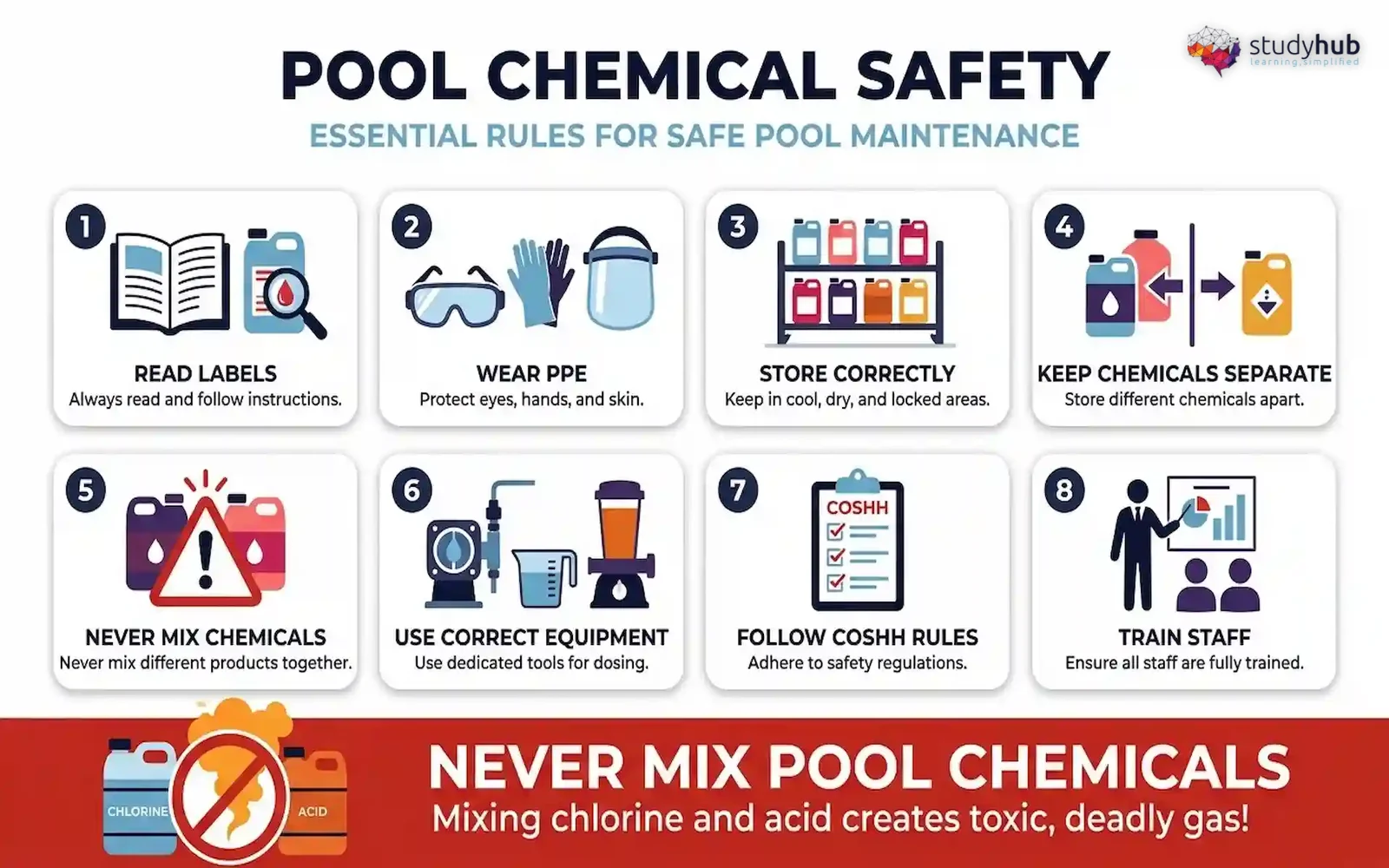
Follow these basic rules:
- Read the product label and safety information before use.
- Wear the PPE required by the risk assessment.
- Store chemicals in their correct, labelled containers.
- Keep incompatible chemicals separate.
- Never mix chlorine products with acids or other chemicals.
- Use only the correct chemical feeder or dosing equipment.
- Follow the site’s COSHH assessment and emergency procedures.
- Make sure staff have suitable information, instruction and training.
Never mix pool chemicals. Some combinations can release dangerous gases. For example, mixing an acid with a chlorine-based product can release chlorine gas.
The HSE’s Health and Safety in Swimming Pools guidance explains the risks linked to pool-treatment chemicals. It also states that pool operators must provide information, training and instruction to employees who work with hazardous substances.
Read the HSE guidance on health and safety in swimming pools and COSHH guidance.
Download the Pool Water Balancing Cheat Sheet
Keeping track of chemical readings can be easier with a simple checklist. A pool water balancing cheat sheet can help you record the starting results, plan the next action and check the final readings.
Your checklist should include:
| Check | Reading or note |
|---|---|
| Pool volume | |
| Total alkalinity | |
| pH | |
| Calcium hardness | |
| Free chlorine or other sanitiser | |
| Combined chlorine, where relevant | |
| Chemical added | |
| Retest result | |
| Corrective action |
Use this as a record-keeping aid, not as a substitute for the pool’s official logbook or operating procedure.
Want to Build Your Pool Maintenance Knowledge?
Studyhub’s Pool Maintenance course covers chemical balance, water quality, cleaning methods, maintenance equipment and pool safety.
Explore the Studyhub Pool Maintenance course to access structured online learning. The course page lists a Chemical Balance of Water module and a Water Quality Maintenance module.
Build Your Pool Maintenance Knowledge with Studyhub
Learn maintenance equipment, cleaning, water chemistry, water quality and pool safety at your own pace, fully online.
- 5 modules, from Maintenance Equipment to Pool Safety
- Study online with unlimited access
- Weekday one-to-one support from professionals
★ 4.9/5 (17 reviews)👥 65 students🎓 CPD accredited∞ Unlimited access
Conclusion
Knowing how to balance pool water helps you maintain better water quality and spot problems before they become more serious. Start with accurate testing, review total alkalinity and pH, assess calcium hardness, maintain the correct sanitiser level and retest after treatment.
Always follow the pool’s operating procedure, use chemicals safely and record the results. For wider knowledge of chemical balance, water quality and pool safety, the Studyhub Pool Maintenance course offers a useful online learning option.
Frequently Asked Questions
1. What Is the Correct Order to Balance Pool Water?
Start by testing the water. A common learning sequence is total alkalinity, pH, calcium hardness and sanitiser, followed by retesting. However, the pool’s operating procedure takes priority, and the required sanitiser level must be maintained throughout.
2. Should I Adjust Alkalinity or pH First?
Total alkalinity is usually checked first because it helps keep pH stable. However, both readings should be reviewed together, and any urgent pH or disinfection issue must be handled according to the pool’s operating procedure.
3. How Do I Know If My Pool Water Is Balanced?
Test the water using a suitable kit or monitoring system. Check pH, total alkalinity, calcium hardness and the required sanitiser readings. Compare them with the correct targets for your pool and record the results.
4. How Often Should I Test Pool Water?
Testing frequency depends on the pool and its use. Domestic pool owners should follow a regular testing routine, while public pool operators must follow their risk assessment and written operating procedures.
5. Can I Swim Immediately After Adding Pool Chemicals?
Not necessarily. Follow the product label and pool operating procedure. The pool should only be used again when the treatment has been mixed as required and all relevant water readings meet the operating limits.
6. What Happens If Pool Alkalinity Is Too High?
High alkalinity can make pH harder to lower and control. It may also contribute to scale-forming conditions. Test the water again and follow the pool’s approved correction procedure.
7. What Happens If Calcium Hardness Is Too Low?
Low calcium hardness may contribute to corrosive water conditions, depending on the pH, alkalinity and pool surface. Check the full water balance before choosing a correction.
8. Why Does Pool Water Become Cloudy After Adding Chemicals?
Cloudy water may have several causes, including poor filtration, circulation problems, high calcium hardness or unsuitable chemical levels. Check the water and treatment system rather than adding more chemicals without testing.
- All Courses
- IT & Software389
- Management287
- Teaching and Education250
- Business245
- Health and Fitness227
- Engineering & Technology180
- Health & Safety163
- Health and Social Care144
- Quality Licence Scheme139
- Healthcare137
- Accounting & Finance130
- Psychology112
- Employability112
- Lifestyle105
- Marketing75
- Office Productivity74
- Animal Care63
- Design and Photography55
- Design50
- Beauty & Makeup49
- Accounting & Bookkeeping34
- Web Development27
- Construction26
- Writing20
- Child Care17
- Digital Marketing13
- Environment10
- Bundle8
- Coaching6
- Agriculture5

Awarded By


0 responses on "How to Balance Pool Water: A Step-by-Step Guide"