



Medical coding and clinical coding are very similar jobs. Both turn patient notes into short codes. “Medical coding” is the American name. “Clinical coding” is the name used in the UK. US coders mainly use ICD-10-CM, CPT and HCPCS. NHS coders use ICD-10 and OPCS-4. The codes also serve different purposes.
Type “medical coding jobs” into Google and you’ll quickly spot a problem. Most results are American. They mention exam fees in dollars, insurance claims and codes the NHS never touches. If you live in Bristol, Belfast or Birmingham, that’s confusing.
This guide clears up medical coding vs clinical coding in the UK in plain English. You’ll find out what each name means, which code books NHS coders use, and whether American certificates are worth your money here.
Is Medical Coding the Same as Clinical Coding?
Yes, the core task is the same. The name changes with the country, and so do the code books.
In most ways, yes. A coder reads a patient’s notes after a hospital visit. Then they swap each illness and treatment for a code. A code is a short mix of letters and numbers.
Picture your local library. Every book gets a shelf number, so anyone can find it. Coding does the same job for health information.
The big difference is the country. Americans call the job “medical coding”. The NHS calls it “clinical coding”. Australia says “clinical coding” too, but it uses its own code books.
American results flood your screen because the US has a huge private healthcare system. Coding there is closely linked to insurance, so there are thousands of US courses, exams and adverts. That’s why medical coding vs clinical coding in the UK trips up so many people.
Medical Coding Certification: Clinical Coding Online Course at QLS Level 3
Work through ICD-10 5th Edition, OPCS-4 and SNOMED CT in about 14 hours of self-paced online study, with tutor support on weekdays.
- ICD-10 5th Edition
- OPCS-4
- SNOMED CT
Medical Coding vs Clinical Coding in the UK and US, Side By Side
UK coders use ICD-10 and OPCS-4 to create NHS data. US coders use different code books, mainly for insurance claims. Here are the main differences at a glance.
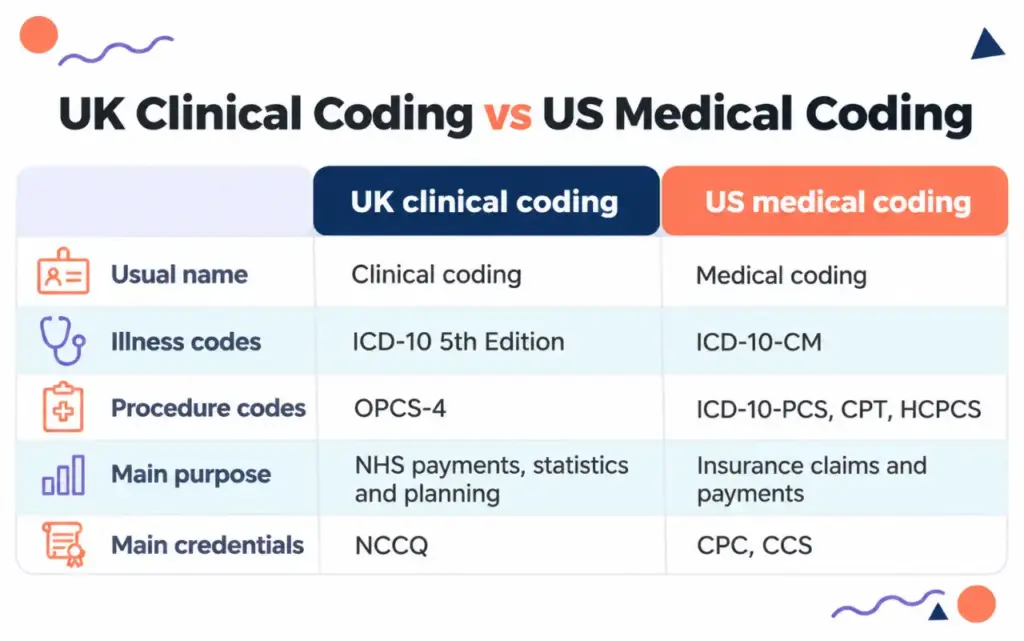
In America, the ICD-10-CM and ICD-10-PCS code sets are managed by US government agencies. CPT codes belong to the American Medical Association. None of these are used for NHS hospital coding.
Same skills, different code books. Hold on to that point when you pick a course.
Which Code Books Do NHS Clinical Coders Use?
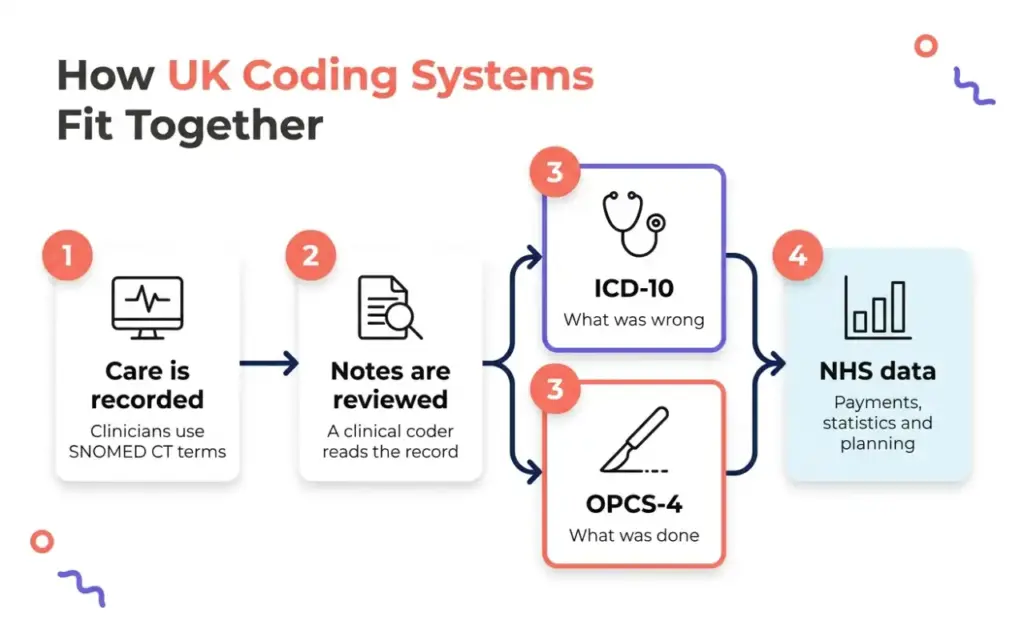
NHS hospital coders use ICD-10 for illnesses and OPCS-4 for operations. SNOMED CT is a separate list of medical terms used in patient records.
NHS hospital coders use two main code books. ICD-10 covers illnesses, and OPCS-4 covers operations and treatments. Both are classifications. A classification is a codebook that sorts health information into neat groups so it can be counted.
ICD-10 5th Edition For Illnesses
ICD-10 stands for the International Classification of Diseases, 10th Revision. It’s looked after by the World Health Organization. The NHS uses the 5th edition. A newer version, ICD-11, exists, but NHS hospital coders haven’t switched to it yet.
OPCS-4 For Operations and Treatments
OPCS-4 is the UK’s own codebook for operations and treatments. Coders use it next to ICD-10. ICD-10 says what was wrong. OPCS-4 says what was done.
NHS England publishes the national clinical coding standards that explain how to apply both. Hospitals in Scotland, Wales and Northern Ireland use the same code books, with help from their own national bodies.
Where SNOMED CT Fits
SNOMED CT works differently. It’s a giant list of medical terms that doctors and nurses pick from when they type into electronic records. GP surgeries in England switched to SNOMED CT from 2018, replacing older Read codes.
Put simply, SNOMED CT records the detail. ICD-10 and OPCS-4 sort that detail into groups.
Why Do NHS and US Coders Use Codes for Different Reasons?
US coding is closely linked to insurance claims. NHS coding creates data for hospital payments, national statistics and planning.
Because the two countries pay for healthcare in different ways. In America, most care is paid for through insurance. Coders turn each visit into codes so the hospital can send a claim. One wrong code can mean the claim bounces back unpaid.
NHS hospitals work differently. Patients don’t get a bill for most NHS care. Instead, in England, coded data is used to:
✓ Set payments to hospitals under the NHS Payment Scheme, using groups called Healthcare Resource Groups (HRGs);
✓ Produce national figures, such as Hospital Episode Statistics;
✓ Plan services, support medical research and check the quality of care.

It works like a giant NHS logbook. If the codes are wrong, the numbers that shape local health services are wrong too. That’s why coding accuracy is checked through regular audits.
So, is clinical coding the same as medical billing? Not in the NHS. NHS coders record what happened; they don’t send bills. Private hospitals in the UK are a little different, because health insurers have their own billing rules.
Are US Certificates Like CPC or CCS Worth It in the UK?
CPC and CCS are respected in America, but they focus on US code books. UK coding jobs usually look for ICD-10 and OPCS-4 skills.
Usually not, if you want to work as a coder in the NHS. Two American certificates pop up in search results again and again:
✓ CPC (Certified Professional Coder) focuses mainly on doctors’ and outpatient coding, using CPT.
✓ CCS (Certified Coding Specialist) focuses mainly on hospital inpatient coding, using ICD-10-CM and ICD-10-PCS.
Both carry real weight in the US. But neither is built around ICD-10 5th Edition or OPCS-4. Paying for a US exam won’t usually prepare you for an NHS coding job.
The UK’s main professional qualification is the National Clinical Coding Qualification (NCCQ). Coders who pass it become Accredited Clinical Coders (ACC). Most people sit it after working as a coder for a while.
So where does a short online certificate fit? Our guide, Clinical Coding Certificate vs NCCQ: Which Do You Need?, sets out how the two work together so you don’t pay for the wrong one.
Get to Grips With NHS Code Books
Work through ICD-10 5th Edition, OPCS-4 and SNOMED CT in about 14 hours of self-paced online study, with tutor support on weekdays.
- ICD-10 5th Edition
- OPCS-4
- SNOMED CT
Example: How One Hip Operation Is Coded In Leeds and Los Angeles
The same operation gets different codes from different code books for different reasons.
Here’s a made-up example to make it real.
A 68-year-old woman has a planned hip replacement for arthritis.
✓ In a Leeds NHS hospital: after she goes home, the coder reads her notes. They add an ICD-10 code for the arthritis and an OPCS-4 code for the new hip, plus any extra codes the national rules ask for. She pays nothing at the point of care. The codes feed into hospital payments and national statistics.
✓ In a Los Angeles hospital: the hospital coder uses ICD-10-CM for the arthritis and ICD-10-PCS for the operation. The surgeon’s claim usually uses a CPT code. All of it goes to her insurer for payment.
Same patient, same operation. Different codebooks, different purposes.
What Does Medical Coding vs Clinical Coding in the UK Mean for Your Career?
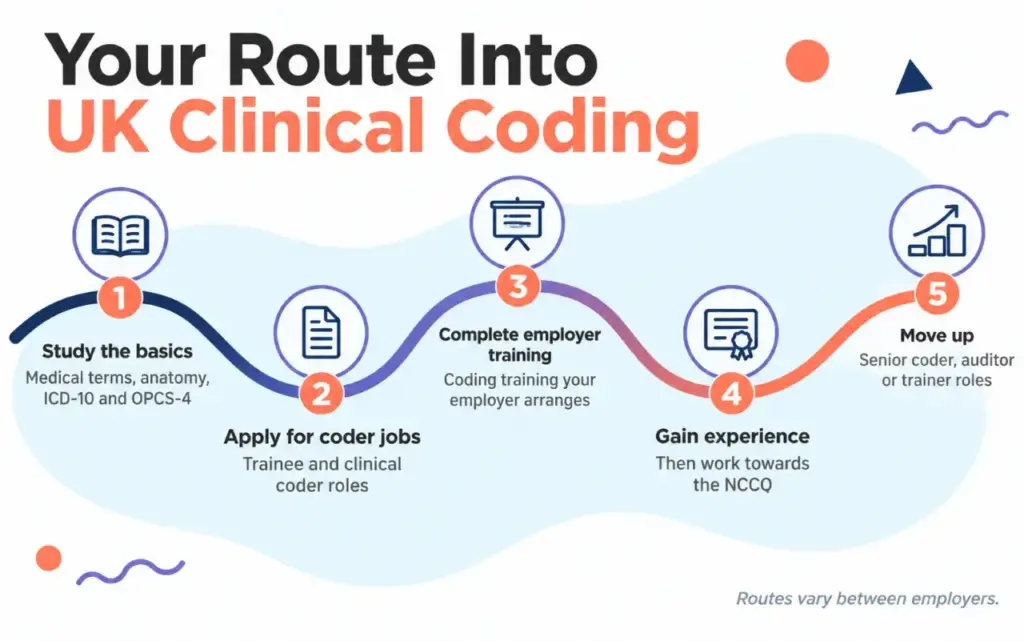
To work as a coder in the UK, focus on ICD-10 and OPCS-4. Most jobs are in NHS trusts and private hospitals. It means you should train in UK code books, not US ones. A common route into the job looks like this:
✓ Get comfortable with medical words, the human body and the basics of ICD-10 and OPCS-4. A clinical coding online course covers these basics at your own pace.
✓ Apply for trainee or clinical coder jobs. NHS roles are advertised on NHS Jobs.
✓ Complete the coding training your employer arranges.
✓ Gain experience, then work towards the NCCQ.
✓ Move up to senior coder, auditor or trainer roles, if you want to.
Choosing Your Next Step
Medical coding vs clinical coding in the UK comes down to two things: place and purpose. The job is similar, but NHS coders use ICD-10 and OPCS-4 to create data that shapes hospital payments and health services. If you want to code in Britain, start with those two code books, and leave the US exams to American coders.
Get to Grips With NHS Code Books
Work through ICD-10 5th Edition, OPCS-4 and SNOMED CT in about 14 hours of self-paced online study, with tutor support on weekdays.
- ICD-10 5th Edition
- OPCS-4
- SNOMED CT
FAQs About Medical Coding and Clinical Coding
No. Clinical coding uses very little maths. It relies on medical terms, anatomy, careful reading of patient notes and following national coding rules.
NHS coders are paid on Agenda for Change pay bands, published by NHS Employers. London roles usually add a High Cost Area Supplement on top.
Every NHS hospital needs coded data, so coders work across the UK. Trusts and private hospitals advertise coding roles regularly, including on NHS Jobs.
There’s no sign of that yet. Software can suggest codes, but trained coders still check records, apply national rules and support audits.
Not straight away. US employers use different code books and usually expect US credentials, such as the CPC or CCS, before hiring coders.
Rarely. NHS job adverts usually say “clinical coder”. Some private and international employers use “medical coder” for similar work, so search for both titles.
- All Courses
- IT & Software389
- Management287
- Teaching and Education250
- Business245
- Health and Fitness227
- Engineering & Technology180
- Health & Safety163
- Health and Social Care144
- Quality Licence Scheme139
- Healthcare137
- Accounting & Finance130
- Psychology112
- Employability112
- Lifestyle105
- Marketing75
- Office Productivity74
- Animal Care63
- Design and Photography55
- Design50
- Beauty & Makeup49
- Accounting & Bookkeeping34
- Web Development27
- Construction26
- Writing20
- Child Care17
- Digital Marketing13
- Environment10
- Bundle8
- Coaching6
- Agriculture5

Awarded By


0 responses on "Medical Coding vs Clinical Coding in the UK: Key Differences"