


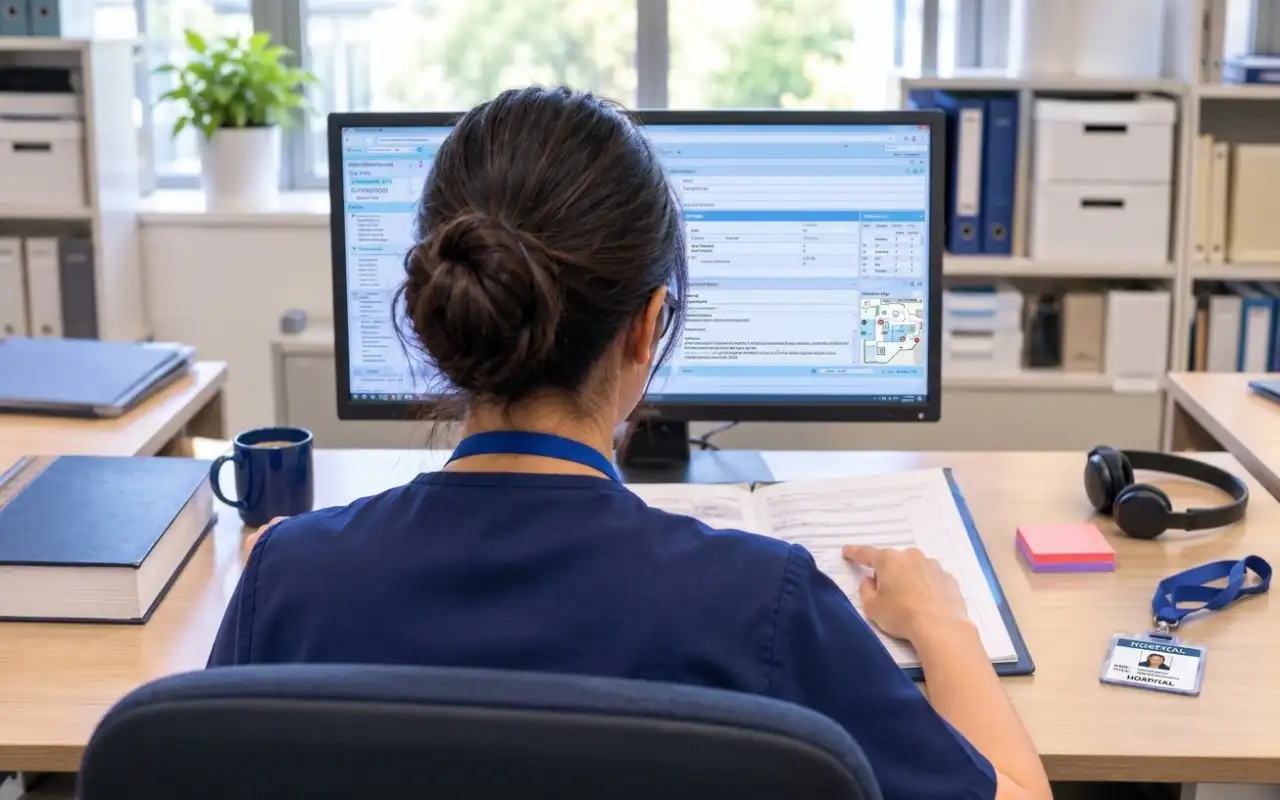
NHS approved clinical coding training does exist. It is called National Clinical Coding Standards training. NHS England sets the standards. Approved clinical coding trainers run the courses. Most people take it after getting a coding job. Employers usually arrange it. Online courses you buy yourself are not NHS approved. They can help you prepare.
If you want to become a clinical coder, you have probably spotted lots of courses using the word “NHS”. So which ones actually count? The honest answer is that NHS approved clinical coding training is one specific thing, and it is not usually something you can buy online.
Clinical coding means turning what doctors write in patient records into standard codes. Hospitals use these codes for statistics, planning and payment. Because the codes must match across the whole country, the NHS has its own national training. This guide covers what that training is, who gets it, and how to get ready now.
Please note: the national standards and rules described here apply in England. Scotland, Wales and Northern Ireland have their own arrangements.
Is There NHS-Approved Clinical Coding Training?
Yes. The NHS has national clinical coding training, but it is mainly for people already working as coders.
Yes. In England, NHS-approved clinical coding training means the National Clinical Coding Standards training. NHS England sets the coding rules, and this training shows coders how to apply them correctly.
The rules cover two main code sets:
ICD-10 (5th Edition): a World Health Organization system for coding illnesses and conditions, known as diagnoses.
OPCS-4: a UK system for coding operations and procedures.
NHS England publishes these classifications and its national coding standards on Delen , its terminology and classifications platform.
What the Clinical Coding Standards Course covers
The Clinical Coding Standards Course is the starting point for new coders. It teaches trainees how to read patient records and choose the correct ICD-10 and OPCS-4 codes using national rules. Qualified coders later attend refresher courses to keep up with changes, and experienced coders can join extra workshops.

Who delivers national clinical coding training
Approved clinical coding trainers run the courses. They are experienced coders who have completed NHS England’s trainer programme. Many of them work inside NHS trusts.
For a clearer overview of the terminology used in the UK, Medical Coding vs Clinical Coding UK: Key Differences explains how the two terms relate within the healthcare context.
Why NHS Employers Ask for National Standards Training
Accurate codes keep NHS data reliable, so NHS organisations in England are expected to show their coders are properly trained.
Codes are not just paperwork. They feed national statistics, shape service planning and affect how hospitals are paid. Consistent coding errors can distort hospital performance statistics, alter service planning, and directly impact trust financial allocations.
That is why training is checked through the Data Security and Protection Toolkit (DSPT). The DSPT is not a law. It is a yearly self-assessment that organisations with access to NHS patient data and systems must complete.
Its staff training guidance includes an annex on training for clinical coding. This sets out the training NHS organisations are expected to provide for coding staff.
In simple terms, trusts are expected to show their coders have had national standards training and regular refreshers. This keeps coding consistent from Cornwall to Cumbria.
Who Can Get NHS Clinical Coding Training?
Most people get national training through their employer after starting a trainee coder job.
In most cases, you cannot sign up for the national course as a member of the public. Your employer books it for you once you start work as a trainee clinical coder or clinical coding assistant.
Can you get NHS clinical coding training without a coding job?
Usually not. The training is tied to the job, because new coders practise on real records with team support.
So the first real goal is not “buying” NHS approval. It is landing a trainee role.
Before applying for a trainee role, check what employers may expect. The Clinical Coding Course Requirements outlines common entry requirements and how they vary by route.
UK Clinical Coding Credentials Side by Side
Only national standards training is NHS approved. The NCCQ is the main professional qualification, and online courses are preparation.
Four types of training often get mixed up. Here is how each one works.
| Credential | Who runs it | Who it is for | How you get it | Status with NHS employers |
|---|---|---|---|---|
| National Clinical Coding Standards training | NHS England standards, taught by approved trainers | New and current NHS coders | Through your employer | The official national training |
| NCCQ (National Clinical Coder Qualification) | IHRIM | Coders with work experience | An exam, usually after time in post | Widely valued; passing gives Accredited Clinical Coder status |
| Independent online courses | Course providers, sometimes with QLS endorsement or CPD accreditation | Beginners getting ready for a coding career | Enrol at any time | Not NHS approved; useful background knowledge |
| US certificates, such as CPC | US certification bodies | Medical coders in the US | An exam | Not used in NHS clinical coding |
The NCCQ is awarded by the Institute of Health Records and Information Management (IHRIM). Passing it gives you Accredited Clinical Coder (ACC) status, which NHS job adverts for senior coders often ask for.
QLS endorsement and CPD accreditation are quality marks for a course. They are not the same as NHS approval or an Ofqual-regulated qualification.
Wondering which qualification fits your stage? Read Clinical Coding Certificate vs NCCQ: Which Do You Need? for a full side-by-side guide.
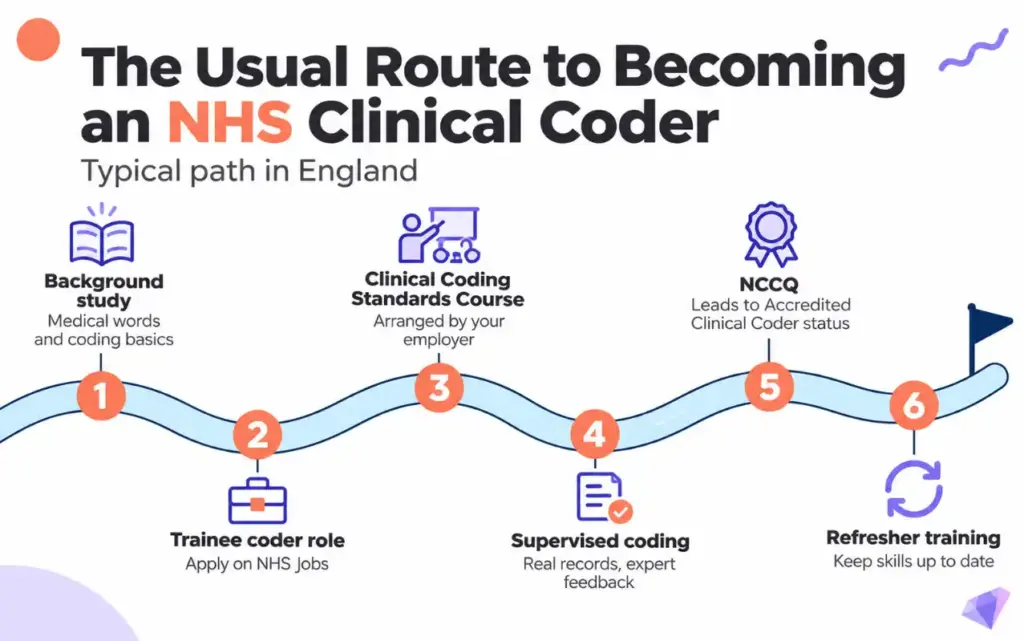
How to Become an NHS Clinical Coder: The Usual Route
Most coders start with background study, get a trainee job, complete national training, then sit the NCCQ.
Get some background knowledge. Medical words, body systems and coding basics make the job easier from day one.
Apply for trainee or assistant roles. On NHS Jobs, search for “trainee clinical coder” or “clinical coding assistant”. NHS job profiles and career guides frequently highlight internal progression from health records, ward clerk, or administrative roles into trainee clinical coding positions.
Complete the Clinical Coding Standards Course. Your employer arranges this.
Code real records with support. Senior coders check your work and help you improve.
Sit the NCCQ. Once you have enough experience, passing gives you Accredited Clinical Coder status.
Stay up to date. Refresher courses keep your skills current. Some coders later move into auditing or training.
An example (illustrative, not a real person): Olivia works as a medical secretary at a hospital trust. She takes an online coding course in the evenings to get used to ICD-10 and OPCS-4. When a trainee coder job opens in her trust, she applies and talks about her course at the interview. If she is offered the role, the trust books her onto the national standards course.
If you’re starting without coding experience, beginner clinical coding courses can help you choose a suitable first step before applying for trainee roles.
Where Online Clinical Coding Courses Fit
An online course can prepare you for a trainee role, but it does not replace NHS training or professional qualifications. An online course will not make you an NHS coder by itself. It can still help in real ways before you apply.
What an online course can do:
- Introduce the code sets NHS coders use, such as ICD-10 and OPCS-4
- Explain patient confidentiality and the legal side of clinical work
- Show employers you have taken a first step on your own
- Help you talk confidently about coding at the interview
What it cannot do:
- Replace the Clinical Coding Standards Course
- Replace a professional qualification
- Promise you a job

For example, our Clinical Coding Online Course at QLS Level 3 covers ICD-10 5th Edition codes from Chapters 1 to 22, plus introductions to OPCS-4 and SNOMED CT. It also covers clinical records, confidentiality, an overview of NHS clinical coding, and legal and ethical aspects of clinical work. It takes about 14 hours at your own pace, with no previous qualifications needed. The course is endorsed by the Quality Licence Scheme, a UK organisation that sets standards for non-regulated training.
Considering self-paced study before applying for NHS roles? Clinical Coding Course Online UK: Practical Guide explains what online courses cover and how to choose one.
How to Check if NHS Approved Clinical Coding Training Is Genuine
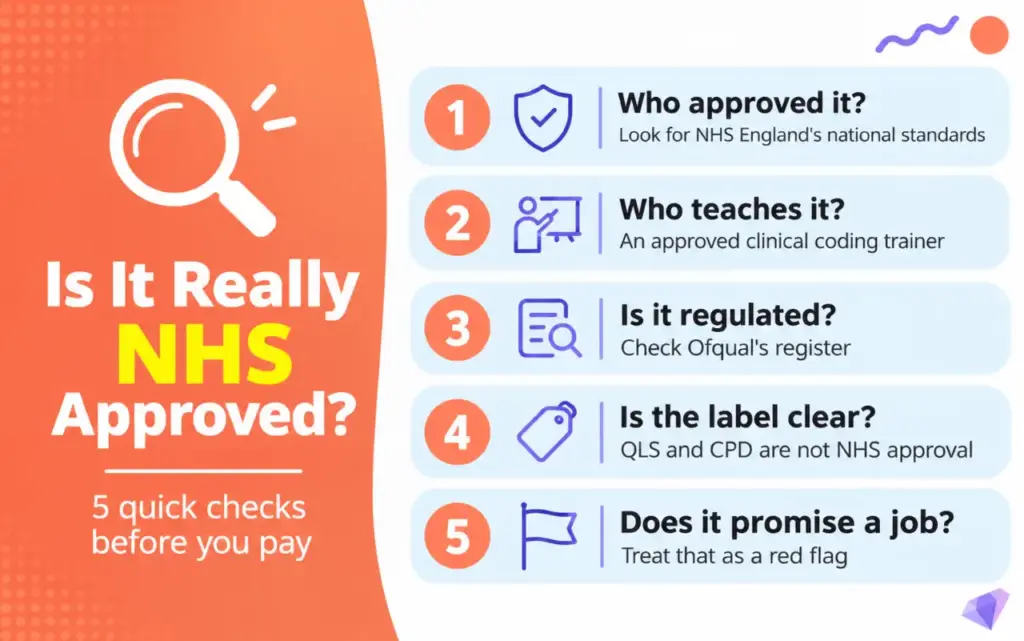
Genuine NHS training links to NHS England and an approved trainer. A vague “NHS” label is a warning sign. Some adverts use the word “NHS” loosely. Before you pay for anything, ask these questions:
Who approved it? Genuine NHS training is based on NHS England’s national standards.
Who teaches it? National courses are run by approved clinical coding trainers.
Is it regulated? If a provider says its course is a regulated qualification, check the Ofqual Register of Regulated Qualifications.
Is the label clear? QLS endorsement and CPD accreditation are useful quality marks, but they are not NHS approval.
Does it promise a job? No course can promise an NHS job. Treat that as a red flag.
Still unsure? Ask the clinical coding manager at your local trust what they look for in new starters.
Planning what to spend before you sign up for any course? Read Clinical Coding Course Fees: What to Budget for a clear cost breakdown.
Final Thoughts on NHS Approved Clinical Coding Training
Official NHS training comes through your employer, so the best first move is preparing for a trainee role.
NHS approved clinical coding training is real, but it is not something you usually buy online. It is the national standards training that employers arrange once you join as a trainee coder. After that, the NCCQ can take you to accredited clinical coder status.
Until then, get comfortable with medical words and the main code sets, and watch NHS Jobs for trainee roles. A short online course, such as the Clinical Coding Online Course at QLS Level 3, can help you take that first step with confidence.
Want the full picture of every training route? Read Clinical Coding Courses in the UK: Training Guide for a complete overview of your options.
Frequently Asked Questions
What qualifications do you need to be an NHS clinical coder?
Most trainee roles ask for good GCSEs, including English and maths, plus strong attention to detail. Each trust sets its own entry requirements.
Is CPC medical coding certification valid in the UK?
Not for NHS clinical coding. CPC is a US certificate based on US code sets, while NHS coders use ICD-10 and OPCS-4.
What is the most recognised clinical coding qualification in the UK?
The NCCQ, awarded by IHRIM. Passing it gives Accredited Clinical Coder status, which NHS employers often ask for in senior coding roles.
How long does clinical coding training take?
An introductory online course can take hours. Becoming an accredited clinical coder takes much longer because the qualification exam usually expects real workplace experience first.
How much does a clinical coder earn in the UK?
NHS clinical coders are paid on Agenda for Change pay bands. Pay depends on your band, experience and where you work.
Do NHS trusts pay for clinical coding training?
NHS employers usually arrange national standards training for the coders they hire. Courses you choose before getting a job are normally self-funded.
- All Courses
- IT & Software389
- Management287
- Teaching and Education250
- Business245
- Health and Fitness227
- Engineering & Technology180
- Health & Safety163
- Health and Social Care144
- Quality Licence Scheme139
- Healthcare137
- Accounting & Finance130
- Psychology112
- Employability112
- Lifestyle105
- Marketing75
- Office Productivity74
- Animal Care63
- Design and Photography55
- Design50
- Beauty & Makeup49
- Accounting & Bookkeeping34
- Web Development27
- Construction26
- Writing20
- Child Care17
- Digital Marketing13
- Environment10
- Bundle8
- Coaching6
- Agriculture5

Awarded By


0 responses on "NHS Approved Clinical Coding Training: Practical Guide"