


According to the Chartered Institute of Personnel and Development, 92% of employees believe essential skills are important for career success, while 56% would consider changing jobs for better skill development opportunities. This shows that continuous learning is becoming just as important as experience in today’s workplace. That is why creating a Personal Development Plan is becoming increasingly valuable. It gives you a clear direction, helps you set realistic goals, and allows you to track your progress step by step. Whether you are a student, an employee, a manager, or planning a career change, a well-structured plan helps you develop the skills needed to achieve long-term success.
Table of Contents
What Is a Personal Development Plan?
A Personal Development Plan (PDP) is a simple plan that helps you improve yourself. It shows where you are today, what you want to achieve, and the steps you need to reach your goals. Instead of guessing what to do next, you have a clear plan to follow.
A Personal Development Plan can help you learn new skills, build confidence, and stay focused. It is useful for everyone, including students, employees, managers, and business owners. No matter your age or career stage, having a plan makes it easier to keep improving.
A good Personal Development Plan usually includes:
Your current skills and strengths
Areas you want to improve
Short-term and long-term goals
Actions to achieve your goals
Deadlines
Regular progress reviews
The best plans are simple and easy to update. As your goals change, your plan should change too.
If you want to improve your skills and continue learning, Studyhub’s Personal Development Course can support your Personal Development Plan with practical lessons that you can use in everyday life and at work.
Why Do You Need a Personal Development Plan?
Many people work hard every day. However, hard work alone does not always lead to progress. Some people stay in the same role for years because they never stop to plan what comes next. Others learn new skills but struggle to apply them because they have no clear direction.
This is where a Personal Development Plan makes a real difference.
It helps you organise your goals and turn them into practical actions. Rather than saying, “I want to become a manager,” you identify the skills you need, decide how to learn them, and set realistic deadlines. As a result, your goals become much easier to achieve.
A Personal Development Plan can also help you:
Build confidence through continuous learning.
Improve your communication and leadership skills.
Prepare for promotions or career changes.
Identify skill gaps before they become problems.
Stay motivated by tracking your progress.
Make better decisions about your future learning.
For example, imagine two employees who both want a promotion. One hopes that experience alone will be enough. The other creates a Personal Development Plan, completes leadership training, improves communication skills, and regularly asks for feedback. After one year, the second employee is far more likely to be ready for greater responsibility because every action has supported a clear goal.
If building stronger workplace relationships is one of your objectives, Studyhub’s Interpersonal Skills for Professional Development: Building Effective Relationships course fits naturally into this stage of your development. It helps improve communication, teamwork, and confidence, all of which support a stronger Personal Development Plan.
A good plan also reduces uncertainty. Instead of wondering what to learn next, you already know your priorities. Consequently, you spend less time feeling stuck and more time making meaningful progress.
Personal Development Plan Examples
A Personal Development Plan does not always focus on getting a promotion or changing careers. It can also help you build better habits, learn new skills, and become more confident in everyday life. The best plan is one that matches your own goals and encourages you to improve a little every day.
Here are some simple Personal Development Plan examples that anyone can follow.
1. Set Clear Goals
Start by deciding what you want to achieve. Your goal could be improving your confidence, learning a new skill, or preparing for a better job. Clear goals make it easier to stay focused.
2. Learn a New Skill
Choose one skill that will help you in school, work, or daily life. For example, you could improve your computer skills, communication, or leadership. Learning one skill at a time makes progress easier.
3. Improve Time Management
Plan your day and complete the most important tasks first. Using a diary or planner can help you stay organised and reduce stress.
4. Build Better Communication Skills
Good communication helps you at work, in education, and in everyday conversations. Therefore, practise listening carefully, speaking clearly, and sharing your ideas with confidence. If this is one of your goals, Studyhub’s Interpersonal Skills for Professional Development: Building Effective Relationships course can help you strengthen these skills.
5. Turn Weaknesses into Strengths
Everyone has weaknesses. Instead of avoiding them, make them part of your Personal Development Plan. For example, if public speaking makes you nervous, practise speaking in small groups before presenting to larger audiences.
6. Develop a Growth Mindset
Mistakes are part of learning. Rather than giving up, treat every challenge as an opportunity to improve. Small improvements made regularly often lead to big achievements.
7. Keep Learning
Successful people never stop learning. Read books, attend workshops, complete online courses, or learn from experienced people. Continuous learning helps your Personal Development Plan grow with your career and personal goals. Join Studyhub courses like – Self Preparation for Success: Mastering Personal Development, Leadership, Personal Development and Networking, Personal Development Coach Course, Level 5 Leadership and Personality Development for Children’s Workforce, Professional Development and Personal Well-being, Personal Development Course, etc.
How to Write a Personal Development Plan
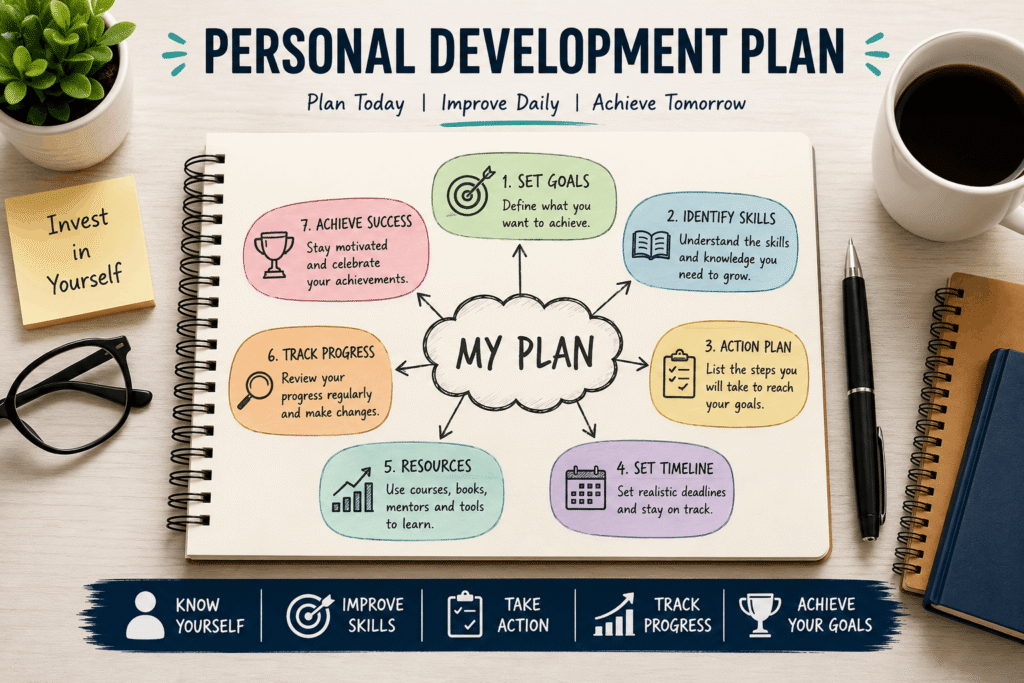
Writing a Personal Development Plan is easier than many people think. The key is to keep every step practical and realistic.
Step 1: Identify Your Current Position
Start by understanding your strengths and weaknesses.
Ask yourself:
What am I good at?
Which skills need improvement?
What feedback do I receive most often?
What career do I want in the future?
You can also use a simple SWOT analysis.
Strengths | Weaknesses |
Good communication | Public speaking |
Teamwork | Time management |
Opportunities | Threats |
Online learning | Industry changes |
Workplace mentoring | Strong competition |
Knowing your current position helps you build a stronger Personal Development Plan.
Step 2: Set SMART Goals
Once you know where you are, decide where you want to go.
Use SMART goals because they are easier to achieve.
SMART | Meaning |
Specific | Clearly describe your goal |
Measurable | Track your progress |
Achievable | Keep it realistic |
Relevant | Match your career goals |
Time-bound | Set a deadline |
Example
Instead of writing:
Improve communication.
Write:
Deliver one presentation every month for the next six months.
This goal is much clearer and easier to measure.
If communication is one of your priorities, Studyhub’s Interpersonal Skills for Professional Development: Building Effective Relationships provides practical techniques that can support this stage of your Personal Development Plan.
Step 3: Create an Action Plan
Every goal should include simple actions.
Goal | Action | Deadline |
Improve leadership | Complete leadership training | 2 months |
Build confidence | Speak during weekly meetings | Weekly |
Improve organisation | Use a planner every day | Starting today |
Small actions completed consistently usually create much bigger results over time.
Step 4: Keep Learning
Learning should continue throughout your career. Therefore, include books, online courses, workshops, podcasts, or mentoring in your Personal Development Plan.
Depending on your goals, Studyhub offers several relevant courses, including Professional Development and Personal Well-being, Personal Development Coach Course, and Personal Development, allowing you to continue building practical skills at your own pace.
Step 5: Review Your Progress
Finally, review your plan every month.
Ask yourself:
Have I completed my actions?
What have I learned?
Which goals need updating?
A Personal Development Plan should grow as your experience grows. Regular reviews help you stay focused while adapting to new opportunities.
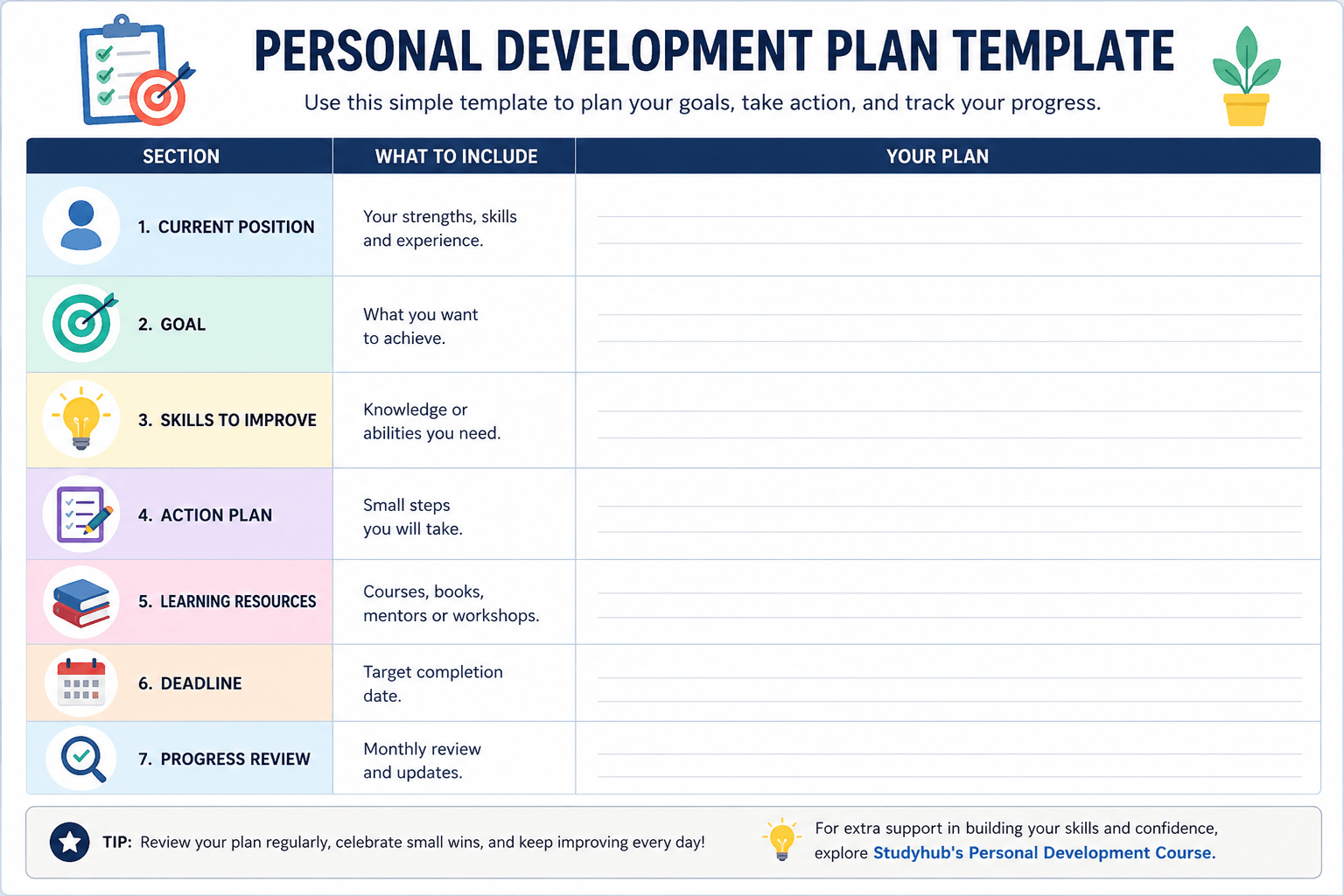
Personal Development Plan Template
Now that you understand the process, you can create your own Personal Development Plan using a simple template. Remember, your plan should be easy to read and update. There is no need to include unnecessary details. Instead, focus on actions that will help you achieve your goals.
Section | What to Include |
Current Position | Your strengths, skills and experience |
Goal | What you want to achieve |
Skills to Improve | Knowledge or abilities you need |
Action Plan | Small steps you will take |
Learning Resources | Courses, books, mentors or workshops |
Deadline | Target completion date |
Progress Review | Monthly review and updates |
You can create this template in Microsoft Word, Excel, Google Docs, or even a notebook. The format matters less than reviewing and updating it regularly.
If your goal is to improve your overall confidence and career skills, Studyhub’s Personal Development Course provides practical learning that fits naturally into your Personal Development Plan.
Common Mistakes to Avoid
Even the best Personal Development Plan will not work if you lose focus. Fortunately, most mistakes are easy to avoid.
Setting too many goals
Trying to improve everything at once often leads to frustration. Therefore, focus on two or three important goals first.
Writing unclear goals
Goals such as “be successful” are difficult to measure. Instead, write specific goals with clear deadlines.
Ignoring feedback
Managers, teachers, mentors and colleagues often notice strengths and weaknesses that you may miss. Therefore, ask for feedback regularly and use it to improve your plan.
Forgetting to review your plan
A Personal Development Plan should never stay the same forever. As your experience grows, your goals should change too.
Expecting quick results
Personal growth takes time. Small improvements every week usually create much bigger results over the long term.
Avoiding these mistakes will help you stay motivated and make steady progress towards your goals.
Access the course library of 3000+ courses for just £149 for a lifetime!
Conclusion
A Personal Development Plan is more than a list of goals. It is a practical roadmap that helps you understand where you are today and where you want to be in the future. By setting clear objectives, learning new skills, taking small actions and reviewing your progress regularly, you can continue moving towards your personal and professional ambitions. The most successful people do not rely on motivation alone. Instead, they follow a clear plan and improve consistently. Whether you are a student, an employee, a manager or a business owner, creating a Personal Development Plan today is an investment in your future. Combine it with continuous learning through Studyhub, stay committed to your goals, and you will be well prepared for new opportunities throughout your career.
FAQs
A Personal Development Plan is a structured document that helps you identify your goals, improve your skills, and track your progress over time.
Anyone can benefit from a Personal Development Plan, including students, employees, managers, business owners and people changing careers.
Review your plan at least once a month. However, update it sooner if your goals or responsibilities change.
It is not essential, but it is highly recommended. A SWOT analysis helps you understand your strengths, weaknesses, opportunities and challenges before setting goals.
Yes. Online learning helps you develop new skills at your own pace. Choosing relevant training from providers such as Studyhub can support the goals within your Personal Development Plan.
- All Courses
- IT & Software388
- Management287
- Teaching and Education250
- Business245
- Health and Fitness227
- Engineering & Technology180
- Health & Safety163
- Health and Social Care143
- Quality Licence Scheme139
- Healthcare137
- Accounting & Finance130
- Psychology112
- Employability112
- Lifestyle105
- Marketing75
- Office Productivity74
- Animal Care63
- Design and Photography55
- Design50
- Beauty & Makeup49
- Accounting & Bookkeeping34
- Web Development27
- Construction26
- Writing20
- Child Care13
- Digital Marketing13
- Environment10
- Bundle8
- Coaching6
- Agriculture5
Awarded By

0 responses on "Personal Development Plan (PDP): Examples, Templates & Step-by-Step Guide"